After Four Years of Delay, Germany’s First RCH 155 Howitzers Reach Ukraine
German Aid to Ukraine confirmed on 5 September 2026 that the first Remote Controlled Howitzer 155 systems have arrived with Ukrainian forces, closing a procurement saga that began when Berlin approved an initial batch of eighteen guns on 17 September 2022. The confirmation came 1,449 days after that first political decision and more than six hundred days after a ceremonial handover in Kassel on 13 January 2025, when Defence Minister Boris Pistorius presented the first vehicle to Ambassador Oleksii Makeiev. That gun stayed in Germany so crews could train at KNDS in Kassel and at the Bundeswehr artillery school in Idar-Oberstein. Production slips, integration with Ukrainian battle-management software, and requested modifications pushed fielding from early 2024 into 2026.
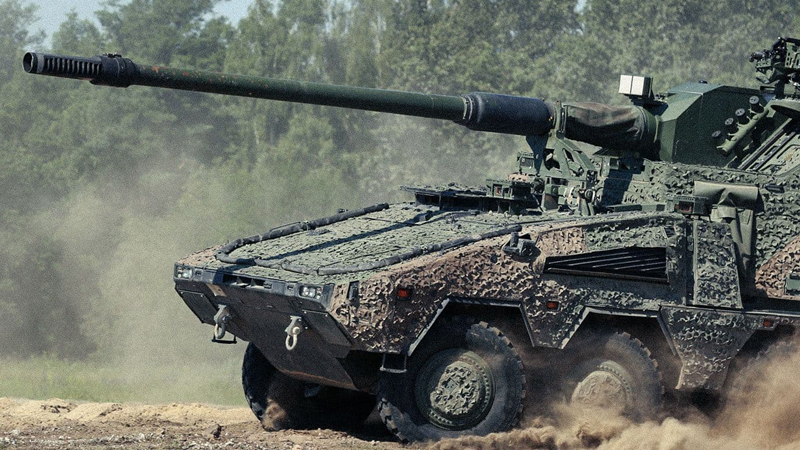
By March 2026 more than 600 Ukrainian soldiers had completed training on the howitzer and the Boxer chassis. Ukraine is contracted for fifty-four vehicles in three batches of eighteen, financed by Germany at a reported €890 million, far above the original €216 million figure for the first tranche. Additional Boxer-based command vehicles have also been associated with the package. Ukraine is presently the only country operating the type; Germany, the United Kingdom, Qatar and Switzerland have ordered it but have not yet fielded it.
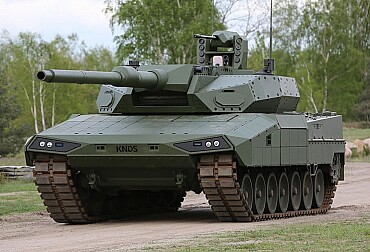
The RCH 155 mounts an unmanned Artillery Gun Module carrying the same NATO-standard 155 mm L52 gun family used on the tracked Panzerhaubitze 2000 onto a GTK Boxer 8×8 hull. Combat weight stays under about forty tonnes. Two people work from the protected chassis: a driver-operator and a commander. The turret loads, lays and fires automatically, including inductive fuze setting as rounds are rammed. Onboard stowage is thirty fused projectiles and 144 modular charges. Road speed exceeds 100 km/h and road range exceeds 700 km, so the battery can reposition over long distances without tank transporters. From a travelling posture the system can be ready to fire in under twenty seconds and leave a firing point in under ten.
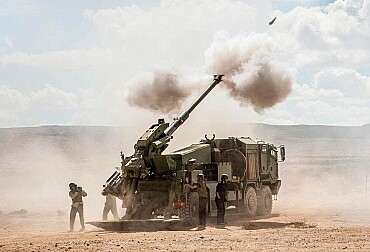
Rate of fire is more than eight rounds per minute and can reach nine. Multiple Round Simultaneous Impact lets several shells fired on different trajectories arrive together. Uniquely among fielded 155 mm howitzers, it can fire while moving. Conventional and base-bleed ammunition reach on the order of thirty to forty kilometres; V-LAP (Velocity Enhanced Long-Range Artillery Projectile) extends that to about fifty-four kilometres; Vulcano precision munitions are cited up to about seventy kilometres. Full 360-degree fire is possible with up to six modular charges without deploying spades. Optional remote weapon stations and optronics support close-in defence and limited direct fire.
Those traits matter in a war dominated by drones and counter-battery radars. Stationary guns that take minutes to emplace and displace are easy to find and hit. A wheeled, armoured system that can shoot and immediately drive, or even fire while rolling, shortens the window in which a reconnaissance drone or Lancet-class munition can complete an attack. The Boxer hull is specified to STANAG 4569 Level 4 protection against small arms and fragments, which is more than many truck-mounted guns offer the crew.
Optional remote weapon stations can engage low, slow aerial threats at short range. Ukrainian practice already pairs artillery with electronic warfare, decoys, camouflage nets, rapid displacement, and layered short-range air defence. The RCH 155 does not remove those requirements; it reduces crew exposure and the time spent static. Claims that Ukrainian crews have hit targets at forty kilometres with the first round remain industry-adjacent and not independently documented in detail. The number of guns actually in Ukraine, their unit assignment and their ammunition stocks have not been officially disclosed.
The new howitzer joins a crowded Ukrainian artillery park that mixes Soviet-calibre leftovers with a large and growing 155 mm fleet. The domestic 2S22 Bohdana wheeled howitzer has become the workhorse of national production, built in rising numbers on several truck chassis and credited with hundreds of vehicles in service by 2026. French CAESAR 6×6 and 8×8 guns remain among the most widely used Western systems because they are light, mobile and comparatively cheap to sustain.
Germany and partners earlier supplied Panzerhaubitze 2000 tracked guns, whose L52 performance is similar to the RCH 155 but which are heavier, need larger crews and have suffered from intensive use and maintenance strain. Poland’s AHS Krab, Sweden’s Archer, various M109 variants, Slovak Zuzana 2, Czech DANA/DITA and towed M777s fill other batteries. Rocket artillery, especially HIMARS and M270, still handles deep precision strikes that tube guns cannot match in range or effect. The RCH 155 sits at the high-protection, high-automation end of the wheeled 155 mm group rather than replacing Bohdana or CAESAR in volume.
Russia’s comparable park is still centred on the tracked 2S19 Msta-S and its digital Msta-SM2 upgrades, 152 mm guns that have absorbed heavy documented losses yet remain the standard divisional self-propelled piece. The intended successor, the 2S35 Koalitsiya-SV, advertises very high rates of fire and long range with specialised ammunition, but only a handful have reached units. The closest Russian analogue to the RCH 155 in concept is the 2S43 Malva, a 152 mm gun on an 8×8 wheeled chassis weighing about thirty-two tonnes, with a crew of five, limited traverse, and a much more exposed mounting.
Malva production has increased and the type has appeared in Ukraine, but it lacks an unmanned turret, fire-on-the-move as a defining feature, and the same combination of armour and automation. Older 2S3 Akatsiya, 2S5 Giatsint-S and 2S1 Gvozdika systems still appear in large numbers. In raw tube count Russia retains depth; in crew protection, displacement speed and first-round automation the RCH 155 is meant to sit above most of those systems. Whether fifty-four guns, arriving late and in small initial numbers, change the artillery balance will depend on ammunition and how quickly the remaining batches follow.