Edge-Native Voice Control Arrives for U.S. Armored Vehicles as GDLS Partners with Primordial Labs
On October 7, 2026, General Dynamics Land Systems and Primordial Labs announced a master teaming agreement to integrate Anura, the latter’s natural-language command-and-control software, across GDLS’s portfolio of U.S. armored vehicles. The partnership targets platforms that already define American ground maneuver forces – the M1 Abrams family, including the emerging M1E3, the XM30 infantry fighting vehicle candidates, and the Stryker series – and places a deliberately constrained form of artificial intelligence inside the crew compartment. Crews will be able to state goals, objectives, and constraints in ordinary speech; Anura will translate that intent into actions on sensors, displays, radios, and linked uncrewed systems. The companies emphasize that the software will not touch fire-control or weapons-release functions.
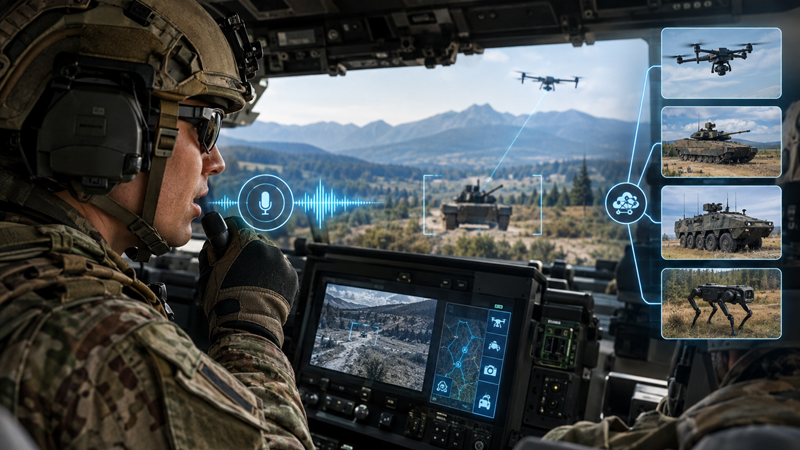
The U.S. Army is deliberately reducing crew sizes on its next vehicles. The M1E3 is being developed with an unmanned turret and autoloader, dropping the traditional four-person crew to three soldiers seated in an armored capsule in the hull. The XM30 program aims to replace the Bradley with a vehicle that can be fought by two soldiers rather than three. At the same time, both vehicles are expected to manage denser sensor suites, more complex tactical networks, and a growing population of off-board robotic teammates. Historically, every new capability added to a combat vehicle has required a new control panel, a new menu hierarchy, and additional training time. Anura is presented as a way to break that cycle: a single, intent-based interface that can absorb subsequent software updates and subsystem integrations without multiplying the cognitive and training burden on the remaining crew members.
Primordial Labs, founded in 2021 and based in New Haven, Connecticut, built Anura primarily around the control of uncrewed systems. Operators can issue discrete commands (“go forward one hundred meters”) or higher-level mission-type orders (“follow vehicle seven from the southeast at a fifty-meter standoff”) without memorizing rigid syntax or switching between specialized ground-control stations. The software has already been demonstrated with platforms such as Teal and Skydio drones and has benefited from Army SBIR work on launched-effects control and uncrewed ground vehicle interfaces. The GDLS agreement expands that architecture onto crewed combat vehicles, where the same interface can now handle both onboard mission systems and external robotic assets.
A central design choice is that Anura does not use generative artificial intelligence of the kind that powers large language models. Primordial CEO Lee Ritholtz has stated that the system “can’t hallucinate because we don’t generate things.” Instead, narrowly focused machine-learning models act as translators between spoken intent and the existing, often cumbersome interfaces of military subsystems. All processing occurs at the tactical edge on the vehicle’s own computers; there is no requirement for cloud connectivity. That property is repeatedly highlighted by both companies because contested and communications-denied environments are the baseline assumption for future high-intensity conflict. External robotic systems still depend on functioning tactical data links, but the voice-to-action layer itself remains available when those links are jammed or absent.
GDLS officials, including U.S. operations vice president Keith Barclay, frame the technology as an enabler of greater lethality with a smaller crew, reduced physical workload, and improved cognitive performance. Geoff Norman, GDLS director of strategy and a retired Army general, has noted that the functions selected for voice control – switching radio nets, generating reports that would otherwise be typed, selecting camera views, and tasking reconnaissance drones – are those that can be verified and validated for safety cases more readily than kinetic engagement tasks. The software is therefore kept off the fire-control system. It is also not installed on the XM30 prototypes currently undergoing Army testing; GDLS intends to offer it as part of future upgrades to XM30, Abrams, and Stryker vehicles.
In operational terms, the promise is that a two- or three-person crew can remain heads-up and focused on the fight while routine but time-consuming subsystem management is offloaded. A commander could verbally task a small drone for a short reconnaissance of a tree line, switch the vehicle’s radio to a different net, and request a sensor view of the left flank without taking hands from the controls or eyes from the terrain. Because the interface is intended to be platform-agnostic and modular, the same spoken interaction model could, in principle, apply across vehicles and to new software-defined capabilities as they are fielded. Primordial and GDLS both stress that this reduces the training barrier for young soldiers who already interact with complex systems through natural language in civilian life, while still operating under the discipline of military test-and-evaluation standards.
Armored vehicle interiors are noisy, vibration-heavy environments; reliable speech recognition under those conditions, especially with multiple crew members speaking, will require careful engineering and testing. Trust in an automated intermediary that interprets intent must be earned through transparent behavior and predictable failure modes. Integration with legacy systems on existing Abrams and Stryker fleets will differ from integration with software-defined next-generation vehicles. The companies have not disclosed financial terms or a firm fielding schedule, and the master teaming agreement establishes cooperation rather than an immediate production commitment.
The partnership sits within a broader U.S. Army emphasis on human-machine teaming and software-defined platforms. Formations of the future are expected to be more dynamic, with crewed vehicles acting as hubs for uncrewed systems. Anura is positioned as one concrete interface that lets any soldier, in any formation, command complex systems more intuitively. Whether that ambition is realized will depend on how cleanly the software can be integrated, how reliably it performs under combat conditions, and how effectively it actually lowers rather than merely relocates the cognitive load. For the moment, the agreement signals that voice-based, edge-native control of non-lethal vehicle functions is moving from experimental uncrewed-system work into the mainstream portfolio of American armored vehicles.