
Western Armies Are Fitting Combat Vehicles Against the Small UAS
The armored vehicle that cannot see the drone is already obsolete. Two procurement decisions from the last week of September 2026 show how Western armies are trying to close that gap before the next war, rather than during it. The U.S. Marine Corps has ordered Anduril Pulsar-L electronic-warfare kits, a firm-fixed-price award of about $15.71 million, to give Amphibious Combat Vehicles a way to detect and jam Group 1 and Group 2 drones while moving from ship to shore and inland. Days later, Hanwha Defence Australia and Visionary Machines said they were assessing the Pandion Sentinel passive optical array on the AS21 Redback infantry fighting vehicle, a multispectral suite meant to track small unmanned aircraft without emitting radar or radio energy. One system shouts into the spectrum. The other tries not to. Together they sketch the layered answer Western forces are converging on, and they also show how little of that answer has yet been proven where the drones already own the sky.
Ukraine is the reference case, and the lesson is not that a single device works. It is that every device fails on its own, and that failure is now routine. First-person-view attack drones, reconnaissance quadcopters, and one-way munitions have forced both sides to treat the armored vehicle as a node that must detect, warn, disrupt, and absorb, because dedicated air defense cannot be everywhere a column moves. Royal United Services Institute analysts Jack Watling and Justin Bronk argued in 2024 that no sensor or effector is universally applicable, and that companies need passive detection, battalions need electronic warfare plus hard-kill interceptors, and brigades need dedicated counter-drone platoons that can be pushed forward. That architecture is what Western programs are now buying in pieces.
Passive protection is the layer that has traveled farthest from the workshop to the field. The most common form is physical. Slat cages, mesh hoods, dangling chains, rubber skirts over running gear, and the heavier “turtle” sheds welded over turrets all try to detonate a shaped charge or fragmentation warhead before it reaches the hull. Ukrainian and Russian crews adopted them after top-attack missiles and then FPV drones exposed the thin roof armor of Cold War vehicles. The record is mixed but real. A Ukrainian Novator armored carrier has been filmed continuing after an FPV strike that the roof mesh absorbed. Abrams tanks supplied to Ukraine have been seen with reactive armor, cages, and jammers fitted together. Nets over roads and positions have become standard. None of this is elegant. Cages add weight, snag on trees, and can be defeated by a drone that approaches from an uncovered angle or simply by a second and third hit. They remain the only passive measure that has repeatedly saved crews in combat.
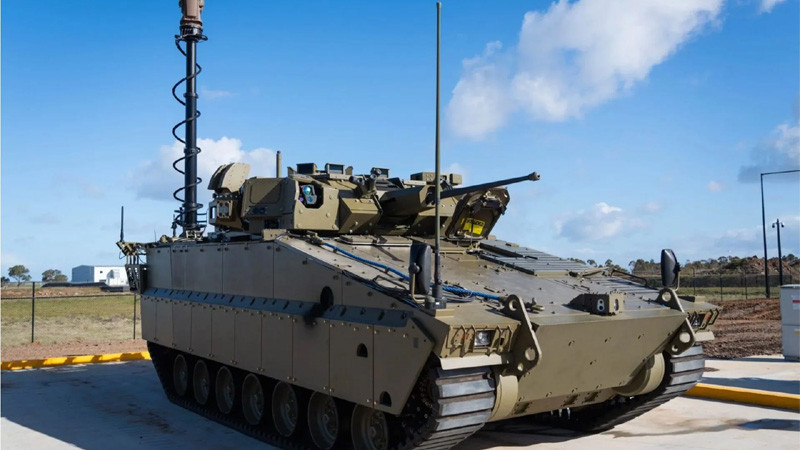
A second passive family listens or looks rather than blocks. Radio-frequency direction finding detects the control link of a conventional drone and can cue a jammer or a gun without the vehicle advertising itself by radar. Optical and infrared arrays do the same against drones that emit little or nothing. Pandion Sentinel, the system under study for the Redback, combines RGB, near-infrared, shortwave infrared, and longwave infrared sensors. Visionary Machines says it can classify Group 1 through Group 3 aircraft, offer more than a kilometer of critical coverage against the smallest class, and draw under 250 watts, while exchanging tracks with a separate effector.
The Redback already carries a 30 mm Bushmaster II able to fire programmable rounds, Spike missiles, and Elbit’s Iron Fist active protection system, so the sensor is meant to sit inside an existing vehicle rather than replace it. The limitation is line of sight. A drone skimming hedges or buildings will not appear in the array until it is close. Acoustic sensors and camouflage, dispersion, and emission control complete the passive set. They buy seconds. They do not finish the engagement.
Active soft-kill systems try to finish it by denying the link. Pulsar-L is the current American example on a frontline amphibious vehicle. Marine Corps Systems Command describes an omnidirectional sensor and jammer able to detect, track, identify, and disrupt drones that depend on radio control or navigation signals, including while the ACV is moving and against more than one aircraft. The requirement called for detection at two to five kilometers and jamming out to about two kilometers, on land and in the littoral, within the vehicle’s space, weight, and power limits. Deliveries for integration are tied to the first quarter of fiscal 2027. No Pulsar-L-equipped ACV has deployed. The Marines are buying it because the ACV family, from the personnel carrier to the 30 mm ACV-30, cannot independently detect and defeat small drones during the interval between leaving the ship and the arrival of a Marine Air Defense Integrated System battery. Anduril already holds larger counter-drone contracts for the Corps, including work related to MADIS. Pulsar-L is the organic layer, not the formation layer.
Vehicle jammers of this class have a combat history, and it is a declining one. Through 2023 and into 2024, omnidirectional jammers on Ukrainian and Russian vehicles regularly broke the radio links of FPV drones and forced them to crash or return. French Army leadership publicly suggested that electronic warfare was accounting for a large and rising share of drone losses. The counter arrived as fiber-optic control. A drone paying out a thin cable has no radio link to jam and no navigation signal that must be trusted. Open reporting in 2025 and 2026 put fiber-guided FPVs at a substantial share of Russian attack drones in some sectors, with spools of 20 kilometers common and longer ones appearing.
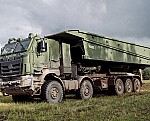
Hard-kill is the layer Western armies are funding most heavily once the link survives. Rheinmetall’s Skyranger 30 puts a 30 mm revolver cannon and programmable AHEAD ammunition, optionally with short-range missiles, on Boxer, Pandur, Piranha, Lynx, and other chassis. Germany, Austria, Denmark, the Netherlands, and Belgium have ordered or optioned systems; Germany has discussed a much larger buy. The cannon is meant to burst tungsten pellets into a quadcopter out to a few kilometers, at a cost per shot far below a missile. Related 35 mm gun systems have been used in Ukraine against mass drone attacks on fixed sites. The U.S. Army’s M-LIDS architecture and the Marine MADIS combine radar, electro-optics, jammers, guns, and Coyote interceptors. Lasers in the 20-kilowatt class, including the Army’s AMP-HEL on the Infantry Squad Vehicle and AeroVironment’s Locust, are in test as a deep magazine against individual small drones. They remain sensitive to weather and to the need to dwell on each target.
Active protection systems built for rockets are being asked to catch drones. Iron Fist is on the Australian Redback and is being fitted to U.S. Bradley M2A4E1 vehicles. Trophy has shown it can handle high-angle rocket threats; its makers have said the architecture can be extended toward some unmanned aircraft. The only recent combat data point is Russian. In the summer of 2026, a T-72B3A fitted with Arena-M was filmed in the Dobropillia sector intercepting incoming FPVs. A Ukrainian drone specialist who spoke with the unit involved said the system shot down seven drones before the magazine ran dry. The tank was still destroyed. The Institute for the Study of War noted that the engagement raised the cost of the attack, to something like 15 to 20 drones, without restoring freedom of maneuver. Oleksandr Syrskyi has said Ukrainian active-protection developments were intercepting 60 to 80 percent of FPV drones in testing. Testing is not a company attack.
What has proved itself in Ukraine is therefore a stack, not a product. Overhead mesh and cages have repeatedly turned lethal hits into survivable ones, at the price of mobility and with no claim to reliability. Radio jammers proved themselves against radio-controlled FPVs and then lost ground to fiber, autonomy, and saturation. Gun-based airburst systems have proved themselves mainly as site defense, not yet as the organic armament of every Western infantry fighting vehicle. Active protection has proved it can thin a salvo and that a finite magazine can be exhausted. Interceptor drones have proved they can hunt other drones, which is a different organization of the same idea. None of the named Western vehicle kits in the September announcements, Pulsar-L or Pandion Sentinel, has a combat record. The programs are attempts to industrialize what Ukrainian and Russian crews improvised in field.