Croatia Turns to South Korea’s Chunmoo After HIMARS Limits, Seeking 290-Kilometer Strike Reach
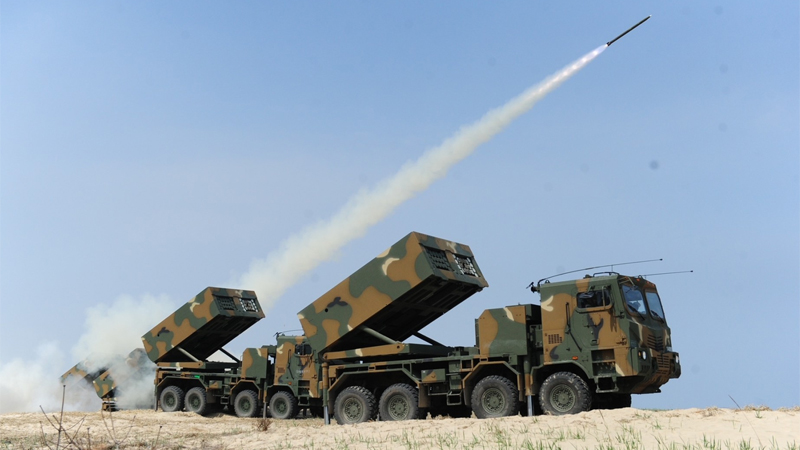
The Croatian government has approved the purchase of 18 K239 Chunmoo multiple launch rocket systems from South Korea’s Hanwha Aerospace, a package valued at about €544 million including VAT, or roughly €435 million excluding tax. Deliveries are planned between 2026 and 2029, with a large share expected by 2028. Hanwha will supply launchers, munitions and support equipment, while Poland’s WB Group will integrate its TOPAZ command-and-control system. Officials present the deal as a complement to eight M142 HIMARS launchers already ordered from the United States, not a replacement.
Together the two fleets would give Croatia 26 modern wheeled rocket launchers and a family of munitions far beyond the roughly 20-kilometer practical reach of the Yugoslav-era M-92 Vulkan and Soviet-designed BM-21 Grad systems they are meant to succeed. Deputy Prime Minister and Defence Minister Ivan Anušić cited shorter delivery times, availability, price and industrial openness as reasons European buyers including Poland, Estonia and Norway have chosen the same Korean system. Prime Minister Andrej Plenković called it one of the largest modernization investments since the Homeland War, after the Rafale fighters.
The K239 Chunmoo, whose name evokes a covering of the sky, was developed between 2009 and 2013 as a replacement for South Korea’s aging K136 Kooryong 130 mm launchers. The Defense Acquisition Program Administration spent about 131 billion won on a program intended to produce a wheeled, automated system compatible with munitions already used on the M270 MLRS that South Korea operated. Initial production began in 2014 and the Republic of Korea Army started fielding batteries in 2015. The launcher sits on an 8×8 Hanwha truck chassis with an armored cab for a three-person crew, STANAG 4569 Level 2 protection, a 450-horsepower diesel engine, a top speed of 80 km/h and a road range of about 450 km. Its defining feature is a pair of interchangeable pods that can carry different calibers at the same time.
One pod can hold twenty 131 mm K33 unguided rockets with a 36 km range, six 230 mm KM26A2 cluster rockets to 45 km, six 239 mm CGR-080 guided rockets to 80 km, four 280 mm CTM-MR missiles to 160 km, or a single 600 mm CTM-290 tactical ballistic missile to 290 km. Guided munitions use GPS-aided inertial navigation, with published circular error probable figures around 15 meters for the CGR-080 and 9 meters for the CTM-290. A full salvo of twelve 239 mm rockets can leave the rails in about a minute; two pods can be reloaded in roughly seven to ten minutes from a matching ammunition support vehicle. The system can fire from the cab or a remote station and then displace quickly, a necessity against counter-battery fire. Later development has added anti-ship ballistic and longer-range variants, but the export package now circulating in Europe is built around the modular dual-pod launcher already in Korean service.
Operators remain concentrated. South Korea is the original and largest user. The United Arab Emirates was an early export customer. Poland signed for 288 launchers, with local production and a large munitions buy that has become a European industrial anchor. Estonia ordered nine and Norway sixteen. Croatia would become the fourth European operator. The pattern is consistent: countries that already have or want HIMARS still buy Chunmoo because it can carry a larger ready salvo, mix munitions on one vehicle, and offer ranges the United States has restricted for export, including the 290 km class ballistic missile. Croatian reporting notes that Washington halted deliveries of 300 km class rockets to allies while 500 km class weapons remain barred, leaving HIMARS useful but incomplete for the deep-strike role Zagreb wanted.
Croatia’s present artillery inventory is modest in quantity and mixed in generation. Open-source tallies put the army at roughly two dozen self-propelled guns, a smaller number of towed pieces and about forty rocket launchers. The self-propelled force includes German Panzerhaubitze 2000 155 mm howitzers and remaining 122 mm 2S1 Gvozdika vehicles. Towed artillery still includes modernized D-30 122 mm guns. Rocket artillery consists of Romanian APR-40 derivatives of the BM-21 and a handful of M-92 Vulkan launchers, both 122 mm systems whose effective range sits near 20 km. Additional 155 mm CAESAR Mk2 wheeled howitzers are on order, and the eight HIMARS launchers with associated 80 km class rockets are due later in the decade. Crew numbers for the new Chunmoo batteries are expected to be similar to those already planned for HIMARS, on the order of one hundred personnel for the full set of eighteen launchers. The leap is therefore less about adding more tubes than about replacing short-range area fire with precision and depth.
A comparison with other Balkan and near-Balkan armies shows why Zagreb treats the purchase as strategic. Serbia fields a substantially larger artillery park: dozens of Nora B-52 155 mm self-propelled guns, many 2S1s, large holdings of towed 122 mm and 152 mm pieces, and rocket systems including M-77 Oganj, residual Orkan launchers and at least the beginning of an Israeli PULS inventory. Serbian rocket and gun numbers together run into the hundreds of pieces, giving Belgrade both mass and a growing precision layer. Bosnia and Herzegovina retains a large stock of older towed guns and roughly two dozen to eighty rocket launchers of Cold War types, high in raw count but low in mobility and precision.
North Macedonia and Montenegro keep small inventories of D-30 howitzers and 128 mm Plamen-family rockets. Slovenia’s artillery is limited to towed Soltam pieces and mortars, with CAESAR systems planned rather than fielded in numbers. Albania still lists large numbers of light Chinese Type 63 rockets but little modern tube or guided rocket artillery. In that landscape Croatia has been a mid-sized NATO army with aging 122 mm rockets and a thin self-propelled gun line. Greece, though geographically on the edge of the peninsula, operates one of Europe’s largest artillery forces, with hundreds of self-propelled M109 and PzH 2000 howitzers, heavy towed batteries and more than a hundred rocket launchers including M270 and RM-70 systems.
Eight HIMARS and eighteen Chunmoo launchers would not match Serbian mass, yet they would give Zagreb the longest published rocket and ballistic reach of any Western Balkan force and a dual-source precision fire capability that most neighbors still lack. Croatian official and media discussion of the buy sits in a climate already defined by the president Zoran Milanović’s public reaction to Serbian long-range rockets, including PULS. Whether eighteen Korean launchers plus eight American ones prove enough is a question of doctrine, ammunition stocks and targeting networks as much as vehicle count. What the contract does change is the range band in which Croatia can answer or deter. From a 20 km Grad salvo to a 290 km guided missile is not an incremental upgrade. It is a different kind of artillery.