
After Six Failed Bradley Replacements, the U.S. Army Finally Has Hardware: Wolf Versus Lynx
The U.S. Army’s long search for a successor to the M2 Bradley has moved from renderings and digital twins into steel. In late August 2026, General Dynamics Land Systems delivered its first XM30 Wolf prototype to Aberdeen Proving Ground, Maryland, the opening physical handoff in a two-company race that the service still intends to keep competitive through 2027. The moment matters because earlier attempts to replace the Bradley collapsed before soldiers ever lived with a finished vehicle. This time the Army has two complete designs, funded prototypes, and a plan to put both into the hands of the 1st Cavalry Division’s Iron Horse Brigade at Fort Hood before a National Training Center rotation that could decide the winner.
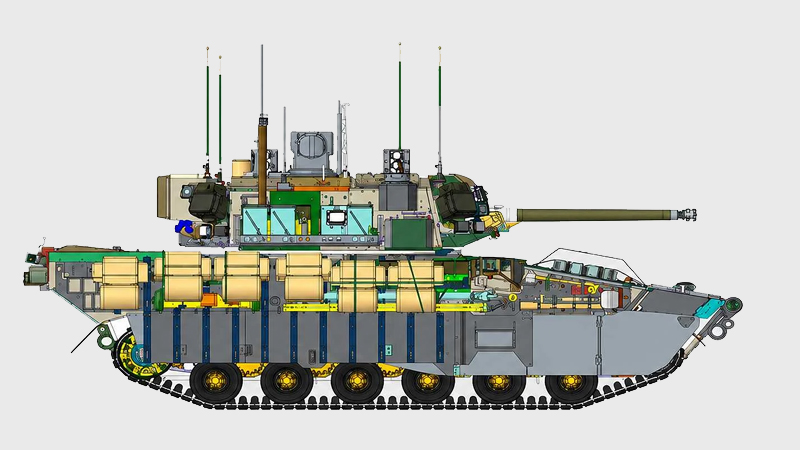
The Wolf is not an incremental Bradley. Army requirements call for a remotely operated turret, a two-soldier crew, space for six dismounts, a 50 mm XM913 cannon with a new family of armor-piercing and airburst ammunition, anti-tank missiles, 360-degree sensors, and a modular open-systems architecture meant to absorb software and hardware upgrades for decades. GDLS has framed the vehicle as born digital, built on a lineage that traces through the Griffin III and European ASCOD family, and assembled across a U.S. and Canadian network that includes Sterling Heights and Grand Rapids in Michigan, Lima in Ohio, Scranton, Tallahassee, and London, Ontario. Retired Brig. Gen. Geoffrey Norman, now directing U.S. strategy and growth at GDLS, said the Aberdeen vehicle is the first of several prototypes the company is finishing, with more headed to Fort Hood so they can be “put through the crucible” of unit evaluation. Additional vehicles were already moving through government acceptance at Lima earlier in the summer, with one earmarked for Aberdeen technical work and others scheduled for Texas around October.
That delivery does not close the contest. American Rheinmetall Vehicles, offering a U.S.-adapted Lynx derived from the KF41 family already in Hungarian, Italian, and Ukrainian service, remains the other Phase 3 and 4 contractor. The two firms split roughly $1.6 billion in June 2023 contracts, each tasked with building seven to eleven prototypes, ballistic hulls and turrets, armor coupons, and digital models. Rheinmetall’s Team Lynx includes Textron Systems, RTX, L3Harris, Allison Transmission, and Anduril. Hull and chassis work has been concentrated at Textron’s Slidell, Louisiana, plant, with turret fabrication and final join-up in Plymouth, Michigan. Company officials said in the spring that first vehicles would undergo internal shakedown testing before Army delivery in the third quarter of 2026, and by early August they were still describing the first Lynx prototypes as completing assembly for soldier familiarization in September and October. As of the last days of August, public reporting had confirmed the Wolf’s Aberdeen arrival; it had not yet confirmed an equivalent government acceptance of a Lynx. That lag is not, by itself, a verdict. Both teams were scheduled to put vehicles with soldiers this fall, and Army officials have said they intend to work with both vendors as long as they can.
The industrial picture is as much about production geography as about armor thickness. Both finalists have rooted prototype work in Southeast Michigan, turning the state into the de facto workshop of the Bradley replacement. American Rheinmetall has also spent more than $40 million expanding and modernizing plants in Michigan, Ohio, and Maine, arguing that a distributed U.S. network can surge if the Army chooses Lynx. GDLS, already the Abrams and Stryker manufacturer, has emphasized existing heavy-vehicle infrastructure and a supply chain it says is ready for a major production program. The eventual production prize is large: estimates around $45 billion to recapitalize a fleet that could run from about 2,500 vehicles toward 4,000 if the Army also replaces reserve and related variants. Low-rate production has been associated with fiscal 2028, first unit fielding with fiscal 2029, and a full-rate decision around 2030, though officials have also left room to delay a down-select if neither design is clearly superior after the next year’s field work.
The soldier test is designed to be unforgiving. The 1st Cavalry Division is expected to take two XM30 platoons and an M1E3 Abrams platoon by the end of 2026, then fight them at the National Training Center into early 2027. Evaluators will look past brochure lethality to crew workload in a two-person turretless fighting compartment, how quickly infantry can dismount, how maintainers reach components in the field, how the 50 mm gun and missile suite behave in combined-arms movement, and how each vehicle’s counter-drone kit performs. GDLS has highlighted AeroVironment Switchblade 300 integration on Wolf; Rheinmetall has pointed to Raytheon Coyote launchers and the option to carry Javelin. Both designs advertise active protection, open architecture, and automation intended to keep a smaller crew from drowning in sensor data. Those claims will now be scored by crews who still know the Bradley’s limits: a 25 mm gun that no longer overmatches peer infantry fighting vehicles, electrical and protection margins that are largely exhausted, and a hull that cannot easily absorb the next decade of electronic warfare and unmanned threats.
History hangs over the schedule. Since the 1980s the Army has launched multiple Bradley replacements and cancelled them. The immediate predecessor, the Optionally Manned Fighting Vehicle, collapsed in 2020 when competing Griffin III and Lynx KF41 offers were disqualified, one for requirements noncompliance and the other for lacking a finished prototype. The restart in 2021 forced five teams through digital design before the field narrowed again to GDLS and American Rheinmetall. Milestone B was reported approved in mid-2025, then briefly shadowed by senior-leader hesitation and a request for information that seemed to leave the door open to reworking the program. Prototype metal on the ground is the Army’s answer to that instability: keep two vendors, put vehicles with a real brigade, and decide in 2027 on the basis of performance rather than briefing slides. Brig. Gen. Troy Denomy has said that if there is no clear winner after the NTC rotation, it may be worth waiting, because money matters but so does locking the wrong vehicle into armored brigade combat teams for forty years.
What Aberdeen received recently is therefore a first data point, not the end of the story. GDLS has shown it can deliver a complete Wolf on the government’s calendar. American Rheinmetall still has to convert Lynx assembly lines and shakedown testing into Army-owned prototypes on a comparable clock. Through the autumn both companies will keep finishing vehicles. Through the winter and spring, Iron Horse soldiers will decide whether either design, or both, can replace a vehicle that has defined U.S. mechanized infantry since 1981. The program’s next public chapter will not be another delivery photograph. It will be whether the Wolf and the Lynx can survive the same desert rotation, side by side, under the same crews, with the same ammunition, drones, and timelines the Army now says it can no longer defer.