Anduril Unveils Thunder: A New Era of Manned-Unmanned Teaming in Rotary-Wing Combat
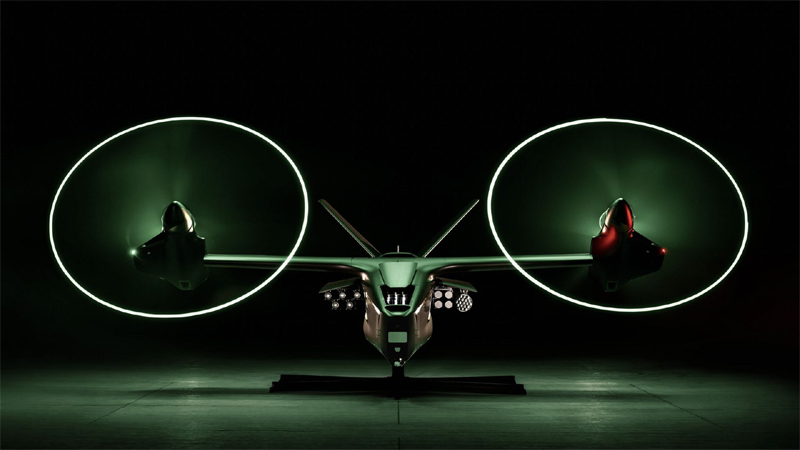
In July 2026 at the Farnborough International Airshow, Anduril Industries unveiled Thunder, a Group 5 autonomous attack rotorcraft developed in partnership with Archer Aviation. Designed as a loyal wingman for the U.S. Army’s AH-64 Apache and the future Bell MV-75 Cheyenne II, Thunder represents a significant extension of the collaborative combat aircraft concept from fixed-wing fighters into the realm of attack helicopters. This hybrid-electric tiltrotor promises to multiply combat power, enhance survivability, and deliver capabilities that traditional crewed platforms struggle to achieve in contested environments saturated with drones and advanced air defenses.
The loyal wingman idea has gained traction across military aviation in recent years. At its core, it involves uncrewed systems that operate alongside piloted aircraft, sharing a common tactical picture while assuming higher-risk roles. Rather than replacing human crews, these platforms act as force multipliers, absorbing threats, extending sensor reach, and increasing available munitions without additional pilots in harm’s way. In the Air Force’s Collaborative Combat Aircraft program, platforms like Anduril’s own YFQ-44A Fury already demonstrate this by teaming with F-35s and future fighters for strike, reconnaissance, electronic warfare, and decoy missions. Thunder brings the same philosophy to Army Aviation, where low-altitude operations face growing threats from cheap loitering munitions and integrated air defense systems. By operating on pilot intent rather than direct stick-and-rudder control, these systems free human operators to focus on command decisions while the machines handle formation flying, navigation in degraded conditions, and coordinated effects.
Thunder’s development began in 2024 as a dual-use platform leveraging commercial eVTOL innovations. Anduril collaborated with Archer Aviation, drawing on electric propulsion expertise, while incorporating military-grade rotor systems from Karem Aircraft. The result is a clean-sheet tiltrotor with a series hybrid-electric powertrain. Rotors tilt between vertical for takeoff and landing and forward for efficient wingborne cruise, enabling runway-independent operations from austere forward sites. This configuration combines the vertical agility of helicopters with the speed and range of faster platforms. Anduril reports performance approaching the legendary AH-56 Cheyenne: top speeds exceeding 480 km/h (around 515 km/h in some projections) and an unrefueled range near 1480 km, while carrying a payload comparable to an Apache. Full-scale surrogate testing has already validated key systems, with the first flight of the actual Thunder targeted for 2027.
A key advantage lies in affordability and producibility. Anduril positions Thunder as “affordable mass,” far cheaper than a crewed Apache (roughly $18 million per unit). This allows operators to accept attrition in high-threat scenarios without catastrophic loss. The aircraft packs into a standard shipping container for rapid deployment by air, sea, road, or rail, supporting dispersed operations in Pacific or high-intensity conflicts. Its hybrid-electric design reduces fuel consumption in cruise and lowers acoustic signature during low-level ingress, improving stealth against acoustic sensors and enemy forces. Lessons from ongoing conflicts, particularly the drone-heavy battles in Ukraine, influenced the emphasis on modularity, autonomy in GPS-denied environments, and counter-drone self-defense.
Thunder’s capabilities center on flexible internal payload bays in the main fuselage and nose. Configurations include up to 10 air-to-ground missiles such as AGM-114 Hellfire, AGM-179 JAGM, or Anduril’s turbojet-powered Barracuda-100M (with nearly 225-km range). Alternative loads feature 16 air-launched effects like the Altius-600 family for loitering munitions, ISR, or electronic warfare roles. Rocket options allow four 19-round pods totaling 76 laser-guided 70mm APKWS II rounds for massed suppressive fire. The nose bay can house up to 12 counter-UAS kinetic effectors. Mixed loads remain possible, and bays also support cargo for contested logistics, or other mission-specific modules. A single Thunder can thus deliver firepower equivalent to multiple Apaches while serving as a mothership for smaller effectors.
Autonomy forms the backbone of operations. Thunder runs on Anduril’s Lattice for Mission Autonomy software, proven on the Fury program. This handles formation behaviors, separation assurance around crewed aircraft, collision avoidance, and collaborative mission execution. An onboard perception stack fuses passive and selective active sensors, computer vision, map data, and edge computing to enable navigation and threat tracking when communications or GPS are jammed. Pilots command through high-level intent – “scout this sector” or “engage threats ahead” – while the system manages the details at machine speed. Formations of three to six Thunders per Apache could triple a Combat Aviation Brigade’s munitions without extra aircrews, at a fraction of the cost of additional manned helicopters. Thunder can also operate independently or in fully autonomous swarms for missions including long-range strike, ISR, maritime patrol, anti-submarine warfare, search and rescue, and logistics under fire.
Anduril’s broader strategy ties Thunder to its fixed-wing successes. The company’s rapid progress with the YFQ-44A Fury – from prototype to production selection in the Air Force CCA program – demonstrates scalable manufacturing. Thunder benefits from shared autonomy architecture and production lessons, promising faster iteration and lower costs. A commercial variant of the underlying platform is also in development, highlighting the dual-use philosophy that accelerates innovation by tapping civilian eVTOL advancements.
Challenges remain, including full integration testing, regulatory approval for autonomous weapons employment (with human oversight for lethal decisions), and scaling production to meet potential demand. Yet the concept aligns with evolving doctrine emphasizing human-machine teams for mass, survivability, and tempo in peer conflicts. Thunder does not seek to eliminate pilots but to empower them. As militaries worldwide grapple with the realities of contested airspace, Anduril’s Thunder offers a compelling vision: faster, farther-reaching, heavily armed autonomous partners that keep humans in command while shouldering the heaviest burdens.