ATMOS Space Cargo Enters the European Defense Sector
ATMOS Space Cargo, a leading European provider of technology for transporting cargo into orbit and controlled reentry to Earth, has closed a €25.7 million Series A funding round. The company will invest this capital in three strategic areas: building and operating the first fleet of three PHOENIX 2 return modules for commercial missions, launching a new division, ATMOS WORKS, for customers in the government and defense sectors, and developing the next-generation PHOENIX 3 return module.
The funding round was led by Balnord and Expansion, with participation from Keen Defence and Security. The European Innovation Council (EIC) also participated through the Accelerator program, providing a combination of grant and equity funding. Other investors include OTB Ventures, HTGF (High-Tech Gründerfonds), APEX Ventures, Seraphim, Faber, E2MC, Kirch Ventures, Lennertz & Co., Mätch VC, MBG Baden-Württemberg, and Tech Horizons.
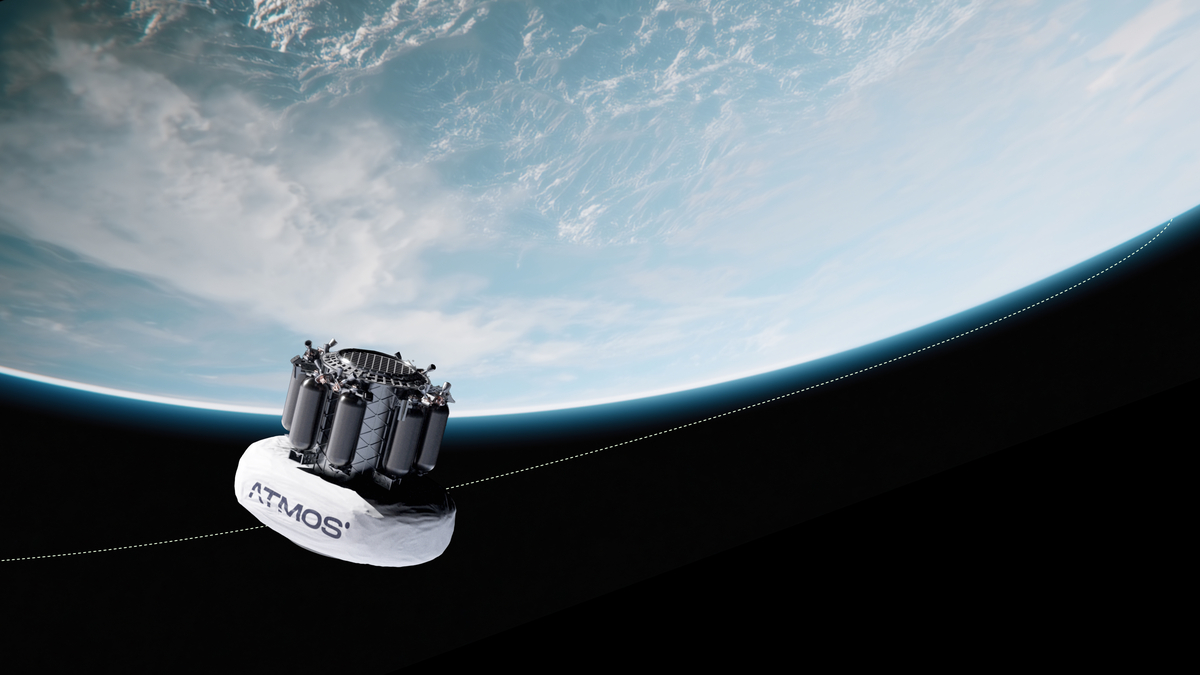
ATMOS has developed inflatable atmospheric decelerator (IAD) technology, which functions as both a heat shield and an aerodynamic brake during reentry from orbit. Its non-ablative design reduces material loss and the environmental footprint while enabling reuse. This significantly reduces the cost of each mission and, for the first time in history, enables a routine and autonomous European return to Earth. ATMOS is currently the only private European company to have successfully carried out such a return.

Video: ATMOS Space Cargo: Cargo Transport from Low Earth Orbit / YouTube
PHOENIX 2: A Fleet for a Series of Three Missions
Following the successful demonstration flight of PHOENIX 1 in April 2025, ATMOS became the first private European company to successfully return from space. After successfully validating the prototype, it is now moving into the operational phase. Three PHOENIX 2-type Orbital Transfer and Return Vehicles (OTRVs) will be deployed on several missions for institutional and commercial customers.
PHOENIX 2 is an autonomously operating spacecraft equipped with an integrated propulsion and power system. In low Earth orbit (LEO), it is capable of carrying out missions lasting from a few hours to several months. Upon mission completion, it performs autonomous deorbiting and a controlled reentry into the atmosphere using ATMOS’s Inflatable Atmospheric Decelerator (IAD) technology, which serves as both thermal protection and an aerodynamic brake. Its non-ablative design (i.e., without gradual material wear during atmospheric reentry) minimizes material loss and environmental impact while simultaneously increasing transport efficiency and return accuracy for rapid cargo retrieval.
The first cargo retrieval operations are being prepared in the Santa Maria area of the Azores, based on the Portuguese license ANACOM-09/2026-AE, which permits commercial reentry operations from orbit within the jurisdiction of a continental member state of the European Union.

A series of three missions establishes an operational rhythm, reduces program risks, and offers a predictable service for research institutions, industrial customers, and government clients. This marks the first time in Europe that orbital return has become a commonly available infrastructure service.

ATMOS WORKS: A New Division for European Government and Defense Institutions
ATMOS Space Cargo is also launching ATMOS WORKS, a specialized division focused on developing and providing advanced capabilities in space logistics and operations for European government and defense institutions. The PHOENIX platform was designed from the outset as a dual-use solution and supports missions such as in-orbit technology demonstrations and testing, the safe return of sensitive hardware, and critical military and civilian operations requiring immediate response.
PHOENIX 3: A New Platform for Significantly Larger Payloads
ATMOS has simultaneously launched the development of PHOENIX 3, a new-generation platform for transporting payloads into orbit and returning them to Earth. Compared to PHOENIX 2, it will offer roughly ten times the capacity—it is expected to transport payloads weighing approximately one ton.
The new spacecraft is designed to transport bulkier cargo and support shared missions for multiple customers. In the future, it is intended to meet the needs of clients in both the institutional and security sectors.
PHOENIX 3 is a direct response to the growing infrastructure demands of the European space economy—it strengthens Europe’s sovereign access to orbit and back, enables independent technology validation, and supports the long-term needs of European science, industry, the public sector, and security agencies.
“The new capital allows us to transition to regular operational flights. A series of three missions lays the foundation for Europe’s first infrastructure for routine returns from orbit. PHOENIX 2 is the first step toward building scalable European capacity that will demonstrate our ability to independently transport materials, data, and hardware to and from orbit. With ATMOS WORKS and PHOENIX 3, we are simultaneously building a complete architecture—commercial, institutional, and defense,” says Sebastian Klaus, CEO and co-founder of ATMOS Space Cargo.
“If a conflict were to break out tomorrow in the Suvalsky Corridor, Europe needs to have drones, armored vehicles, and unmanned ground vehicles (UGVs) available that can be deployed within hours, not days. Thanks to ATMOS, this is becoming a reality. Their PHOENIX capsule enables governments and defense forces to keep key assets in orbit and deploy them quickly anywhere in the world. Moreover, Sebastian is among the most determined and hardworking founders we have met. “We are proud that, in collaboration with ATMOS, we can contribute to strengthening European sovereignty,” says Tichomír Jenkut, Partner at Tech Horizons.
“ATMOS strengthens exactly the kind of dual-use potential that Europe needs more of: sovereign access not only to orbit, but also back down to Earth. “We believe that ATMOS can become a key component of the logistical backbone of Europe’s space industry base—one built on operational services, strategic autonomy, and the ability to serve commercial, institutional, and defense customers from a single platform,” says Aleksander Dobrzyniecki, General Partner at Balnord.
“Europe’s strategic autonomy in space depends on sovereign, full-fledged access to and from orbit. ATMOS Space Cargo addresses a critical gap in European space infrastructure. This investment reflects the EIC Fund’s commitment to supporting deep tech companies that strengthen European competitiveness, technological sovereignty, and the long-term development of the European space economy,” says Svetoslava Georgieva, Chair of the EIC Fund’s Board of Directors.