
Bastille Day 2026: A Massive Military Parade Under the Banner of Europe’s Strategic Awakening
The 14 July 2026 Bastille Day military parade will be remembered as one of the most ambitious and symbolic in recent years. More than 6,000 service members, accompanied by 315 vehicles, 98 aircraft, 33 helicopters, and 193 horses of the Republican Guard, embodied the vitality of the French armed forces and Europe’s collective awakening in the face of contemporary threats. The chosen theme, “Europe’s Strategic Awakening,” gave the event a distinctly international dimension, with the unprecedented participation of nearly 500 troops from around thirty allied nations, including Ukraine, Estonia, Poland, Czechia and other members of the coalition of volunteers. This foreign presence, which opened the parade alongside French troops, underscored transatlantic and European solidarity in a tense geopolitical context.
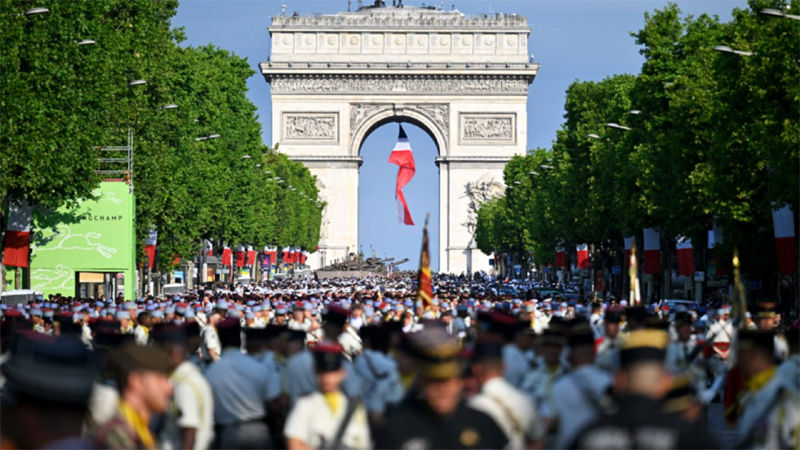
The morning began with the arrival of the President of the Republic at 9:50 a.m., followed by a troop review and honors. At 10:21 a.m., the Patrouille de France opened the aerial display with its traditional “big nine” formation on Alpha Jets, accompanied by Mirage 2000s carrying Ukrainian co-pilots trained in France – a powerful symbol of support. The air parade, denser than usual, highlighted Rafales, A400Ms, drones, and other aircraft demonstrating French power projection. Around 11:30 a.m., 33 military helicopters flew over the avenue, followed by motorized troops and, to close the spectacle, the Republican Guard’s horses in a majestic finale.
On the ground, the marching troops honored several major formations reflecting France’s commitment on Europe’s eastern flank. The 2nd Armored Brigade, heir to General Leclerc’s division, held a central place with emblematic regiments such as the 92nd Infantry Regiment, the 12th Cuirassiers Regiment, and the 40th Artillery Regiment. Training schools marched with pride: Polytechnique, Saint-Cyr, the Interarms Military School, ENSOA, and others, reminding spectators that recruitment and training quality remain the foundation of French military power. The Foreign Legion, with its bearded pioneers carrying axes, along with the Legion’s band playing the famous “Boudin” and the 1st Foreign Engineer Regiment, once again captivated the audience with their unique tradition and bearing. The 501st Combat Tank Regiment and the 3rd Marine Artillery Regiment, representing NATO multinational battalions in Romania and Estonia respectively, embodied France’s concrete engagement with its allies.
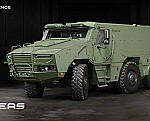
The motorized parade followed a clear operational logic, replicating the theoretical order of deployment on a high-intensity battlefield. Leading the way were units from the Special Forces Command, followed by heavy armor and combat vehicles. Stars of the show included upgraded Leclerc tanks in the XL-R version, equipped with new digital capabilities and enhanced protection. Griffon and Jaguar armored vehicles from the Scorpion program, versatile Serval vehicles, modernized VBCIs, Caesar howitzers, and MEPAC mortars paraded in force, illustrating the profound transformation of the Army. Mistral air-defense systems, engineer bridging equipment, logistics vehicles, communication assets, and cyber-defense means completed this comprehensive capability panorama. Internal security forces – National Police, Gendarmerie, Civil Security, and Customs – also displayed their vehicles, highlighting the security continuum between external defense and domestic protection.
This parade was more than a spectacular showcase; it fits into a broader context of French and European rearmament. After years of force reductions and budget cuts in the name of the peace dividend, France has undertaken a major effort to rebuild its military strength. The 2026 defense budget reaches approximately €68.5 billion, a significant increase, with projections exceeding €76 billion by the end of the decade. An updated military programming law provides an additional €36 billion for 2026–2030, aimed at replenishing ammunition stocks, accelerating equipment modernization, and strengthening the national defense industry. These investments respond to the collective realization prompted by high-intensity warfare in Ukraine, China’s rise, and uncertainties regarding U.S. commitment to Europe.
The Army, with around 120,000 personnel, continues implementing the Scorpion program, which modernizes its collaborative combat capabilities. In 2026, it is scheduled to receive hundreds of new or renovated vehicles, enhancing its ability to operate in coalition environments. The Navy is advancing on a new nuclear-powered aircraft carrier to replace the Charles de Gaulle and new attack submarines. The Air and Space Force is transitioning to an all-Rafale fleet while developing drones and future combat systems, despite the termination of the joint FCAS project with Germany due to industrial and work-share disagreements. The MGCS tank program also faces delays, prompting France to consider an interim tank to bridge the gap until the 2040s.
These budgetary and industrial efforts are accompanied by deep strategic reflection. As a nuclear power and permanent member of the UN Security Council, France assumes a leadership role in European defense. It maintains deployments in Romania, Estonia, and other theaters while strengthening its deterrence posture and power-projection capacity. Challenges remain: recruiting and retaining personnel amid civilian-sector competition, maintaining aging equipment, accelerating ammunition production for prolonged conflicts, and fostering still-fragile European cooperation despite the strong intentions displayed during the parade. The “strategic awakening” is not mere rhetoric; it translates into concrete investments, defense-industrial reindustrialization, and doctrinal adaptation to hybrid and high-intensity warfare.
Beyond numbers and equipment, the 14 July 2026 parade recalled the essential contract binding the Nation to its armed forces: recognition, cohesion, and shared commitment. In the stands and along the sidewalks, the French public could appreciate the scale of the display and the quality of the men and women in uniform. This parade, highlighting air-ground interactions, helped the public better understand the realities of the modern battlefield. It heralds a stronger, better-equipped army fully integrated into a European defense effort essential for the continent’s sovereignty in the decades ahead.