
What Happened at Russia’s Only Su-57 Production Plant
A fire has reportedly broken out at the Komsomolsk-on-Amur Aviation Plant (KnAAZ), the only facility in Russia that serially produces the Su-57 Felon fifth-generation fighter jet, raising fresh questions about the resilience of one of Moscow’s most strategically important defense programs.
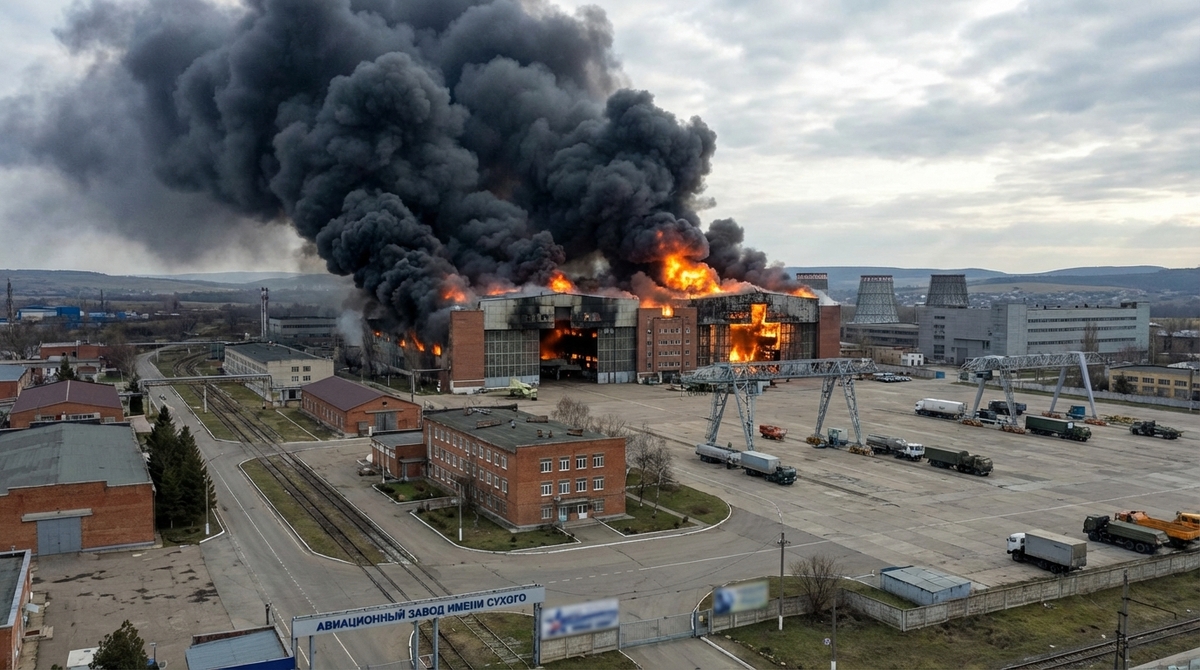
Footage and reports circulating on social media indicate that the incident occurred inside the grounds of the KnAAZ complex in Komsomolsk-on-Amur, located in Russia’s Far East Khabarovsk Krai region. The open-source intelligence group Cyberboroshno, which monitors Russian military-industrial activity, said videos and online posts point to a fire inside Shop No. 46 of the plant. At the time of writing, neither KnAAZ, parent company Sukhoi, the United Aircraft Corporation (UAC), nor Russian emergency services had issued a public statement on the incident.

If confirmed, the location of the fire makes the event especially significant. Shop No. 46 is assessed to be the dedicated production workshop for polymer composite material components used in the Su-57 airframe. According to Cyberboroshno, the facility manufactures around 300 separate part types, including roughly 100 large structural elements. These reportedly include aileron panels, flaperon panels, floor sections, and outer wing tip fairings — all critical components that feed directly into final aircraft assembly.
That matters because these parts are not easily replaceable. KnAAZ is not just another aircraft plant; it is the sole Russian facility certified for serial Su-57 production. If output from Shop No. 46 is interrupted, even temporarily, the disruption could ripple through the entire production chain. Composite structures are central to the Su-57’s design, contributing both to weight reduction and to the aircraft’s low observable characteristics. Without a steady supply of these specialized parts, downstream assembly stages could face delays that are difficult to absorb.
The risk is amplified by how these components are made. Production inside Shop No. 46 is understood to rely heavily on manual work, with only partial automation. That makes the workshop particularly vulnerable to any damage affecting its skilled workforce, production tooling, clean-room conditions, curing systems, or specialized machinery. In advanced aerospace manufacturing, especially for stealth aircraft, these capabilities cannot be rebuilt quickly. Training technicians to work with polymer laminates, autoclave curing systems, and precision layup processes takes years, not months.
The Su-57 itself has long been central to Russia’s effort to project fifth-generation air power. Developed from the T-50 experimental aircraft program, the fighter was designed to compete with aircraft such as the U.S. F-22 Raptor and F-35 Lightning II. It is intended to perform a broad mission set, including long-range air combat, close engagement, strikes against land and naval targets, and operations against advanced air defense networks. Much of that capability depends on airframe design features made possible by extensive use of polymer composite materials.

Yet the Su-57 program has struggled for years with slow production and limited fielding. Under a 2019 contract, Russia is expected to deliver 76 aircraft by 2027–2028 for the Russian Aerospace Forces, which remain the platform’s only operator. Even so, unofficial estimates in late 2025 suggested that only around 20 to 25 Su-57s had entered service — well below early ambitions for a program that began flight testing in 2010.
KnAAZ is also strategically important because it produces the Su-35S in parallel with the Su-57. That means any serious disruption at the plant could have broader implications for Russian tactical aviation production. The factory has also been operating under heavy external pressure. It was sanctioned by the United States in March 2022, with the European Union later imposing its own restrictions. Those measures have complicated access to foreign equipment and forced the plant to pursue domestic alternatives in several production areas.
For that reason, a fire affecting a core composites workshop would be more than a localized industrial accident. It could become a bottleneck for a flagship defense program that already faces structural constraints, sanctions-related procurement issues, and persistent production shortfalls. Because composite manufacturing sits near the front end of the aircraft build process, any significant damage in Shop No. 46 could affect everything that follows, from structural integration to final testing and delivery schedules.
At this stage, the scale of the incident remains unclear. No official confirmation has been issued, and the extent of any structural or equipment damage has not been independently verified. But if the workshop sustained meaningful losses, the consequences for Su-57 production could be serious and long-lasting.