New HQ-29 Footage Just Changed What We Know About China’s Missile Shield
Fresh footage circulating on Chinese social media has offered one of the clearest looks yet at China’s highly secretive HQ-29 missile defense system, revealing what appears to be the rail transport of a full battery in an undisclosed location. The video is drawing attention not only because of the rarity of the images, but also because it may provide new clues about the scale of the system’s deployment and the scope of its intended mission.
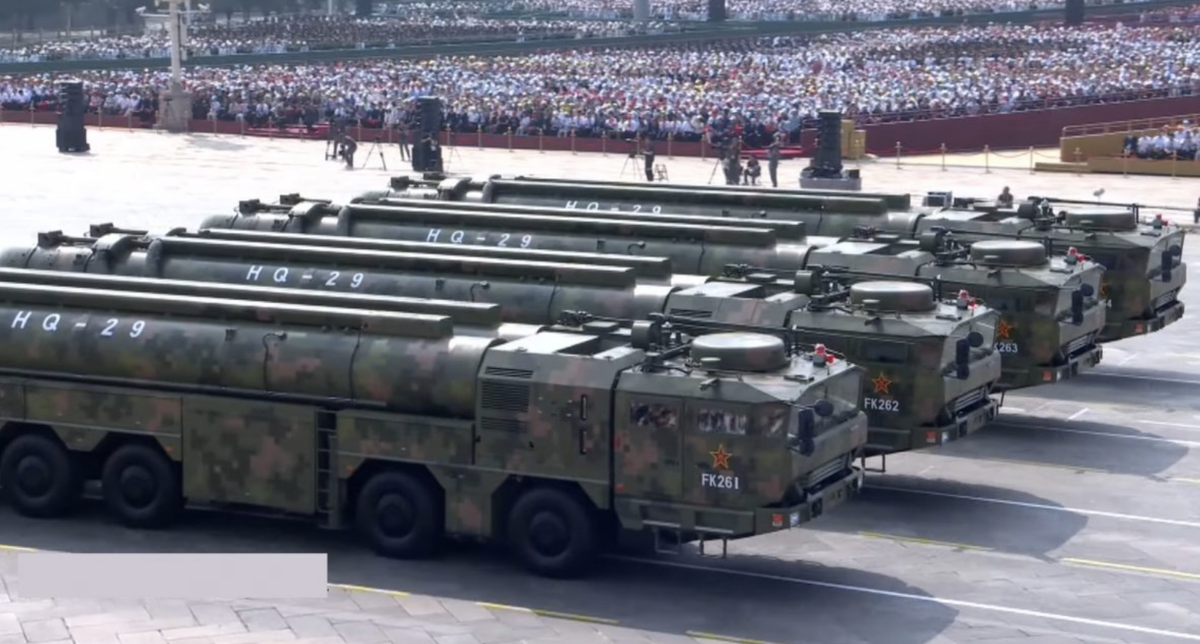
The footage reportedly shows at least eight HQ-29 launchers being moved by rail, together with 16 interceptor missiles. While official details remain extremely limited, the appearance of such a large formation suggests that the HQ-29 is moving beyond the ceremonial stage and into a more visible operational role.

The HQ-29 was only publicly unveiled in September 2025 during a military parade in Beijing, although reports indicate it had already entered service earlier that year. Its development is believed to date back to the early 2000s, pointing to a long and likely highly classified gestation period. That timeline alone suggests the system has been designed as a strategic asset rather than a symbolic showpiece.
One of the more intriguing aspects of the newly surfaced footage is the possibility that China may already field at least two HQ-29 batteries. Analysts have noted that the launchers seen in the recent transport video appear to carry different camouflage patterns and markings from those displayed during the 2025 parade. This has led to speculation that the systems shown in transit may belong to a second operational battery.
That said, such a conclusion remains far from certain. It is equally possible that the launchers seen previously were repainted or re-marked after the parade, meaning both appearances could still involve the same equipment. For now, the footage raises important questions, but does not provide a definitive answer about force size.
What makes the HQ-29 especially significant is the range of capabilities attributed to it. Although Beijing has released almost no official performance data, outside assessments describe the system as a high-end missile defense platform potentially capable of intercepting ballistic missiles, including possible intercontinental threats, as well as hypersonic weapons and satellites in low Earth orbit.
Some estimates place the HQ-29’s engagement range at up to 2,500 kilometers, with interception altitudes reaching as high as 850 kilometers. Other assessments offer a more restrained view, suggesting a likely interception envelope of roughly 150 to 600 kilometers in altitude. The interceptor’s speed has been estimated at between Mach 6 and Mach 10, equivalent to approximately 7,350 to 12,250 kilometers per hour.
Even the more conservative figures would place the HQ-29 among the most ambitious missile defense systems currently associated with any military power. If the higher-end estimates prove even partially accurate, the system could represent a major leap in China’s anti-ballistic missile and anti-satellite capabilities.
Such claims inevitably invite comparison with Russia’s S-500, often presented as one of the world’s most advanced air and missile defense systems. The S-500 is reported to engage targets at ranges of up to 600 kilometers and interception altitudes of up to 200 kilometers. On paper, the HQ-29’s rumored specifications would place it well beyond those thresholds.
Still, caution is essential. Nearly all of the HQ-29’s reported characteristics remain unverified, and there is a wide gap between theoretical performance, claimed capability, and proven operational effectiveness. Without official technical disclosures or demonstrated combat performance, many of the boldest claims surrounding the system remain speculative.
Even so, the emergence of this new footage matters. It provides a rare visual confirmation that the HQ-29 is not merely a parade feature, but a system that appears to be moving, deploying, and potentially entering broader service. Whether it ultimately rivals or surpasses systems like the S-500, the HQ-29 is clearly shaping up to be a central element in China’s expanding strategic defense architecture.
At minimum, the video offers a reminder that China’s missile defense ambitions are advancing steadily—and perhaps more quietly and quickly than many had assumed.