
Beyond 2038: The Technical, Financial and Strategic Case for a Dual French Carrier Fleet
In the autumn of 2026 the French Navy’s Chief of Staff, Admiral Christophe Cluzel, told the National Assembly’s defence committee that France is studying whether its sole nuclear-powered aircraft carrier, the Charles de Gaulle, can remain in service beyond its long-planned 2038 retirement. The study is not merely technical housekeeping. It opens the possibility that, for the first time since the late 1990s, France could operate two aircraft carriers simultaneously for a meaningful period. The new ship that is supposed to take the place of the Charles de Gaulle is the Porte-Avions de Nouvelle Génération, now officially named France Libre. Its construction has already been authorised and its design is largely fixed. Whether the older vessel can usefully share the stage with it is still an open question whose answer will shape French naval power for a decade or more.
The France Libre is conceived as a genuine step change rather than a simple replacement. At approximately 78,000 to 80,000 tonnes full load and 310 metres in length, with a flight-deck beam approaching 90 metres, it will be nearly twice the displacement of the 42,500-tonne, 261.5-metre Charles de Gaulle. Propulsion will come from two new K22 pressurised-water reactors, each producing roughly 220 megawatts thermal, driving three shafts to a maximum speed of about 27 knots. The flight deck will feature three electromagnetic aircraft launch systems (EMALS) supplied by General Atomics and an Advanced Arresting Gear recovery system, a decisive improvement over the two steam catapults of the present ship. The air wing is planned around thirty combat aircraft – initially Rafale Marine and later the New Generation Fighter of the SCAF programme – plus E-2D Advanced Hawkeye airborne early-warning aircraft, helicopters and unmanned systems. A crew of roughly two thousand will man the vessel. Nuclear propulsion preserves the strategic autonomy that France has prized since the Charles de Gaulle entered service in 2001, and the larger size is intended to accommodate future aircraft, more sustained sortie rates and greater stores endurance.
Official cost estimates for the France Libre have risen sharply. Figures circulating in the 2024–2030 military programming law were in the range of five to seven billion euros for development and construction; by 2026 the working number had settled around 10 to 12.2 billion euros, excluding certain port infrastructure upgrades and the aircraft themselves. Some industrial and expert assessments that include American catapult and radar components, or longer-term support, push the total higher still. The programme will mobilise several thousand jobs annually, peaking near 14,000, concentrated in the Pays de la Loire, Brittany and Provence-Alpes-Côte d’Azur. Hull construction is scheduled to begin at the Chantiers de l’Atlantique yard in Saint-Nazaire around 2031–2032. The incomplete ship is expected to move to Toulon in the mid-2030s for final outfitting and nuclear fuelling, with sea trials beginning in 2036 and full commissioning targeted for 2038 – precisely the year the Charles de Gaulle was previously expected to leave service.
Extending the life of the Charles de Gaulle is a different order of problem. The ship is powered by two K15 reactors of submarine origin. These cores must be replaced roughly every decade, and each major technical stop (historically called IPER or ATM) removes the vessel from the fleet for well over a year. The next such overhaul is scheduled for 2027–2028. Admiral Cluzel has said that studies conducted in the context of that refit will examine wear on the reactor cores, the possibility of keeping fuel aboard longer, and the condition of every auxiliary system – “the carrier is as old as its arteries.” Results are due in early 2029. Earlier estimates, including one attributed to a previous chief of naval staff, suggested that a meaningful extension could cost more than one billion euros, principally for additional reactor cores and associated work. Whether the steel of the reactor vessels and the rest of the ship can safely support another cycle of operations will be known only after those inspections.
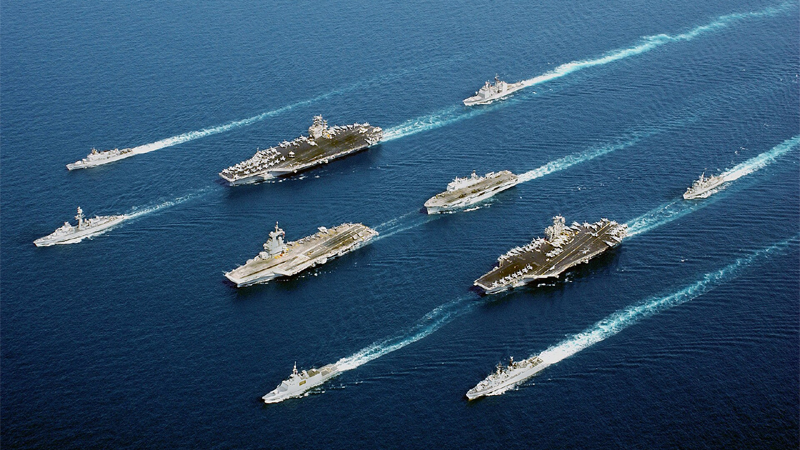
The operational case for retaining both ships for several years is straightforward. With a single carrier the French Navy’s availability for high-end air operations from the sea is capped at roughly 65 percent. Every major maintenance period creates a multi-month gap during which France has no fixed-wing carrier capability at all. Two hulls would allow a standing alert posture from Toulon and would provide a hedge against any delay in the France Libre programme. They would also permit a controlled transfer of skills: two trained crews would already be active during the planned 2036–2038 overlap, reducing the risk that carrier expertise is lost in a clean hand-over. In addition, the Charles de Gaulle still contributes to the airborne component of French nuclear deterrence by carrying the ASMPA-R missile; keeping it available longer preserves that option while the new ship matures. Admiral Cluzel has been careful to note that two carriers do not equal continuous presence at sea – that would require three – and that the decision is ultimately political rather than purely military.
The probability that the dual-carrier window actually materialises is moderate rather than high. Technically the odds are reasonable if the 2027–2028 inspections show that the reactors and major systems can be life-extended without prohibitive risk or cost; the French nuclear industrial base has the experience to manufacture additional cores if ordered in time. Politically and financially the picture is more fragile. The France Libre alone already represents a sum that could buy a substantial number of new frigates, and France’s public finances remain under pressure. The Navy leadership has framed the second carrier as a “political ambition,” not a service requirement it can dictate. Should the 2029 studies return a favourable technical verdict and the political leadership accept the extra expenditure, France could enjoy a two-carrier fleet for perhaps five to ten years after 2038. If either the reactors or the budget fail the test, the Charles de Gaulle will retire on schedule and the France Libre will, like its predecessor, operate alone. The studies now under way will therefore decide whether the late 2030s mark a brief dual-carrier interlude or simply the clean replacement of one unique national asset by another.