
Building European Readiness 2030: €1.07 Billion EDF Investment Targets Drones, Eastern Flank, Air and Space Shields
In mid-April 2026, the European Commission announced a significant boost to collaborative defence research and development across the continent. Following evaluation of the 2025 calls under the European Defence Fund, Brussels will allocate €1.07 billion to 57 new projects. This latest round of funding directly supports the Defence Readiness Roadmap 2030, a comprehensive strategy aimed at closing critical capability gaps and enhancing the European Union’s capacity to act autonomously and collectively in an increasingly volatile security environment.
The investment breaks down into €675 million for 32 capability development initiatives focused on delivering ready-to-use technologies and €332 million for 25 more experimental research projects. With a record 410 proposals submitted – a 37 percent increase over the previous year – the strong response from industry, research institutes, and member states underscores growing momentum behind joint European defence efforts. These projects span a wide spectrum of critical domains, including artificial intelligence, cyber defence, drones and counter-drone systems, advanced sensors, and secure communications.
At the heart of this funding wave are the EU’s four major defence flagships: the European Drone Defence Initiative, the Eastern Flank Watch, the European Air Shield, and the European Space Shield. More than 15 of the selected projects will contribute directly to these flagships, providing concrete technological building blocks for integrated, multi-layered capabilities that address threats ranging from low-cost drone swarms to sophisticated missile attacks and orbital vulnerabilities.

The European Drone Defence Initiative stands out as one of the most urgent priorities. Drawing lessons from ongoing conflicts, particularly the extensive use of unmanned systems in Ukraine, the initiative seeks to establish a flexible, 360-degree counter-drone architecture. Selected projects will advance interoperable solutions for detection, tracking, neutralisation, and even precision strike capabilities using drone technology itself. Emphasis lies on multi-layered systems that combine sensors, effectors, and AI-driven command networks, ensuring seamless integration across member states and with NATO structures. One notable example is the AETHER project, which focuses on propulsion and thermal management technologies essential for next-generation unmanned platforms and their countermeasures.
This flagship addresses not only military threats but also hybrid challenges, such as drone incursions near critical infrastructure or borders. By fostering scalable production and continuous innovation, the EU aims to build resilient drone and counter-drone ecosystems that reduce dependency on external suppliers while accelerating the translation of research into operational capabilities. Initial capacities are targeted by the end of 2026, with full functionality expected in 2027.
Complementing drone defence efforts is the Eastern Flank Watch, designed to strengthen security along the EU’s eastern borders. Projects under this umbrella will integrate land, air, maritime, and hybrid defence elements, with particular attention to situational awareness, counter-drone networks, and protection against hybrid operations. The initiative envisions layered surveillance systems spanning the Baltic to the Black Sea, incorporating ground sensors, unmanned platforms, and secure data-sharing frameworks. By bolstering border resilience and internal security linkages, the Eastern Flank Watch aims to deter aggression while supporting rapid response in high-risk areas. Full operational capacity is projected by the end of 2028.
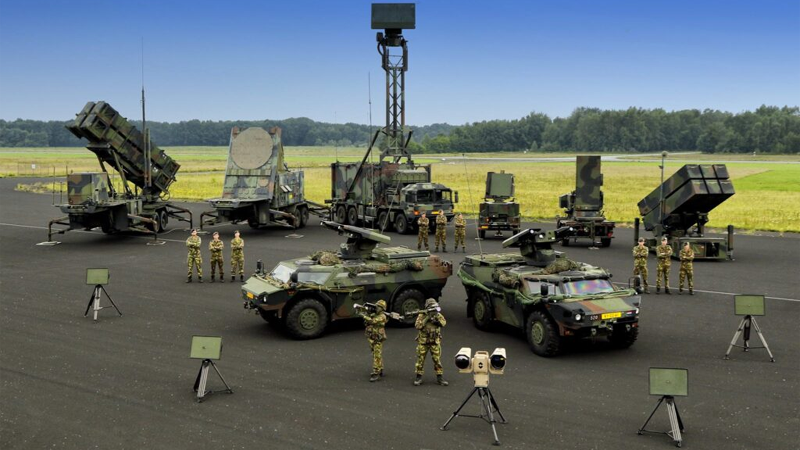
The European Air Shield flagship targets one of Europe’s most pressing collective vulnerabilities: integrated air and missile defence. Funding will support development of multi-layered systems covering the full spectrum of aerial threats, from ballistic missiles to cruise missiles and unmanned aerial vehicles. Projects emphasise sensors, interceptors, and command-and-control architectures fully interoperable with NATO systems. This effort seeks to create a cohesive protective umbrella that reduces national dependencies and enhances burden-sharing across the Union. Launches and initial deployments are aligned with the 2026 roadmap milestones.

In parallel, the European Space Shield focuses on protecting and enhancing the resilience of European space assets and services. With growing risks of orbital congestion, anti-satellite weapons, and hybrid interference, selected projects will advance technologies for satellite protection, space situational awareness, secure communications, and rapid reconstitution capabilities. This flagship recognises space as a critical enabler for terrestrial operations, navigation, intelligence, and command functions. By safeguarding IRIS2 and other EU space programmes, the initiative aims to ensure continuity of essential services even in contested environments.
Beyond the flagships, the broader portfolio of 57 projects reinforces cross-cutting priorities such as AI for decision support, cyber resilience, and supply chain security. Ukrainian entities are participating in several initiatives, deepening industrial ties and incorporating hard-won operational insights from the frontline. This inclusion aligns with broader EU efforts to integrate Ukraine’s defence innovation ecosystem into European frameworks.
The EDF’s role extends far beyond pure research. By mandating cross-border collaboration – typically requiring at least three entities from different member states – the Fund drives industrial consolidation, technology transfer, and the emergence of a more competitive European Defence Technological and Industrial Base. It complements other instruments such as the European Defence Industry Programme and national investments, creating synergies that accelerate production scaling and common procurement.
Challenges remain, however. Fragmentation across national markets, varying defence spending levels, and bureaucratic hurdles continue to slow progress. Intellectual property sharing, export controls, and alignment with NATO priorities require careful management to maximise impact. Nevertheless, the scale and focus of this €1.07 billion tranche signal a maturing strategic culture in Brussels, one that treats defence industrial policy as integral to overall security strategy.
As Europe confronts persistent threats from state actors, hybrid campaigns, and technological disruption, these investments represent tangible steps toward greater readiness. The projects funded today will feed into capability coalitions, joint procurement initiatives, and operational forces in the years ahead. With the Defence Readiness Roadmap 2030 providing clear milestones, the EU is moving from conceptual planning to concrete deliverables in air defence, drone warfare, border security, and space domain awareness.
This latest EDF wave demonstrates that European nations recognise the need for collective action in an era where no single country can master the full spectrum of emerging threats alone. By prioritising innovation, interoperability, and industrial resilience, the Union is laying foundations for a more capable, sovereign, and secure defence posture – one that strengthens both its own citizens and the broader transatlantic alliance. Implementation of these 57 projects over the coming years will offer important indicators of how effectively Europe can translate funding and political will into battlefield-relevant capabilities by the end of the decade.