
CSG Provides Tatra Chassis for Azerbaijan’s CWS-30GD Viking - New Pantsir-Style Air Defense System
Azerbaijan has unveiled a new short-range air defense system, the CWS-30GD Viking, positioning it as a locally assembled alternative to systems such as Russia’s Pantsir-S1. Presented at the ADEX 2026 defense exhibition in Baku, the Viking combines a European heavy truck platform with Turkish weapon components and a mixed gun-and-missile layout designed for modern low-altitude threats.
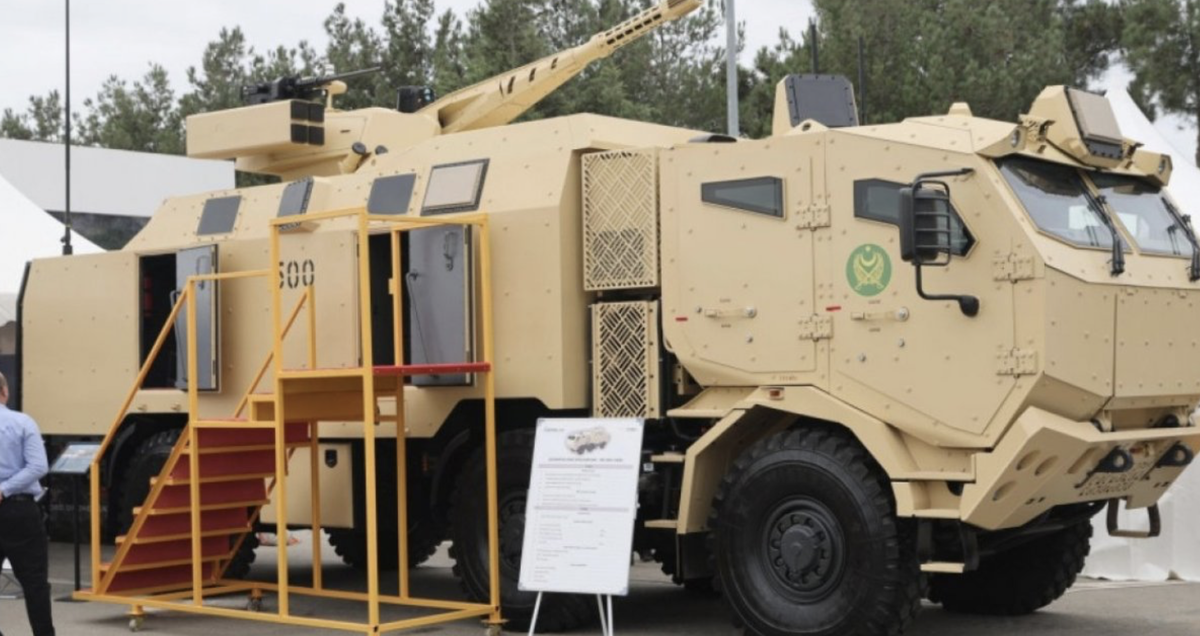
The system is especially notable because it appears at a time when battlefield experience in Ukraine has reshaped global thinking about air defense. Small drones, loitering munitions and low-flying cruise missiles have forced militaries to look for more flexible, mobile and layered protection. Azerbaijan’s answer is a 26.6-ton combat vehicle built around the Czech Tatra T815 chassis and equipped with a combination of cannon, machine gun and surface-to-air missiles.
A Czech chassis with Turkish weapons
The CWS-30GD Viking was developed with the involvement of Czech defense group CSG, whose Tatra T815 chassis provides the base vehicle. This platform gives the system the mobility and payload capacity required for a truck-mounted air defense complex.
Its weapons package includes a 30 mm Sk30 gun with a stated range of up to 2.5 km, a Turkish-made 12.7 mm Canik machine gun and one or two missile launchers carrying a total of four surface-to-air missiles. For detection and targeting, the vehicle is fitted with an ADR-4005 radar and a COAPS-L electro-optical targeting station.
The exact missile type has not been disclosed. However, based on the size of the launch containers, the missiles are believed to be short-range weapons. One possible option mentioned in reporting is the Turkish SUNGUR missile, which has a range of up to 8 km.
This combination suggests the Viking is aimed primarily at close-range protection against drones, helicopters, low-flying aircraft and cruise missiles rather than long-range area air defense.
Why comparisons with Pantsir-S1 are inevitable
Visually and conceptually, the Viking invites comparison with Russia’s Pantsir-S1. Both systems place guns and missiles on a large truck chassis, both are designed for short-range air defense, and both are meant to protect troops, infrastructure or key military assets from aerial threats.
But the comparison also highlights important differences. The Russian Pantsir-S1 uses missiles with a reported range of up to 20 km, giving it a clear advantage against higher-altitude or more distant targets. Unless Azerbaijan integrates larger interceptors into the Viking, the new system will likely remain more limited in missile reach.
At the same time, the Viking includes a 12.7 mm machine gun, which is not a standard feature of Pantsir-S1. This may give the Azerbaijani vehicle an additional low-cost option against certain close-range targets, especially smaller drones where using a missile may be inefficient.
The timing of the Viking’s debut is also significant. Pantsir-S1’s reputation has suffered during Russia’s war against Ukraine, where Ukrainian drones and precision strikes have repeatedly exposed weaknesses in Russian short-range air defense. That does not mean Pantsir is obsolete, but it does mean the global market is now more open to alternative systems that promise better adaptation to drone-heavy warfare.
Built for the drone age
The rise of inexpensive unmanned systems has created a difficult economic problem for air defense forces. Shooting down a low-cost drone with an expensive missile is often unsustainable. Modern short-range systems therefore need a mix of effectors: guns, machine guns, missiles and sensors capable of detecting small, low-signature targets.
The Viking appears to follow this logic. Its 30 mm gun can engage targets at short range, while the machine gun adds another layer for very close threats. Missiles extend the reach beyond the gun envelope and allow the system to engage faster or more dangerous aerial targets.
In this sense, the Viking sits within the same broad category as other modern counter-drone and short-range air defense systems, including Germany’s Skyranger 30. However, one key detail remains unclear: whether the Viking can use programmable airburst ammunition. Such rounds can greatly improve effectiveness against small drones by detonating near the target rather than relying on a direct hit.
So far, there has been no confirmed information that the Viking uses this type of ammunition. If it does not, that could limit its effectiveness compared with systems designed from the start around programmable 30 mm rounds.
Azerbaijan’s defense-industrial message
Beyond the technical specifications, the Viking carries political and industrial significance. Azerbaijan is showing that it can assemble and field increasingly complex defense systems through international partnerships. The use of a Czech chassis and Turkish weapons reflects Baku’s growing ability to combine foreign components into a system tailored to its own military needs.
This approach also fits Azerbaijan’s broader defense posture. After years of investing in drones, precision weapons and modern command systems, the country is now strengthening the defensive side of that equation. A mobile short-range air defense system gives the Azerbaijani military a tool for protecting maneuver units, command posts and critical infrastructure from the kind of aerial threats that now dominate modern battlefields.
The system is currently expected to serve Azerbaijan’s own armed forces. However, if it performs well and receives further development, export opportunities are possible. Many countries are looking for affordable and mobile counter-drone systems, particularly those that can combine guns and missiles on one platform.
Export potential — but with serious competition
The Viking may attract attention from states that want an alternative to Russian equipment, especially as confidence in some Russian systems has weakened. A platform using Czech and Turkish components may also be easier to market in countries that are diversifying away from Russian defense suppliers.
Still, the export market will not be easy. The Viking would have to compete with established and emerging systems, including Turkey’s own Korkut and European solutions such as Skyranger. Buyers will likely judge the system not only by its appearance or weapons layout, but by sensor performance, ammunition options, missile integration, command-and-control compatibility, price and proven battlefield effectiveness.
For now, the CWS-30GD Viking should be seen as a promising regional air defense project rather than a confirmed Pantsir replacement. It has the right basic concept: mobility, layered weapons and sensors aimed at short-range threats. But its real value will depend on details that remain unknown, especially missile type, ammunition options, radar performance and integration with wider air defense networks.
What is already clear is that Azerbaijan is entering a crowded but strategically important field. The war in Ukraine has shown that short-range air defense is no longer a secondary capability. It is now one of the central requirements of modern warfare. With the Viking, Azerbaijan is trying to build a system for that new reality — and to do so on its own terms.