

Drone Strike Damages Two Ships at Russia’s Port of Azov, Exposing Another Vulnerable Link in Moscow’s Logistics Network
Two ships were damaged at Russia’s Port of Azov during a drone attack on the Rostov region on the night of October 10, according to the regional governor. The incident adds another pressure point to Russia’s southern transport and fuel infrastructure, which has repeatedly come under attack as the war continues to expand far beyond the front line.
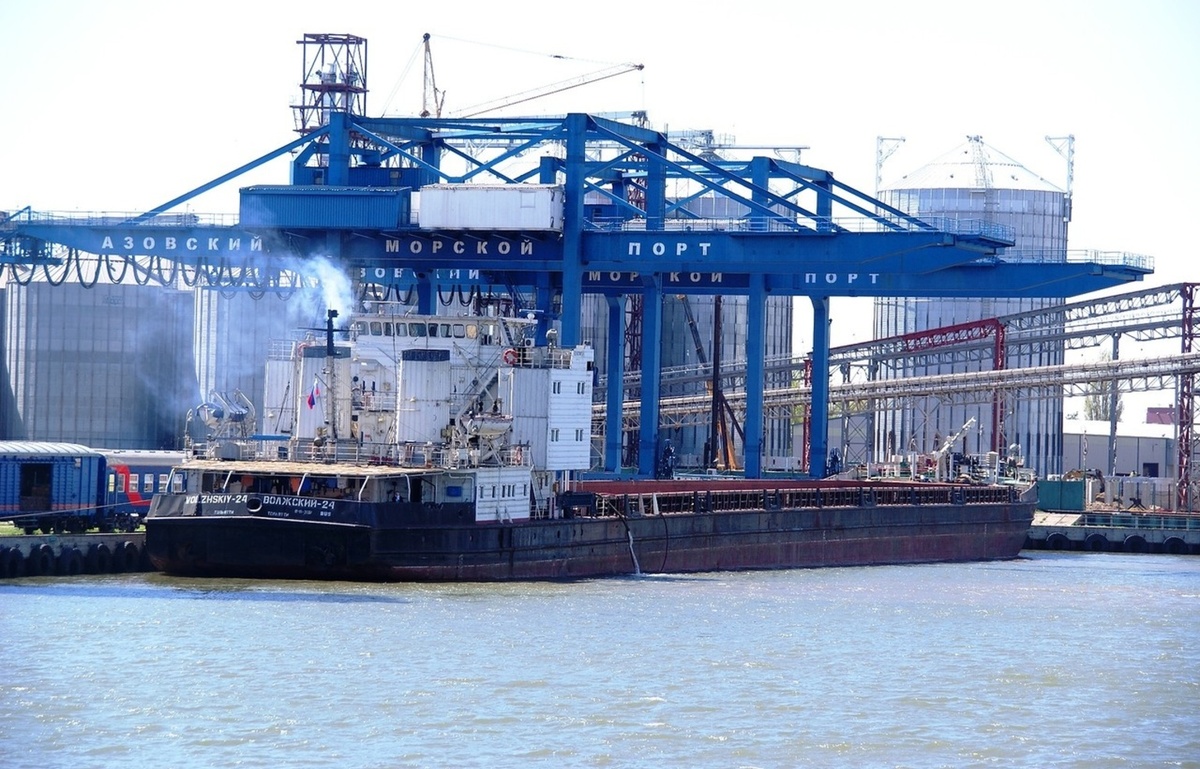
The names of the damaged vessels have not been disclosed. Russian officials also did not specify the type or scale of damage sustained by the ships. That lack of detail leaves open several important questions: whether the vessels were operational, what cargo they carried, whether port activity was disrupted, and how long repairs might take.

Still, even with limited information, the target itself is significant.
The Port of Azov is not just a local harbor. Located in the Don River Delta, it serves as a commercial seaport linking river and sea transport. Through the Azov-Don Sea Canal, the port connects with the Sea of Azov, making it part of a broader transport chain used for cargo movement across southern Russia.
One of the port’s major operators, Azov Sea Port JSC, has 11 berths with a total length of 1,485 meters, according to Russia’s Ministry of Transport. Its declared cargo terminal capacity is 5.64 million metric tons per year. In practical terms, this means the port is built to handle substantial cargo flows — and any disruption there can carry economic and logistical consequences beyond the immediate damage to individual vessels.
A strike on ships, but also on confidence
The direct material result of the attack remains unclear. Two damaged ships may sound limited compared with strikes on refineries, ammunition depots, or military airfields. But ports are sensitive systems. Their value lies not only in the vessels docked at the berths, but in the predictable movement of cargo, crews, fuel, rail connections, customs operations, and loading schedules.

A drone attack changes that calculation.
Even if damage is quickly repaired, port operators must account for the possibility of repeated strikes. Insurance costs, security procedures, vessel movement schedules, and cargo handling decisions can all be affected. Ships are mobile assets, but while berthed, they become exposed targets. A port that can no longer guarantee basic protection becomes less efficient, more expensive to operate, and less attractive for commercial traffic.
This is why the attack on Azov matters. It suggests that Russian infrastructure in the Rostov region remains within reach of drone operations, even when the targets are not strictly military in appearance.
Rostov remains under pressure
The strike on the Port of Azov was not an isolated event in the region. During the same October 10 attack, Ukrainian drones also struck the oil loading terminal at the Novoshakhtinsk Oil Refinery in Rostov-on-Don, where a large fire broke out on the refinery grounds.
That matters because it shows a broader pattern: drones are being used not only against one symbolic target, but against interconnected nodes of Russia’s logistical and energy system. Ports, oil depots, refineries, loading terminals, and rail-linked facilities all play different roles, but together they help sustain the flow of fuel, goods, and military-relevant supplies.
The Rostov region is particularly important because of its geography. It sits close to occupied Ukrainian territories and serves as a rear-area hub for Russian operations. Infrastructure there supports civilian industry, but it also exists in a wartime environment where transport, fuel, and industrial capacity can have military relevance.
That dual-use character makes the region vulnerable to a campaign designed to stretch Russian defenses and force Moscow to protect a growing list of potential targets.
Azov has been hit before
The October 10 incident also follows earlier attacks in the same area. On July 10, 2026, Ukrainian drones struck an oil depot in Azov, causing tanks with petroleum products to catch fire. That previous strike demonstrated that Azov was already on the map as a target for long-range drone operations.
The latest damage to two ships suggests that the threat has not been eliminated. Instead, the pattern appears to be continuing — with drones reaching facilities linked to fuel, cargo, and transport inside Russia’s southern regions.
For Russia, this creates a difficult defensive problem. Protecting every refinery, depot, bridge, rail junction, port, terminal, and vessel is extremely demanding. Air defense systems are expensive, limited, and cannot be placed everywhere in equal strength. Even when drones are intercepted, a small number getting through can still cause fires, delays, and economic disruption.
For Ukraine, the strategic logic is clear: inexpensive or relatively low-cost drones can impose disproportionate costs on Russian infrastructure and force the Kremlin to divert resources away from the front.
The war behind the front line
The damage at the Port of Azov is another example of how the war has expanded into a contest over logistics. Modern wars are not decided only by trenches, tanks, and artillery positions. They are also shaped by fuel availability, cargo throughput, repair capacity, transport corridors, and the ability to keep rear areas functioning under pressure.
Ports like Azov are part of that system.
If ships cannot berth safely, if terminals must suspend work during air alerts, if fuel facilities burn, and if regional authorities must constantly respond to drone incidents, the cumulative effect becomes more important than any single explosion. The aim is not necessarily to destroy one facility completely. Often, the goal is to create friction: delays, uncertainty, higher costs, and reduced confidence in Russia’s ability to shield its own rear.
The October 10 attack achieved at least one thing: it showed that Russian ports in the Rostov region remain exposed.
Limited facts, wider implications
At this stage, the known facts are narrow. Two ships were damaged. The incident happened at the Port of Azov during a drone attack on the Rostov region. The regional governor confirmed the damage but did not name the vessels or describe the extent of the impact.
But the broader implications are harder to ignore.
Azov is a functioning cargo port with access to the Sea of Azov and a declared annual terminal capacity measured in millions of tons. It sits in a region that has already seen repeated drone strikes on fuel and industrial infrastructure. And it forms part of the rear-area network that Russia depends on during a long war.
That makes the attack more than a local port incident. It is another sign that the battlefield now extends deep into logistical infrastructure — and that drones continue to reshape the cost, reach, and rhythm of the war.
The immediate damage may be measured in two vessels. The larger message is that Russia’s southern transport network is no longer operating beyond the reach of war.