
Strike at the Source: Ukraine Hits Russian Plant Fueling Rocket Warfare
Sometimes the most important target is not the launcher, but the factory that keeps the launcher alive.
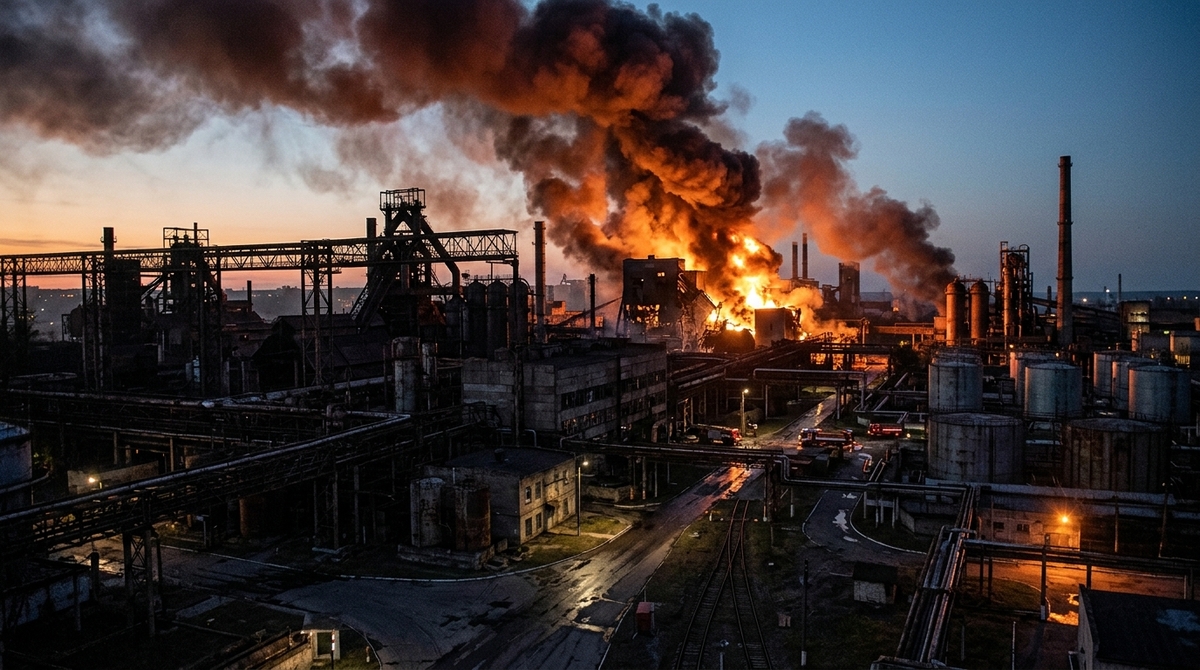
That is what makes Ukraine’s strike on the Kamensky Combine in Russia’s Rostov region so significant. This was not just an attack on another military site. It was a hit on a critical part of the industrial chain that feeds some of Russia’s most destructive rocket systems.
Located in Kamensk-Shakhtinsky, the Kamensky Combine produces explosives, gunpowder, and solid rocket propellant. Those materials are used in ammunition for the Uragan, Smerch, and Tornado-S multiple-launch rocket systems, and also support other missile systems and air-launched weapons. In practical terms, the plant helps turn Russian firepower from a stockpile into a continuing threat.
The overnight strike on August 16 cut directly into that process.
Two production workshops were destroyed, and four more were damaged. That alone makes the attack more than symbolic. It means the blow landed where manufacturing capacity lives — inside the facilities that produce the energetic materials Russian weapons depend on.
The deeper significance lies in what kind of target this was.

Factories like the Kamensky Combine are harder to replace than individual launchers or ammunition depots. A destroyed rocket battery can sometimes be substituted. A damaged production base is another matter. It affects output, repair cycles, logistics planning, and the state’s ability to sustain pressure over time. When a war depends heavily on artillery and rocket strikes, propellant production becomes a strategic nerve.
That is why the defenses around the site matter almost as much as the strike itself.
The facility had been heavily prepared against attack. Key workshops were covered with anti-drone nets and protected by large earthen berms. It also sat under a dedicated air-defense umbrella. Even so, Ukrainian strike assets still reached multiple sections of the plant.
At least five different areas were hit. Several Russian air-defense vehicles were reportedly struck as well. Fire was also visible at the position of what appeared to be a Pantsir-S1 system, and at positions associated with the fire-control radars of S-300/S-400 systems. In other words, the attack did not simply slip through weak defenses. It appears to have punched through layered protection built specifically to prevent this kind of outcome.
That detail changes the story.
This was not only an industrial strike. It was also a demonstration that even hardened, defended military production sites inside Russia remain vulnerable. A plant shielded by passive protection measures and covered by modern air defense was still hit hard enough to lose production workshops. That sends a message far beyond one facility.
It suggests that the battlefield is no longer defined only by trenches, front lines, and occupied territory. It also runs through the factories, depots, radar positions, and support infrastructure that make sustained warfare possible. The rear is no longer truly rear.
For Russia, that creates a new pressure point. Protecting industrial capacity at home requires more than dispersing equipment or hiding warehouses. It means defending the machinery of war itself — the places where explosives are mixed, propellant is made, and ammunition begins its life long before it reaches the front.
For Ukraine, strikes like this carry strategic logic. Instead of focusing only on what Russia has already deployed, they aim at what Russia still needs to build. It is an attempt to degrade capacity, not just inventory.
That may be the clearest takeaway from Kamensk-Shakhtinsky.
A missile system is dangerous because it can fire. But before it fires, someone must manufacture the chemistry inside it. Someone must produce the propellant, assemble the materials, and keep the production line moving. Ukraine’s strike targeted that invisible foundation.
And when the foundation is shaken, the damage can travel much farther than the blast itself.