Dutch CV90 Expansion Restores Tracked Infantry Capability for High-Intensity Conflict
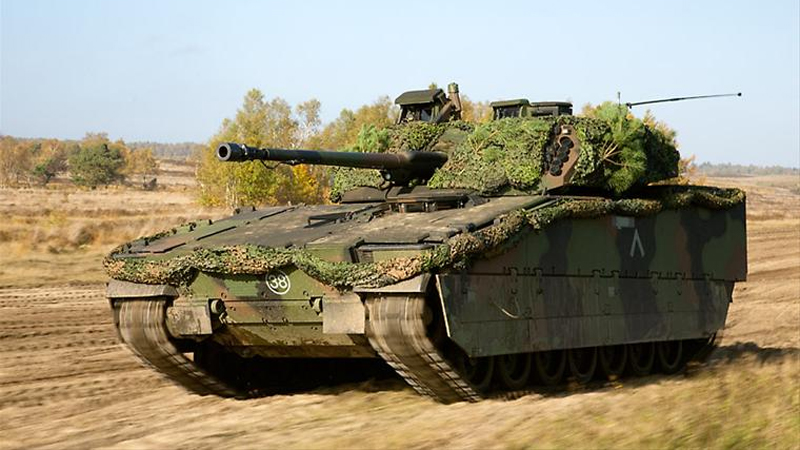
On 26 October 2026 the Dutch Ministry of Defence informed parliament that the Royal Netherlands Army would receive additional modern CV90 combat vehicles together with a wider package of engineering, bridging, support and recovery systems. The decision forms part of a deliberate effort to restore the ability of Dutch ground forces to fight, manoeuvre and sustain operations in a high-intensity conflict against a well-equipped opponent. The new CV90s are destined for an armoured infantry battalion now being established at the Nassau-Dietz Barracks in Budel. Exact numbers and the precise configuration have not been published, but the vehicles are described as modern CV90s acquired through a Swedish-led joint procurement known as the Nordic Initiative, which also involves Finland, Norway and Lithuania. Estonia withdrew earlier in the year in order to prioritise air defence. Participation in the common programme is intended both to accelerate delivery and to improve standardisation across northern European users.
The acquisition is not limited to fighting vehicles. The Netherlands is also buying additional bridge-laying tanks, Wisent 2 heavy recovery vehicles, Armoured Combat Support Vehicles from German firm FFG, and a replacement for its ageing Leopard 2-based Kodiak engineering breaching vehicles. The Kodiak fleet has suffered from reliability problems and is judged insufficiently protected against current and future threats. The new engineering assets are required to clear minefields, walls and other obstacles so that a mechanised formation can maintain momentum. Bridge layers will allow temporary crossings, while recovery and support vehicles will keep damaged armour mobile. In short, the programme is rebuilding an entire armoured combat system rather than simply adding more infantry fighting vehicles.
The Netherlands already operates 122 CV9035 vehicles that are undergoing a substantial mid-life upgrade. That programme, contracted in 2021, equips the fleet with a new turret, Elbit’s Iron Fist active protection system on a large portion of the vehicles, Spike anti-tank guided missiles, improved electro-optics and composite rubber tracks. The upgraded vehicles are expected to remain in service until 2039. Sweden and Denmark have ordered newer CV9035 MkIIIC vehicles built to a comparable standard, showing that Dutch modernisation experience is already feeding into a wider European baseline. The additional vehicles now ordered will therefore expand a fleet that is already being brought to a high contemporary standard rather than replace an obsolete one.
This Dutch move sits within a broader European return to tracked mechanised capability. BAE Systems Hägglunds notes that the CV90 has been selected by ten European nations, eight of them NATO members, with roughly 1,900 vehicles ordered across seventeen variants. Commonality of the tracked chassis allows operators to share training, spare parts, upgrade paths and operational lessons while still fitting national weapon, sensor and protection packages. The Nordic Initiative itself is designed to generate scale, shorten lead times and reduce long-term sustainment costs through coordinated demand.
A useful point of comparison is the Czech Republic’s parallel CV90 MkIV programme. In May 2023 Prague contracted for 246 CV9030 MkIV vehicles in seven variants for approximately 59.7 billion Czech crowns (around 2.2 billion US dollars). The package comprises 141 infantry fighting vehicles together with command, reconnaissance, engineering, artillery observation, recovery and medical variants. Thirty-nine vehicles are produced in Sweden; the remaining 207 are assembled in the Czech Republic by VOP CZ and a growing network of more than fifty Czech companies, ensuring that at least 40 % of contract value remains in the domestic industrial base. The first Czech vehicle was rolled out in Sweden in August 2025 and the configuration was publicly displayed at Future Forces Forum in Prague in October 2026. Final deliveries are planned for 2030.
The Czech CV9030 MkIV is a clean-sheet MkIV build powered by a Scania diesel of up to 1,000 horsepower with the X300 transmission and active suspension. Gross vehicle weight can reach 38 tonnes, providing growth margin for additional armour and systems. Main armament is the 30 mm Bushmaster II chain gun capable of firing programmable air-burst ammunition, paired with a coaxial machine gun and Spike-LR anti-tank missiles. The Saab UTAAS fire-control system gives the vehicle a useful organic capability against low-flying aerial threats including drones. Protection includes modular armour that can exceed STANAG 4569 Level 6 in key arcs, mine and IED protection, and the planned integration of the Trophy active protection system. Eighteen cameras and advanced sensors provide continuous 360-degree situational awareness. Rubber tracks are available to reduce weight, noise and vibration.
Dutch and Czech choices therefore differ in several practical respects. The Netherlands is expanding and upgrading an existing CV9035 fleet that already mounts the 35 mm Bushmaster III; the new vehicles are expected to follow the same or a closely related Nordic standard, preserving commonality with the upgraded hulls already in service. Czechia is introducing an entirely new MkIV fleet armed with the 30 mm gun, chosen in part for ammunition commonality and availability. Both programmes emphasise active protection, advanced sensors and digital architecture to cope with the drone and top-attack threat environment demonstrated in Ukraine. Both also stress industrial participation, although Czechia has structured a larger share of final assembly and component work at home, while the Netherlands emphasises joint procurement speed and subsequent local involvement in support vehicles.
For the Dutch Army the new battalion restores tracked infantry fighting vehicles to a brigade that had previously shifted toward wheeled Boxer and Bushmaster platforms. The wider engineering and recovery package ensures that the formation can actually breach and sustain itself rather than merely possess protected mobility. For Czechia the CV9030 MkIV replaces Soviet-era BVP-2 vehicles with a modern, NATO-standard platform that also rebuilds national industrial capacity. Together the two programmes illustrate how European armies are simultaneously modernising existing CV90 fleets and introducing the MkIV generation, thereby increasing the overall density of capable tracked mechanised infantry across the Alliance’s eastern and northern flanks.
The Dutch decision, like the Czech contract that preceded it, reflects a shared recognition that high-intensity conventional warfare still requires protected, mobile infantry supported by dedicated engineering and recovery assets. In a battlespace shaped by drones, precision fires and dense obstacle belts, the combination of an upgraded or new-build CV90, active protection, programmable ammunition and a complete support train offers a practical answer. As both countries move from contract to delivery over the remainder of the decade, their parallel but distinct CV90 efforts will provide a concrete test of how effectively European industry and armed forces can convert political intent into sustained mechanised combat power.