
Estonia’s CV90s Bolster Layered Counter-Drone Defense – A Model for NATO’s Eastern Flank?
In the shadow of the ongoing war in Ukraine, Estonia has rapidly adapted its Ground-Based Air Defenses (GBAD) to confront the proliferating threat of unmanned aerial systems. Central to this evolution is the integration of its existing fleet of CV9035 infantry fighting vehicles into a sophisticated, multi-layered counter-unmanned aerial systems (C-UAS) architecture. Far from being mere troop carriers, these tracked vehicles now serve as mobile kinetic effectors within a broader network that draws on real-time sensor fusion, centralized command, and a mix of soft- and hard-kill options. This approach reflects hard-won lessons from Ukrainian battlefields, where massed drone swarms and loitering munitions have forced defenders to rethink traditional air-defense paradigms.
Estonia’s layered C-UAS strategy begins at the outer edges with early-warning sensors. Passive and active detection systems, including electro-optical/infrared cameras, acoustic arrays, and compact radars, scan for incoming threats across a wide spectrum. These feed data into a centralized command-and-control environment, tested in exercises like Digital Shield, which mirrors Ukraine’s Delta system for rapid information sharing. The goal is a “detect-decide-act” loop that operates faster than adversaries can adapt.
Intermediate layers emphasize non-kinetic disruption. Electronic warfare jammers target command links and GNSS navigation of hostile drones, while interceptor drones – such as those from Origin or TYTAN – provide affordable kinetic intercepts at medium ranges. Man-portable or vehicle-launched missiles like Mistral and Piorun handle higher-value or faster aerial threats, including helicopters and cruise-missile-like loitering munitions. Legacy systems, such as ZU-23-2 towed guns or heavy machine guns, fill cost-effective roles against slower, closer targets. This redundancy ensures that if one layer is saturated or jammed, others remain effective.
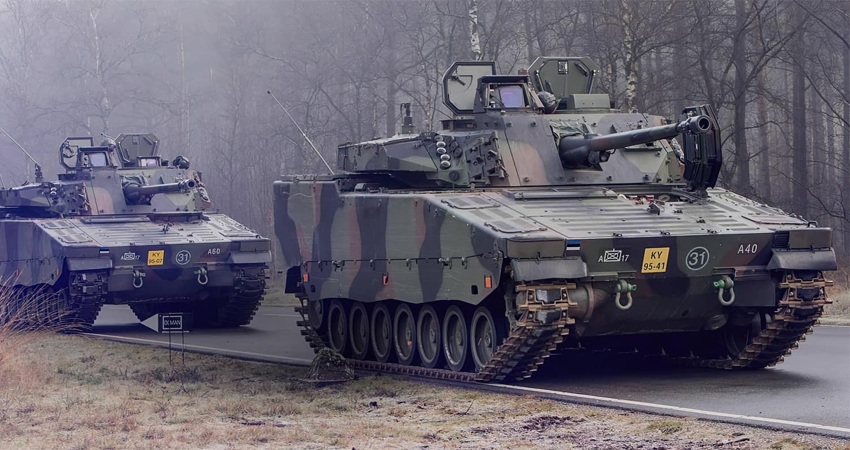
At the inner, mobile layer sits the CV9035 itself. Estonia operates 44 of these Dutch-sourced vehicles, armed primarily with the 35 mm Bushmaster III autocannon. Recent upgrades and integrations, notably with domestic Marduk Technologies’ Piraya passive drone detection and targeting system, have transformed them into potent C-UAS platforms. Piraya uses electro-optical sensors that emit no radar or radio signals, preserving the vehicle’s stealth in contested electromagnetic environments. Once a threat is identified – quadcopters, fixed-wing UAVs, or larger models – the system hands off precise targeting data directly to the turret’s fire-control system.
The CV90 engages primarily through direct kinetic fire from its 35 mm cannon. Programmable air-burst munitions (such as 3P or equivalent) allow shells to detonate near the target, creating a cloud of fragments ideal for shredding small, fragile airframes. In live-fire tests during Siil 2025 and related drills, CV9035 crews destroyed multiple quadcopters at ranges up to two kilometers and engaged larger fixed-wing surrogates with high precision, often requiring just one or two rounds per kill. The vehicle’s stabilized turret, advanced optics, and battle-management system enable rapid target handoff from networked sensors, allowing engagements while on the move or in concealed positions. This makes the CV90 particularly effective against Category 1 and 2 small drones (mini- and small UAVs under 25 kg, typical of tactical reconnaissance or FPV strike platforms) and extends to some Category 3 medium systems. It is less suited for very large, high-altitude, or heavily armored threats, which fall to missile layers.
The vehicle’s mobility is a key advantage. Unlike static emplacements, CV90s can reposition quickly after firing, complicating enemy targeting – a critical survivability feature given Ukraine’s experience with drones hunting air-defense assets. Upgrades to electronics, sensors, and fire-control systems, funded partly by service-life extensions, will further enhance this role. Estonia’s decision in 2026 to halt procurement of new CV90 MkIV vehicles and redirect roughly €500 million toward drones, C-UAS, and air defense underscores this prioritization. Existing hulls will be modernized and kept in service longer, focusing investment on capability over numbers.
This Estonian model – sensor fusion, passive detection, networked C2, and mobile gun platforms – offers a pragmatic, affordable blueprint for NATO allies facing similar hybrid threats. It balances high-tech innovation with legacy systems, maximizing the utility of platforms already in inventory.
A parallel development worth watching is the Czech Republic’s ambitious CV90 program. Prague signed a major contract in 2023 for 246 CV90 MkIV vehicles in multiple variants, including infantry fighting vehicles equipped with 30 mm. Deliveries are to begin this year, with local industry involvement in production and integration. While the initial focus is on ground combat capabilities – mobility, protection, and firepower – the MkIV’s open architecture, advanced sensors, and potential for weapon upgrades position it well for future C-UAS roles.
Czech Army has acknowledged the growing importance of Ground-Based Air Defense and mobile C-UAS, with market research underway for systems that could protect maneuvering units. The CV90 MkIV’s modular design supports integration of enhanced optics, battle-management systems, and even air-burst munitions or remote weapon stations optimized to combat drones. BAE Systems highlights the platform’s inherent anti-air potential, drawing from broader CV90 family experience with programmable ammunition and sensor networks.
Whether the Czech fleet will fully replicate Estonia’s integrated, CV90-centric C-UAS layer remains to be seen. It will depend on funding priorities, specific variant configurations (such as dedicated anti-air or C-UAS modifications), and the pace of sensor and effector integration. Czech industry is already active in counter-drone technologies, suggesting strong potential for domestic enhancements. If pursued, the program could yield a similar multi-role capability: robust ground support combined with mobile short-range air defense, contributing to a layered national system. Given shared NATO standards and regional threats, interoperability with Estonian and other Baltic setups is likely. Success will hinge on adapting the vehicles beyond baseline IFV roles toward the networked, drone-focused warfare that defines contemporary conflicts.
Estonia’s experience demonstrates that even modest fleets, when smartly upgraded and networked, can punch above their weight in counter-drone defense. For the Czech Republic, the ongoing CV90 project represents not just modernization but an opportunity to embed similar versatility from the outset. As drone threats evolve, the ability of these vehicles to detect, track, and destroy them with precision fire – within a cohesive layered framework – may well determine tactical superiority on future battlefields. Both nations illustrate a broader shift: armored vehicles are no longer just for closing with the enemy but for dominating the airspace immediately above and around friendly forces.