Eurofighter Quadriga Takes Flight: Europe’s Revitalized Typhoon Bridges to the Next Generation of Air Power
The Eurofighter EF2000 Quadriga, the latest Tranche 4 iteration of the iconic Typhoon, completed its maiden flight in mid-July 2026, marking a significant milestone for Germany’s Luftwaffe and the broader Eurofighter consortium. Built by Airbus in Manching, this advanced variant represents not just a refresh of an aging fleet but a strategic investment in maintaining European air superiority capabilities well into the 2060s. As tensions in Europe and beyond underscore the need for robust, interoperable combat aircraft, the Quadriga’s debut underscores the Typhoon’s transition from a Cold War-era concept to a mature, battle-proven platform ready for modern multi-domain operations.
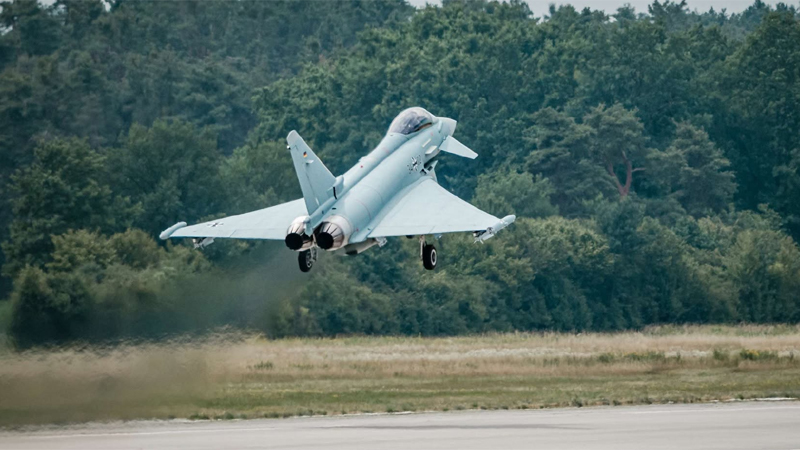
The history of the Eurofighter project
The history of the Eurofighter project stretches back to the turbulent 1980s, a period when European nations sought to assert technological independence from American suppliers while countering Soviet air threats. Initial collaborations among the UK, Germany, Italy, Spain, and briefly France aimed to develop a next-generation fighter under the Future European Fighter Aircraft program. France ultimately departed to pursue its own path with the Dassault Rafale, citing differences in design authority and requirements. The remaining partners pressed forward, drawing on the British Aerospace EAP demonstrator that flew in 1986.
The first Eurofighter prototype took to the skies on March 27, 1994, from Manching, Germany. Production contracts followed in 1998, with the aircraft entering service in 2003. Originally conceived primarily as an air-superiority fighter with exceptional agility, the Typhoon evolved rapidly into a true swing-role platform capable of seamless air-to-air and air-to-surface missions. Over two decades, it has accumulated more than a million flight hours across its operators, proving its worth in operations from Libya in 2011 to ongoing NATO air policing and Middle East deployments.
The Quadriga program
The Quadriga program, signed in late 2020, orders 38 new Tranche 4 aircraft – 30 single-seaters and eight twin-seaters – for the German Air Force to replace its earliest Tranche 1 jets. These new-build fighters incorporate substantial upgrades over earlier variants, most notably the integration of the ECRS Mk1 (or Captor-E) active electronically scanned array (AESA) radar developed by Hensoldt. This radar offers superior detection ranges, multi-target tracking, and electronic attack capabilities compared to the mechanically scanned Captor-M of prior Tranches. Enhanced avionics, improved electronic warfare suites, and better weapon integration further distinguish the Quadriga. It supports advanced munitions like the Meteor beyond-visual-range air-to-air missile, Taurus KEPD 350 cruise missiles for precision strikes, and a range of air-to-ground ordnance.
Additional features include refined sensor fusion, data links for networked operations, and provisions for future electronic warfare variants, such as the Typhoon EK for suppression of enemy air defenses. Performance remains class-leading: powered by two Eurojet EJ200 turbofans delivering up to 180 kN of thrust with afterburner, the aircraft achieves speeds exceeding Mach 2, a service ceiling above 55,000 feet, and outstanding maneuverability thanks to its canard-delta configuration and carefree handling via digital fly-by-wire controls. The airframe’s composite-heavy construction contributes to a planned service life exceeding 6,000 flying hours.
Germany is not alone in embracing Tranche 4. Spain’s Halcón program includes orders for additional Tranche 4 jets, while Italy has signaled interest in up to 24 more. These aircraft will serve alongside existing fleets in the core partner nations – Germany, the UK, Italy, and Spain – as well as export operators like Austria, Saudi Arabia, Oman, Kuwait, and Qatar. For the Luftwaffe, the Quadriga jets will form a cornerstone of its combat strength through the 2050s and likely into the 2060s, bridging the gap until the Franco-German-Spanish Future Combat Air System (FCAS) matures in the 2040s.
Deliveries are slated from late 2026 through 2030, with some aircraft configured for electronic warfare roles to eventually supplant the Panavia Tornado ECR. This extended service horizon reflects ongoing upgrade pathways, including software blocks that incrementally enhance capabilities without requiring full fleet replacements. The Typhoon’s modular design and consortium support ensure that partner air forces can sustain high operational availability while sharing costs and expertise.
Eurofighter Quadriga stands as a formidable 4.5-generation contender
In the broader landscape of contemporary fighters, the Eurofighter Quadriga stands as a formidable 4.5-generation contender, excelling in certain domains while facing trade-offs against stealth-focused peers. Compared to the Lockheed Martin F-22 Raptor, the Typhoon lacks the Raptor’s all-aspect stealth and supercruise efficiency but offers superior kinematic performance in visual-range dogfights, a larger external payload, and lower operating costs per flight hour in many scenarios. The F-22’s emphasis on air dominance through invisibility contrasts with the Typhoon’s emphasis on agility, sensor reach via AESA and PIRATE infrared search-and-track, and multi-role flexibility.
Against the F-35 Lightning II, the Quadriga trades some low-observability for higher speed, better thrust-to-weight ratio, and easier maintenance in forward bases. The F-35’s distributed sensor network and internal weapons bays provide advantages in contested environments, yet the Typhoon’s proven reliability, twin-engine redundancy, and Meteor missile integration give it strong beyond-visual-range lethality, often described as superior in “energy-maneuverability” fights.
The Dassault Rafale presents perhaps the closest peer comparison, sharing a European heritage and swing-role philosophy. Both aircraft deliver excellent agility and sensor suites, but the Rafale’s naval variant and somewhat more compact design offer flexibility the land-based Typhoon lacks. The Quadriga’s newer AESA radar and potential electronic attack enhancements may close any perceived gaps, while the Typhoon’s larger airframe supports greater fuel and weapons loads for long-range missions.
Saab’s Gripen E/F, a lighter 4.5-generation option, emphasizes affordability, rapid deployment, and advanced networking. While cheaper to operate and maintain, the Gripen yields in raw performance and payload to the heavier Typhoon, making the latter preferable for high-intensity, high-threat scenarios where brute power and presence matter. Overall, the Quadriga positions the Eurofighter as a high-end complement within mixed fleets – pairing effectively with stealth platforms like the F-35 for “first-day-of-war” penetration while handling sustained combat air patrols, strike, and suppression roles.
The Quadriga’s successful first flight arrives at a pivotal moment. With over 600 Typhoons delivered or on order globally, the program demonstrates the resilience of European industrial collaboration. Upgrades continue apace, including enhanced helmet-mounted displays, conformal fuel tanks in some configurations, and integration of hypersonic or directed-energy weapons on the horizon. For air forces operating the type, the variant ensures decades of relevance against evolving threats from peer adversaries. As Europe confronts renewed great-power competition, the EF2000 Quadriga embodies continuity and progress: a capable guardian of sovereign skies that honors the project’s ambitious origins while adapting to the demands of an uncertain future. Its legacy, already rich with operational success, now extends firmly toward mid-century air dominance.
This aircraft does not merely replace older airframes; it revitalizes a program that has consistently delivered on promises of performance, interoperability, and longevity. In an era where fighter development cycles span generations, the Typhoon’s ongoing evolution stands as a model of pragmatic modernization.