
Fire on Russian Icebreaker Admiral Makarov Raises Questions Over Repair Delays at Kronstadt
A fire broke out aboard the Russian diesel-electric icebreaker Admiral Makarov while the vessel was undergoing repairs at the Kronstadt Marine Plant, adding another complication to Russia’s efforts to maintain and return aging strategic support ships to service.
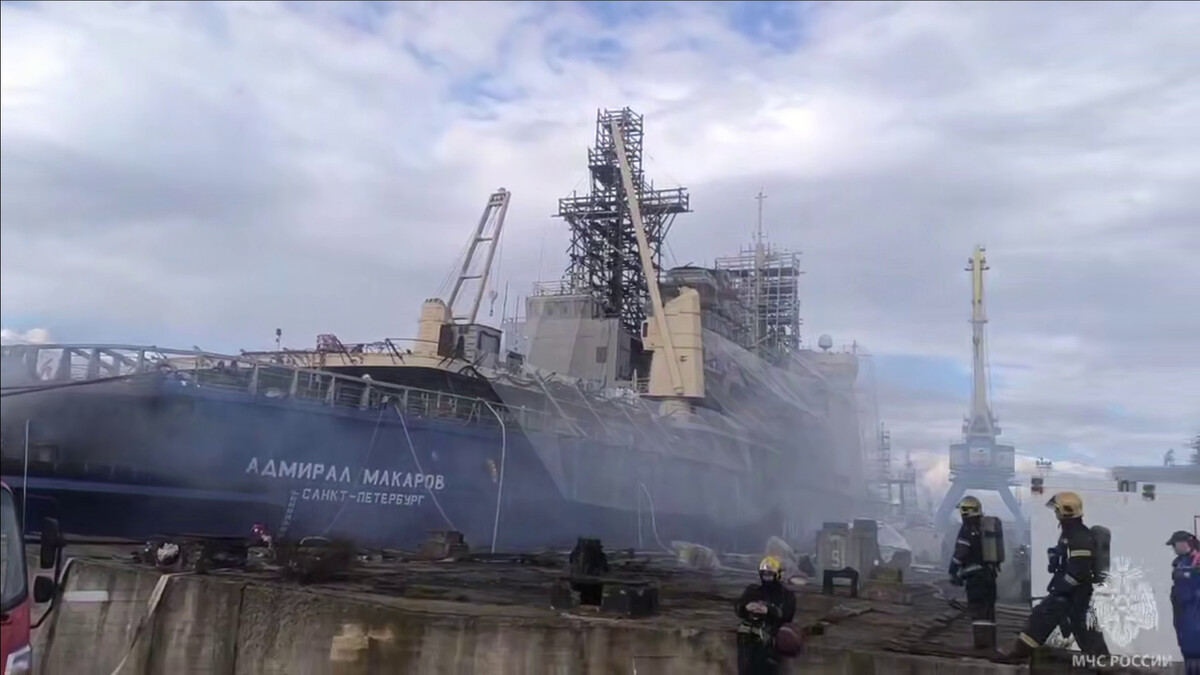
According to reports cited by Militarnyi, the blaze started in the vessel’s steering-gear compartment, an area that contains equipment linked to the rudder drive and ship maneuvering systems. Initial estimates placed the affected area at around 100 square meters.
Emergency services responded with 52 personnel and 10 units of equipment. Firefighters reportedly managed to localize the fire and extinguish open flames within approximately two hours. Preliminary information indicated that there were no casualties.
The full extent of the damage remains unclear. The cause of the fire has also not been officially confirmed.
A fire in a critical technical compartment
Although the Admiral Makarov was not at sea when the fire occurred, the location of the blaze is significant. The steering-gear compartment is a vital section of any large vessel, especially an icebreaker, which depends on precise maneuverability when escorting ships through heavy ice.
Damage in this area could potentially complicate the repair schedule, depending on whether the fire affected mechanical systems, electrical cabling, hydraulic equipment, control lines, or surrounding structural elements. Even a contained fire can create secondary problems from smoke, heat, firefighting water, and contamination in confined shipboard spaces.
For an older vessel already undergoing a major overhaul, this kind of incident may require additional inspection before repair work can continue.
Admiral Makarov: a Soviet-era Arctic workhorse
The Admiral Makarov is a large Project R-1039 diesel-electric icebreaker built in 1975 at the Wärtsilä shipyard in Helsinki, Finland. It belongs to the Ermak-class series of icebreakers constructed for the Soviet Union.
The vessel was designed to escort merchant and transport ships through difficult ice conditions, making it an important support asset for winter navigation and Arctic operations.
Key specifications include:
- Displacement: approximately 20,247 tonnes
- Length: 134.84 meters
- Beam: 26.05 meters
- Draft: up to 11 meters
- Maximum speed: around 19.5–20 knots
- Power plant output: approximately 30.5 MW
- Crew: 58
- Fuel endurance: up to three months
- Icebreaking capability: up to 1.5 meters of level ice at about 2 knots
For many years, the Admiral Makarov operated in Russia’s Far East before later being used in Arctic-related missions. In late 2025, it was transferred to the North-Western Basin Branch of Rosmorport, indicating plans to use the vessel in Russia’s northwestern maritime routes.
After repairs, the icebreaker was expected to support winter navigation to Russian ports in the eastern part of the Gulf of Finland.
Repairs already underway before the incident
The Admiral Makarov had already been undergoing significant repair work before the fire. In spring 2025, the ship was placed in dry dock for work on its hull, propellers, and three propeller shafts.
Separate repairs to the vessel’s main engines were also underway, with completion planned by the end of 2026.
The fire may now place additional pressure on that schedule. Older vessels often require extended repair periods because replacement parts, legacy systems, and shipyard capacity can all become limiting factors. For a vessel built nearly five decades ago, even a localized incident can lead to delays if inspections reveal damage beyond the original repair scope.
Why the incident matters
The Admiral Makarov is not a combat ship, but icebreakers play an important role in Russia’s maritime infrastructure. They support commercial shipping, port access, Arctic logistics, and state-controlled navigation routes in difficult winter conditions.
Russia’s icebreaker fleet is one of the key tools that allows it to maintain regular maritime activity in northern waters and ice-prone regions. Any damage to a large icebreaker reduces available capacity, especially during seasonal peaks when escort vessels are needed to keep shipping lanes open.
The incident is also notable because it occurred at Kronstadt, a strategically important maritime and naval location near St. Petersburg. Earlier in 2026, the same broader area drew attention after a separate fire aboard the Russian Project 20380 missile corvette Boikiy, which Militarnyi reported had been struck by Ukrainian drones at Kronstadt Naval Base.
There is no confirmed link between that earlier incident and the fire aboard the Admiral Makarov. However, the latest fire again highlights vulnerabilities around Russian ship repair and maintenance facilities.
Damage assessment still pending
At this stage, the most important unanswered questions are the cause of the fire and whether the vessel’s steering systems suffered serious damage.
If the fire was limited to surface materials or non-critical equipment, the impact may be manageable. If it damaged control systems, power cabling, hydraulic components, or structural sections, the icebreaker’s return to service could be delayed.
For now, Russian emergency crews have reported no casualties, and open flames were extinguished. The condition of the Admiral Makarov, however, will depend on detailed technical inspections at the Kronstadt Marine Plant.
The incident adds another setback to a ship already in the middle of a long repair cycle — and to a fleet where every operational icebreaker remains important for Russia’s northern and Baltic maritime plans.