
France Redirects Nuclear Carrier Charles de Gaulle to Eastern Mediterranean in Response to Regional Tensions
The deployment of the French nuclear-powered aircraft carrier Charles de Gaulle to the eastern Mediterranean, announced on March 1, 2026, marks a swift and decisive shift in France’s naval strategy amid escalating tensions in the Middle East. Having recently participated in high-profile exercises in the North Atlantic and Baltic Sea as part of Mission Lafayette 26 and the large-scale ORION 26 drills, the carrier and its strike group abruptly interrupted those northern commitments to head south. This redeployment follows an emergency meeting of France’s Defense and National Security Council, prompted by reports of drone attacks, including one on the Al-Salam naval base in Abu Dhabi that houses French personnel. President Emmanuel Macron emphasized France’s solidarity with affected partners and the urgent need to safeguard citizens while averting broader regional instability. The move aligns with coordinated warnings from France, Germany, and the United Kingdom about readiness to adopt defensive postures against further Iranian-linked threats.
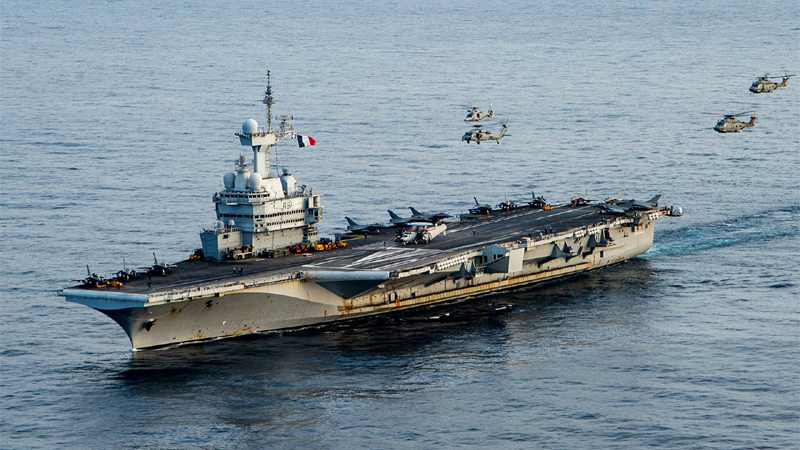
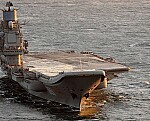
As Europe’s only nuclear-powered aircraft carrier, the Charles de Gaulle stands out for its exceptional endurance and versatility. Its two pressurized water reactors provide essentially unlimited range, allowing sustained operations far from home ports without frequent refueling stops. Measuring over 260 meters in length and capable of speeds exceeding 27 knots, the vessel employs a CATOBAR configuration with steam catapults, enabling it to launch heavily armed aircraft. The embarked air wing typically includes around 30 to 40 fixed-wing and rotary assets, prominently featuring Rafale M multirole fighters equipped for air superiority, precision strikes, reconnaissance, and electronic warfare roles.
Complementing these are E-2C Hawkeye aircraft for airborne early warning and control, alongside helicopters optimized for antisubmarine warfare, search and rescue, and utility support. This combination allows the carrier to generate significant daily sortie rates, project power over extensive maritime and coastal zones, and deliver layered intelligence, surveillance, and reconnaissance capabilities. Recent incidents, such as the detection and neutralization of a drone near the group in the Öresund Strait during its Baltic phase, have underscored the robustness of its defensive systems and the effectiveness of integrated countermeasures.
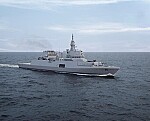
The carrier never sails in isolation; it forms the nucleus of a formidable Carrier Strike Group designed for comprehensive protection across multiple domains. The escort typically comprises advanced surface combatants drawn from France’s modern fleet, including FREMM-class frigates specialized in air defense with Aster missiles and sophisticated radar suites, as well as Horizon-class frigates providing additional layered anti-air coverage. Antisubmarine frigates equipped with torpedoes, sonars, and embarked helicopters guard against underwater threats, while a nuclear attack submarine often shadows the group for stealthy scouting, deterrence, and potential strike options.
Replenishment vessels, such as those from the Jacques Chevallier class, ensure sustained logistics by delivering fuel, munitions, and provisions at sea. In the context of the current redeployment from northern waters, the group likely retains much of its recent composition—potentially including vessels like the FREMM Alsace, Horizon Chevalier Paul, and support ships—though adjustments may occur to emphasize defenses against drone swarms, ballistic missiles, or asymmetric attacks prevalent in the eastern Mediterranean theater.
Beyond France’s unilateral action, the deployment carries broader implications for European and NATO contributions in the region. While the European Union lacks a unified military command structure for such rapid power projection, member states and NATO partners could amplify the effort through existing frameworks. Italy, with its strong Mediterranean presence, might offer frigates from the FREMM or Horizon classes, or even deploy its light carrier Cavour to support joint operations. Greece could provide frigates, submarines, and basing at Souda Bay, a critical hub for NATO activities in the eastern Mediterranean. Spain’s Aegis-equipped F-100 frigates bring ballistic missile defense expertise, while other allies like Portugal or the United Kingdom might contribute through Standing NATO Maritime Group patrols or indirect assets such as maritime patrol aircraft.
NATO’s ongoing Operation Sea Guardian maintains a persistent presence in the Mediterranean for maritime security, situational awareness, and deterrence, and exercises like Dynamic Manta 26—concluding around this period—have already involved multiple European nations in antisubmarine and interoperability drills. These elements could facilitate coordination, sharing of intelligence, and mutual support without necessitating a formal new coalition.
Strategically, the redeployment of the Charles de Gaulle signals France’s willingness to lead in protecting shared European interests, from securing vital sea lines of communication to defending personnel and allies in the Gulf. Positioned in the eastern Mediterranean, the Charles de Gaulle enhances deterrence against further escalations, offers rapid response options for contingencies such as evacuations or defensive intercepts, and reinforces NATO’s southern flank at a moment when U.S. carriers are also present in the area. It demonstrates Europe’s capacity for independent yet complementary action in a volatile environment, bridging national priorities with Alliance commitments. As France prepares for its future next-generation carrier, the current mission highlights the enduring value of this asset in projecting influence and stability far beyond European shores.