From Stealth to Statement: USS Alaska’s Visible Deployment in Gibraltar Underscores America’s Strategic Posture Against Tehran
In the early days of May 2026, as diplomatic exchanges between Washington and Tehran grew increasingly strained following President Donald Trump’s rejection of Iran’s latest ceasefire counterproposal, the U.S. Navy took an unusual step. The Pentagon publicly confirmed the arrival of a ballistic missile submarine in Gibraltar, a British territory at the gateway to the Mediterranean Sea. Local observers and media quickly identified the vessel as the USS Alaska (SSBN-732), one of the U.S. Navy’s most potent Ohio-class nuclear-armed submarines. This rare disclosure of a typically secretive asset’s location has been widely interpreted as a deliberate strategic signal in the context of ongoing tensions with Iran, particularly over nuclear enrichment, maritime security in the Strait of Hormuz, and broader regional stability.
The move comes at a sensitive juncture. With ceasefire talks faltering and concerns mounting over Iran’s nuclear ambitions and potential disruptions to global energy routes, the visible positioning of such a powerful platform serves multiple purposes: reassuring NATO allies, deterring escalation, and reminding adversaries of America’s unmatched undersea capabilities. Unlike routine submarine transits, which remain shrouded in secrecy to preserve stealth, this public acknowledgment marks a calculated departure from standard operational security, highlighting the gravity of the moment.
The USS Alaska belongs to the Ohio class, the backbone of the United States’ sea-based nuclear deterrent. Designed during the Cold War to replace aging Polaris and Poseidon submarines, the Ohio class represented a leap forward in strategic submarine technology. The first boat, USS Ohio (SSBN-726), was commissioned in 1981, with construction continuing through the 1990s. Eighteen submarines were ultimately built, though six planned hulls were canceled as the Cold War wound down. Of the 18 completed, 14 remain configured as ballistic missile submarines (SSBNs) dedicated to nuclear deterrence, while four were converted in the 2000s to guided-missile submarines (SSGNs) for conventional strike and special operations roles.
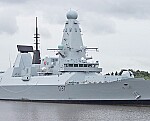
USS Alaska herself was ordered in 1978, laid down in 1983 at General Dynamics Electric Boat in Groton, Connecticut, launched in January 1985, and commissioned on January 25, 1986. Named for the 49th state, she is the fourth U.S. Navy vessel to bear the name. Initially homeported on the West Coast at Naval Submarine Base Bangor, Washington, she later shifted to Kings Bay, Georgia, on the East Coast. Over her four decades of service, Alaska has conducted numerous deterrent patrols, undergone major overhauls including a Trident II D5 backfit, and earned multiple awards for operational excellence, including several Battle “E” awards and the Strategic Command Omaha Trophy. She notably achieved milestones such as being the first ballistic missile submarine to win the Battenberg Cup as the best ship in the Atlantic Fleet.
Physically imposing, the Ohio-class submarines measure 560 feet in length with a beam of 42 feet and a submerged displacement of approximately 18,750 tons, making them the largest submarines ever fielded by the U.S. Navy. Powered by a single S8G pressurized-water nuclear reactor driving two geared turbines and a single shaft, they can exceed 25 knots submerged – though official figures are often lower for security reasons – and operate at test depths greater than 800 feet. Their endurance is limited only by food supplies and crew endurance, with two alternating “Blue” and “Gold” crews allowing extended patrols of around 70-90 days each. The design emphasizes extreme quieting, rendering them among the stealthiest vessels afloat, virtually undetectable at cruising speeds.
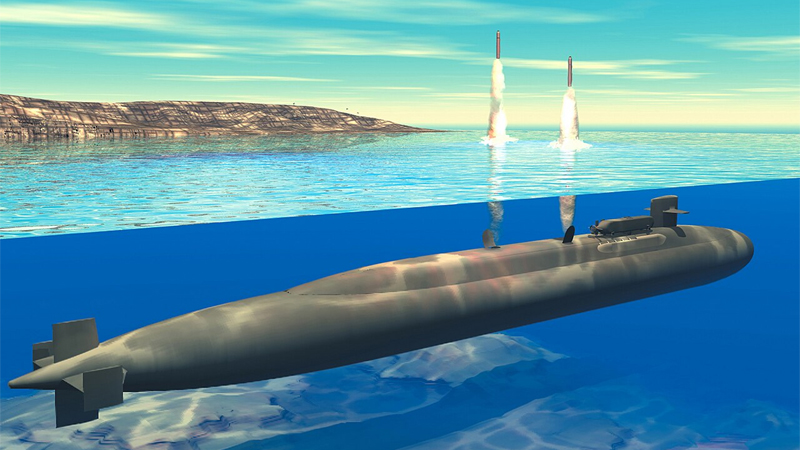
In their SSBN configuration, these boats carry formidable firepower. Originally designed for 24 Trident submarine-launched ballistic missiles (SLBMs), the number was reduced to 20 per boat under the New START treaty. USS Alaska deploys Trident II D5 missiles, each capable of delivering up to eight (though typically fewer under arms control limits) multiple independently targetable reentry vehicles (MIRVs) with W76 or higher-yield W88 warheads. These missiles boast ranges exceeding 4,000 nautical miles and exceptional accuracy, enabling strikes against hardened or distant targets from virtually any ocean. For self-defense, the submarines also mount four 21-inch torpedo tubes firing Mk-48 advanced capability torpedoes. Advanced sonar suites, including bow arrays, towed arrays, and sophisticated fire-control systems, enhance their situational awareness without compromising stealth.
The Ohio class emerged from the need for a survivable, second-strike nuclear capability during heightened superpower rivalry. Their introduction dramatically strengthened the U.S. nuclear triad – comprising land-based ICBMs, strategic bombers, and submarine-launched missiles – by providing a mobile, hard-to-detect platform that could remain on patrol for months. This ensured credible deterrence even in the face of a first strike. Post-Cold War, the class adapted to new realities, with the SSGN conversions adding massive conventional firepower through up to 154 Tomahawk cruise missiles, proving versatile in conflicts from the Global War on Terror onward. Alaska’s own history reflects this evolution, transitioning from Trident I C4 to the more capable D5 and supporting extended operations from both U.S. coasts.
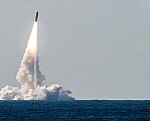
The public revelation of USS Alaska’s presence in Gibraltar carries layered strategic implications. Gibraltar sits at the western entrance to the Mediterranean, offering access to critical sea lanes and proximity to the Middle East. While the Navy described the visit as demonstrating “U.S. capability, flexibility, and continuing commitment to its NATO allies,” the timing – shortly after Trump’s dismissal of Iran’s proposals – suggests a broader message to Tehran. Ballistic missile submarines are the ultimate guarantors of deterrence, their positions usually unknown to maintain survivability. By allowing photographs, confirming the stop, and permitting local sightings under tight security (including exclusion zones), the U.S. signals readiness without immediate escalation.
This presence may serve several purposes. First, it acts as a visible deterrent, underscoring that any Iranian move toward nuclear breakout, closure of the Strait of Hormuz, or attacks on shipping could trigger overwhelming response. Trident missiles from a Mediterranean or nearby position could theoretically reach deep into potential conflict zones, though their primary role remains global strategic stability. Second, it reassures regional partners and NATO of American commitment amid fragile ceasefires. Third, it provides operational flexibility – perhaps en route to or from patrols, or positioned for rapid response – while showcasing logistical reach through allied ports.
Critics might argue such disclosures risk operational security, but in an era of satellite surveillance and persistent tensions, the calculated reveal amplifies psychological impact. Submarines like Alaska embody silent service traditions, yet their rare public moments speak volumes. As diplomatic efforts continue and military posturing persists, the USS Alaska’s transit through the Strait of Gibraltar reminds observers of the immense power lurking beneath the waves, a quiet yet unmistakable assertion of U.S. naval supremacy in an increasingly volatile world.
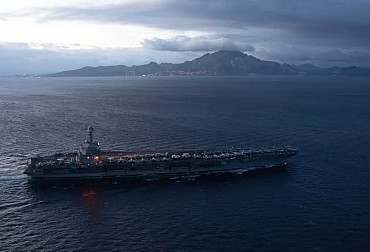
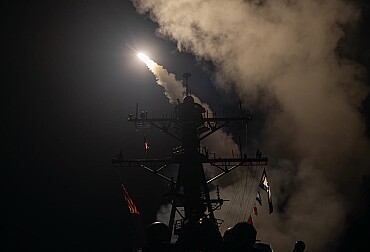
This deployment fits into a pattern of measured signaling. Earlier actions, including carrier strike group movements and other naval assets, complement the submarine’s role. For Iran, facing internal pressures and international scrutiny, the image of a nuclear-capable “boomer” at the Mediterranean’s edge likely reinforces the high costs of miscalculation. Whether the situation de-escalates or worsens, platforms like the Ohio class ensure the United States maintains options across the spectrum of conflict, from deterrence to decisive action.