
Future Power: China’s New Weapons at the 80th Anniversary Victory Parade over Japan
Tiananmen Square has recently been transformed into a showcase for Chinese military power. In honor of the 80th anniversary of Japan's defeat in World War II, the Chinese People's Liberation Army held the largest military parade of the last decade. It featured dozens of weapon systems—nearly fifty of which were introduced into service last year—with more to come this year or in the near future. Let's take a look at some interesting examples.
While in the past these events were mainly domestic demonstrations of loyalty, this year's parade had a distinctly international character. Russian President Vladimir Putin, North Korean leader Kim Jong-un, as well as representatives of the Shanghai Cooperation Organization (SCO) and several African countries sat in the VIP box.
The symbolism was clear—China sees itself as the leading force in the emerging multipolar world. China has made it clear that the modernization of its army is progressing not only in terms of quantity but also quality: the nuclear triad, hypersonic weapons, laser systems, and autonomous combat drones are no longer just prototypes but are now actually deployed components of the armed forces. While ten years ago China's main goal was to copy foreign technologies, the PLA has now presented a comprehensive weapons ecosystem.
The nuclear triad: from shadow to light
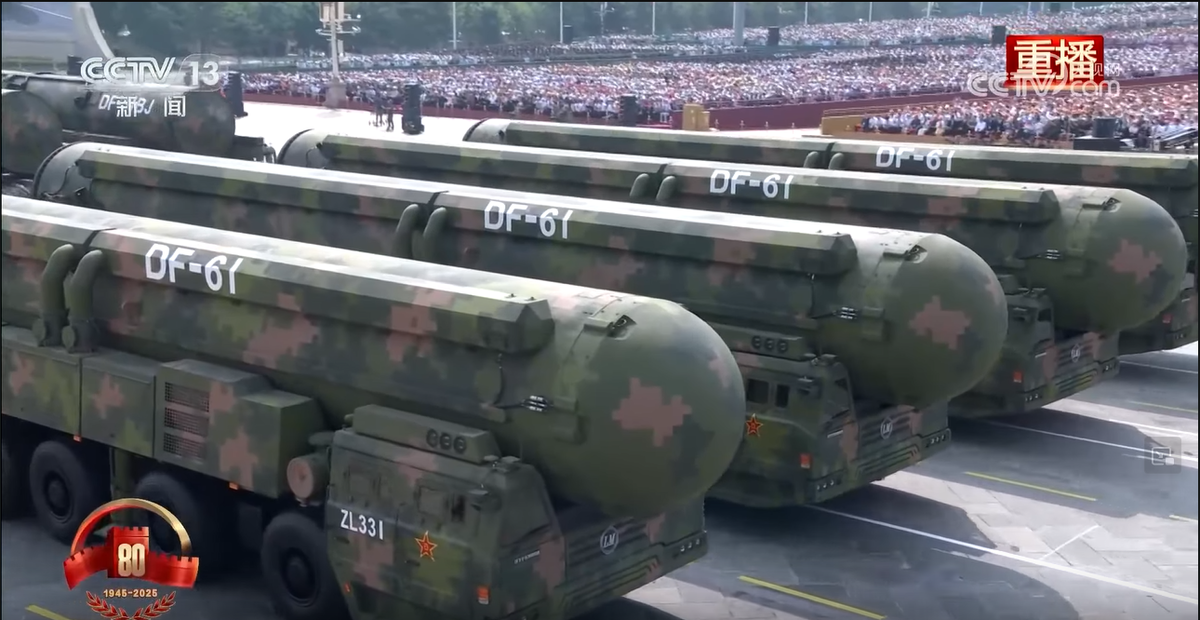
The star of the show was undoubtedly the "complete" nuclear triad, which China publicly displayed for the first time in history. This symbolically ended a long era of strategic "secrecy." China has doubled the size of its arsenal from 300 warheads in 2020 to an estimated 600 in 2025. The US Department of Defense estimates that there will be more than 1,000 by 2030.
In this situation, the DF-61 mobile ICBM is becoming the new backbone of China's land-based nuclear forces. Compared to previous versions, it carries more separable warheads and has an improved anti-aircraft defense system. It is important to mention the modernized DF-5C, a heavy intercontinental missile with a range of up to 20,000 km, which is a clear evidence of China's transition from a geographically minimalist to a robust nuclear deterrent.
The naval component was represented by the new JL-3 (Julang-3) submarine missile, designed for Type 096 submarines. According to American sources, its range exceeds 10,000 km, giving the Chinese navy the ability to strike distant targets from the safe waters of the South China Sea.
The air component was represented by a new carrier designated "Jinglei-1," probably designed for the modified H-6 bomber. This is the first official confirmation of the existence of China's airborne nuclear capability—the last missing link in the triad. With this step, China has de facto joined the ranks of countries that can implement full-fledged nuclear deterrence on all three levels – land, sea, and air.

Hypersonic and long-range strike
One of the most watched moments of the show was the unveiling of a new generation of Chinese hypersonic and supersonic weapons. The YJ-15, YJ-17, YJ-19, and YJ-20 families of anti-ship and multi-purpose missiles, referred to by Western observers as "carrier killers," made their first appearance. These missiles are capable of flying at speeds of over Mach 6–8 (potentially even more). China thus has a wide range of hypersonic and supersonic anti-ship missiles at its disposal.
The modernized version of the DF-26D has attracted particular attention. Compared to the older version, it has an improved targeting system that allows the flight path to be corrected until the final phase, making it extremely difficult for US missile defense systems to intercept.
It is precisely this combination of speed, accuracy, and the ability to change targets in flight that gives China the ability to paralyze high-value targets in the first minutes of a conflict. While American hypersonic projects are still in the testing phase, China is already presenting them operationally. This has a strong deterrent effect, especially on American naval forces in the Western Pacific.
A new dimension in defense
The second key area of the exhibition was weapons based on directed energy. The LY-1 laser platform, deployed in both land and sea variants, was presented to the public for the first time. According to Chinese sources, it is designed to neutralize low-flying drones and missiles.
Footage showed a vehicle on an 8×8 chassis with a turret-mounted laser module with a power output of approximately 60 to 100 kW, capable of destroying targets at a distance of several kilometers. In addition to the laser, China also unveiled a mobile HPM microwave system capable of taking out a swarm of drones with a single electromagnetic pulse. Together with kinetic systems, they form a key part of the defense of command posts and critical infrastructure.
Ground forces: automation on the front line
While rockets and drones attracted most of the media attention, the presentation of new ground systems was equally significant. At the show, the PLA Ground Forces presented themselves as a highly modernized component, moving away from cumbersome mechanization towards a networked and automated army. The main attraction was the new ZTZ-99B tank, upgraded with modern sensors, digital connectivity, and the GL-6 active protection system. Alongside it, the ZTZ-100, described as a 4th generation medium tank, was unveiled for the first time.
This machine, with its unmanned turret and modular design, represents a transition to lighter platforms. The ZTZ-100 is designed not only for direct combat, but also for coordination with unmanned vehicles and the ZBD-100 support vehicle. Compared to earlier designs, it relies more on information superiority and active protection than on massive armor.
Both types demonstrate that China is focusing on technological complexity and cooperation between machines controlled by artificial intelligence. In terms of mobility and survival in an environment saturated with drones, this is a fundamental shift in ground combat strategy.
The parade also featured a new generation of tracked "airborne combat vehicles." Specifically, it was an armored personnel carrier armed with a pair of ATGMs, supplemented by a machine gun, grenade launcher, and protected by an APS system. An infantry fighting vehicle with a likely unmanned turret armed with two types of guided missiles and a 30 mm autocannon was also presented. It is also protected by an APS system, and finally, a fire support vehicle in the form of a self-propelled mortar. It can be assumed that this trio will replace the established but outdated ZBD-3 in Chinese airborne units.
Air Force
The premiere of the J-35 stealth fighter, which is also to serve on Fujian-class aircraft carriers, attracted considerable attention. It is complemented by a new modernization of the Y-20B heavy transport aircraft with domestic WS-20 engines. The KJ-600 early warning aircraft also appeared in the sky. The UAV category at the show was represented by several different types of UCAV prototypes and "wingmen" under development, as well as the naval variant of the GJ-11.
In the field of air defense, the HQ-20 missile system, designed for medium-range and mobile defense of units in the field, made its debut. The HQ-9C, a modernized variant capable of destroying a wide range of air targets, was also publicly displayed. The parade also featured new AEW radars and sensors that improve data connectivity between fighter jets and ground systems.
More than ever before, this year's parade was a symbolic demonstration of strength and self-confidence – an act of demonstration that has primarily a psychological effect. According to comments in The Economist, it is a clear signal to strengthen the loyalty of the army and national pride and to challenge American dominance in the Asia-Pacific region.
The above list of specific weapon systems is a subjective selection by the author and does not cover the complete range of innovations presented at the military parade. The examples mentioned in the text are the result of an effort to highlight the most significant achievements of the Chinese arms industry.