
Inferno at Tuapse: Ukrainian Drones Smash Strategic Russian Energy Hub
Ukraine widened its pressure campaign against Russia’s energy infrastructure overnight, striking the Black Sea port of Tuapse in an attack that killed at least one person and triggered multiple fires at one of the country’s key export hubs.
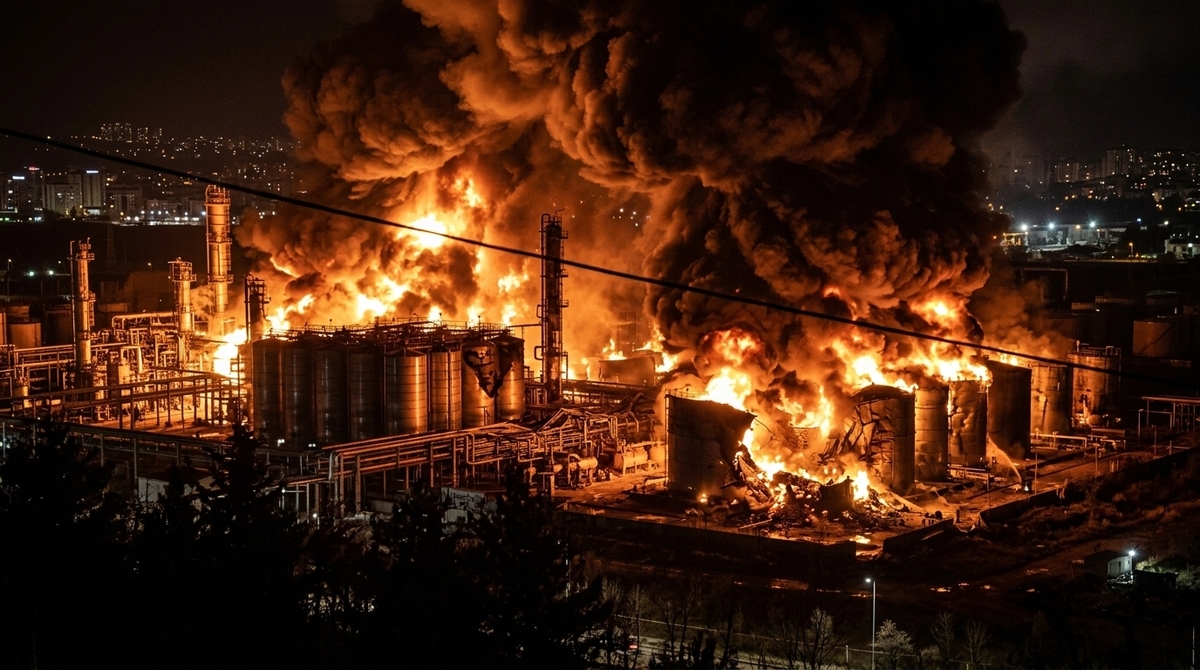
The assault hit the strategic port city early Monday and appeared to focus on the Rosneft-owned Tuapse refinery, a major processing and export site that had only recently recovered from another drone strike days earlier. Fires from the previous attack had just been extinguished when the new wave of strikes hit, underscoring both the persistence and the timing of Ukraine’s campaign.
Local officials said the attack damaged several parts of the port’s export terminal. Emergency teams were deployed across multiple locations as firefighters and rescue crews worked to contain the aftermath. Tuapse Mayor Sergei Boyko said the strikes affected several sites, while regional authorities confirmed that a gas pipeline, a church and two schools also suffered damage.
The human toll was immediate. Krasnodar region Governor Venyamin Kondratyev said one man was killed and another injured. The attack also sent thick smoke billowing over the area. Satellite imagery later showed a long plume of black smoke stretching dozens of kilometers east from Tuapse, a stark visual sign of the scale of the fires.
Videos circulating on Telegram channels, said to have been filmed by eyewitnesses, appeared to show oil storage tanks burning inside the terminal. The images added to concerns over the vulnerability of one of Russia’s most important oil export arteries on the Black Sea.
The Tuapse refinery holds strategic significance far beyond the local level. Owned by Rosneft, it processes around 12 million metric tons of oil each year and serves as a major outlet for Russian naphtha, diesel and fuel oil exports. Any sustained disruption there has the potential to affect both logistics and revenue flows tied to Russia’s energy trade.
The latest strike came less than a week after another Ukrainian attack on infrastructure in Tuapse, which Kyiv said also targeted two oil depots in annexed Crimea. Russian officials later said that earlier strike caused an oil spill in the Black Sea. Independent estimates placed the spill at roughly 7 square kilometers, raising fresh environmental concerns alongside the security and economic implications of repeated attacks on coastal energy facilities.
Moscow said its air defenses intercepted 112 Ukrainian drones overnight, including targets over the Black Sea and annexed Crimea. In a separate strike in Russia’s southwestern Kursk region, one person was also reported killed, illustrating the geographic breadth of the latest wave of attacks.
The operation fits into a broader Ukrainian strategy aimed at increasing the cost of war for the Kremlin by targeting energy infrastructure that helps sustain state revenues. With oil income remaining a critical pillar of Russia’s economy, such attacks are designed not only to create immediate disruption but also to erode the financial cushion that supports the war effort.
The political context has sharpened that strategy. President Volodymyr Zelensky on Sunday criticized the Trump administration’s decision to renew a temporary sanctions waiver on Russian oil, arguing that moves which ease pressure on Moscow risk blunting the impact of efforts to curb the Kremlin’s war financing. Against that backdrop, the strikes on Tuapse send a clear message: if financial restrictions weaken, Ukraine will continue seeking other ways to hit the infrastructure that powers Russia’s energy exports.
For Tuapse, the back-to-back attacks reveal a growing pattern. What was once primarily a logistical energy node is increasingly becoming a contested frontline target — one where military pressure, export capacity, environmental risk and civilian vulnerability now intersect in increasingly visible ways.