Lai Reveals $40B Defense Plan Aimed at Making Any Chinese Invasion “Prohibitively Costly” by 2027
November 26, 2025, marked a new milestone for Taiwan as its leaders formalized a strategy to field a fully operational military capability by 2027. This date has become a key benchmark for intelligence agencies and foreign ministries worldwide, crystallizing concerns over China’s intentions as its military rise reshapes the regional balance of power.
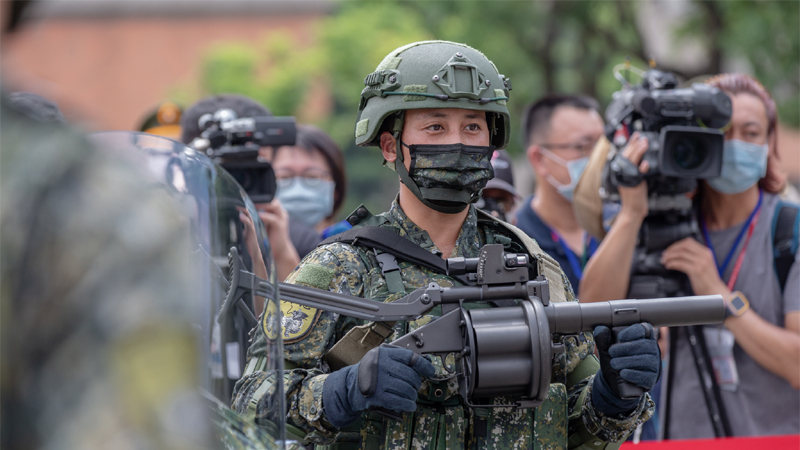
To meet this deadline, President Lai Ching-te unveiled an additional US$40 billion (€36.8 billion) defense spending plan spread over eight years. This supplement will come on top of the regular 2026 defense budget of NT$949.5 billion (€27.3 billion), equivalent to 3.32% of GDP — a level not reached since 2009. Presenting the program, Lai declared that “there is no room for compromise on national security.” The statement reflects Taiwan’s determination to dramatically raise the cost of any Chinese military intervention at a time when Beijing is intensifying its shows of force across the Taiwan Strait.
The new funds will finance critical systems: anti-aircraft missiles, reconnaissance drones, long-range precision weapons, and enhanced light naval forces. The goal is to implement an asymmetric defense strategy capable of delaying, disrupting, or deterring a numerically superior adversary. A flagship project is the T-Dome multi-layered air-defense system, which integrates radars, advanced sensors, interceptors, and automated command-and-control capabilities. T-Dome must be fully operational by 2027 to enable Taiwan’s military to counter the complex, coordinated air attacks China could launch in the opening hours of a conflict.
The 2027 deadline is no coincidence. It aligns with widespread analyst predictions that the People’s Liberation Army will achieve sufficient operational maturity that year to contemplate coercive action against Taiwan. Lai’s government has responded by stating: “We want to strengthen deterrence by adding greater costs and uncertainties to Beijing’s decision-making calculus.” The doctrine is explicit: make any attack so risky and costly that Beijing prefers diplomatic and economic pressure over military force. As Lai emphasized, “Taiwan cannot afford to be a breach in the first island chain’s regional security architecture.”
Over the past two years, Chinese incursions into Taiwan’s air defense identification zone have surged, while naval and air exercises around the island have demonstrated growing proficiency in combined operations. These maneuvers both probe Taiwan’s defenses and send political signals to Taipei. Meanwhile, China continues to modernize its amphibious forces, ballistic missiles, and air power, steadily increasing strategic pressure on the island.
The $40 billion plan still requires parliamentary approval. The opposition-controlled legislature is demanding greater transparency on fund allocation and long-term fiscal sustainability. Debates are expected to be fierce, given the tight timetable. The government, however, insists that any delay would jeopardize military preparedness and dangerously weaken Taiwan’s leverage against China.
Internationally, the announcement also signals Taiwan’s resolve to its strategic partners — chiefly the United States and Japan — that a more defensible Taiwan is essential to Indo-Pacific stability. By bolstering its posture, Taipei is sending Beijing a clear message: military action would be not only risky but potentially prohibitive in cost and outcome. Taiwan’s strategy rests on a straightforward principle: make deterrence so credible, visible, and robust that China never views force as a viable option.