MBDA’s Pod and the Race to Arm Fighters Against Drone Swarms
Germany has commissioned MBDA Deutschland to develop an airborne high-energy laser demonstrator, a so-called Laser-Pod whose key components must already be designed for actual flight. The contract, awarded by the Federal Office of Bundeswehr Equipment, Information Technology and In-Service Support (BAAINBw) and announced on 2 November 2026, aims to establish the technological foundations for future laser weapons on Luftwaffe combat aircraft. Primary targets are hostile drones and cruise missiles – precisely the threats that have multiplied in Ukraine and that consume scarce and expensive missiles when fighters try to intercept them with conventional weapons.
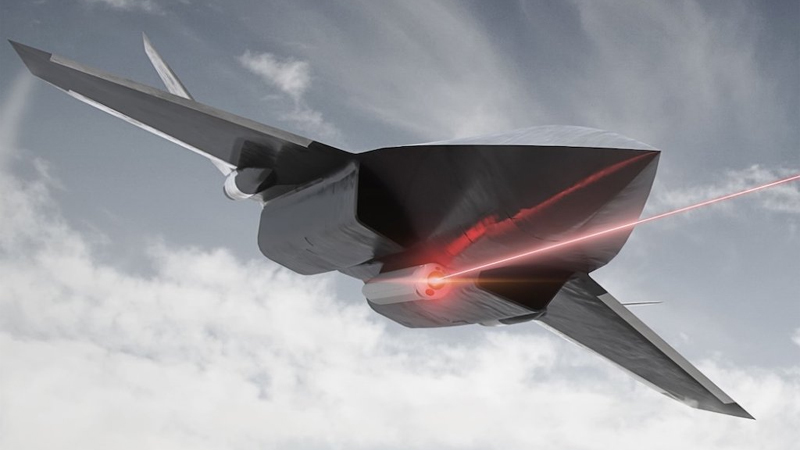
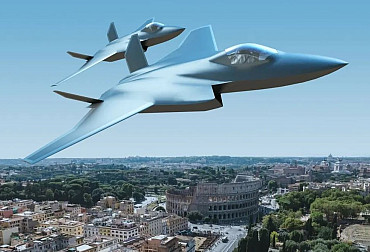
This is not a laser mounted on a small unmanned aerial system. The platform is intended to be manned combat aircraft, with concept imagery showing stealthy fighter-like shapes carrying the pod and engaging aerial targets. Secondary reports note that the same pod architecture could later migrate to unmanned combat aerial vehicles, but the immediate programme focuses on proving the physics and engineering of flight integration. MBDA has emphasised German supply chains and domestic know-how so that the eventual system remains free of US export controls.
Unofficial reporting linked to Die Welt describes a laser source of up to roughly 10 kilowatts housed in a pod comparable in size to a Taurus cruise missile. Flight trials are provisionally slated for around 2031 after roughly three years of development work, with operational capability possibly following in the early to mid-2030s. The company itself calls an airborne laser the “supreme discipline” of the technology because of extreme constraints on size, weight, power, cooling, vibration resistance and beam stability while the aircraft manoeuvres.
The effort builds directly on German naval laser work. MBDA and Rheinmetall, working as ARGE HEL, already tested a containerised high-energy laser aboard the frigate Sachsen for more than a year, logging over 1,000 successful shots against air, sea and land targets in adverse weather. That demonstrator operated at about 20 kilowatts and is now moving toward a full naval system expected to enter service around 2029. The airborne project extends the same core technology into an environment that is far less forgiving.
Airborne directed-energy weapons remain rare for good reason. The United States Air Force’s SHiELD (Self-protection High Energy Laser Demonstrator) programme, which involved Lockheed Martin, Boeing and Northrop Grumman and targeted a pod for fighters such as the F-15, advanced far enough to produce hardware and conduct ground testing against missiles. It was quietly shelved around 2024 without completing full flight trials, largely because of the same size, weight, power and thermal problems that MBDA now confronts.
Larger platforms have fared better: the US Air Force has pursued the Airborne High Energy Laser on the AC-130 gunship for air-to-ground effects, and the Missile Defense Agency has funded low-power laser demonstrators intended for UAVs in a missile-defence role. General Atomics has also explored high-energy laser concepts for the MQ-9 family. These efforts illustrate that power generation, thermal rejection and aero-optic beam control remain the decisive barriers; a fighter simply has far less spare electrical capacity and volume than a freighter or a warship.
Other nations are active but at earlier stages. Chinese aerospace institutes have displayed promotional material for fighter-mounted laser tracking and aiming systems claimed to weigh under 380 kilograms and deliver at least 100 kilowatts, though public evidence of flight testing is absent. India’s DRDO has issued tenders for laser enclosures, airborne battery systems and gimballed pods, signalling a deliberate push toward aircraft-mounted directed-energy subsystems without yet naming a host platform.
The United Kingdom’s DragonFire, in which MBDA is a lead partner, is a mature naval and land system already on a path to Royal Navy service, but it is not an airborne fighter weapon. Israeli Iron Beam technology is primarily ground- and ship-based; airborne variants have been discussed but remain less advanced than the German demonstrator contract. Historical programmes such as the American YAL-1, a chemical laser mounted on a Boeing 747 for ballistic-missile defence, showed that very large airframes can carry high-power lasers, yet they also highlighted the impracticality of such solutions for tactical fighters.
What distinguishes the MBDA effort is its deliberate sequencing and national control. Germany is leveraging a proven naval demonstrator, insisting on flight-qualified components from the outset, and keeping the technology sovereign. A 10-kilowatt-class airborne laser will not defeat hardened cruise missiles at long range, but it can offer an economical magazine against the small, fast, numerous drones that currently force fighters to expend costly missiles or gun ammunition.
In a contested European theatre where interceptor stocks can be exhausted in days, that cost-per-shot advantage becomes strategically significant. Success is far from guaranteed – atmospheric turbulence, vibration-induced beam jitter and the need for continuous high-precision tracking while manoeuvring have defeated earlier attempts – but the contract marks the first concrete European step toward putting a high-energy laser on a tactical combat aircraft rather than merely talking about it.
Whether the Laser-Pod ultimately flies on a Eurofighter, a future 6th generation platform or an unmanned wingman, the technical foundations now being laid will determine whether Europe can field its own airborne directed-energy capability or remains dependent on foreign systems. For now, the programme is modest in power and long in timeline, yet it addresses the hardest domain of laser weapons at precisely the moment when drone and cruise-missile threats are making that domain operationally relevant.