
Missile Truck of the Skies: the F-15EX is Bolstering U.S. Air Superiority Against Russian and Chinese Rivals
The United States Air Force is charting a significant shift in its tactical fighter modernization strategy with a dramatic expansion of its F-15EX Eagle II fleet. In its fiscal year 2027 budget request, the service revealed plans to procure a total of 267 of these advanced fourth-generation-plus fighters, more than doubling the previous target of around 129 aircraft. This move, which includes an initial request for 24 jets in FY2027 at an estimated cost of $3 billion, signals a renewed commitment to a proven airframe upgraded with cutting-edge systems. As global tensions rise with peer competitors, the F-15EX is positioned not merely as a replacement for aging F-15C/D models but as a key enabler for high-volume firepower in contested environments, complementing the stealth-focused F-35 fleet.
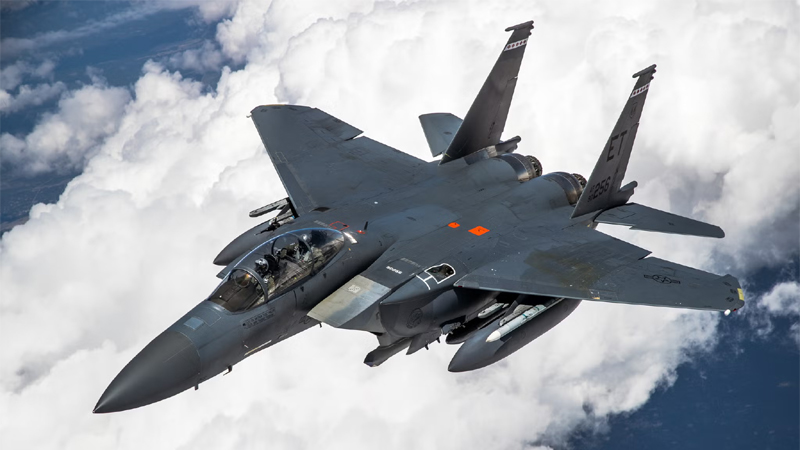
The decision comes at a pivotal moment. Many legacy Eagles are reaching the end of their structural lives, and the F-15E Strike Eagle fleet, which has shouldered much of the combat burden in recent decades, requires recapitalization. By scaling up the F-15EX buy, the Air Force aims to field roughly 13 squadrons while maintaining operational tempo during the transition to next-generation platforms. Boeing’s Eagle II builds directly on the successful F-15QA export variant developed for Qatar, incorporating digital fly-by-wire controls, a modern glass cockpit with large-area displays, and an open-mission systems architecture that allows for rapid software updates.
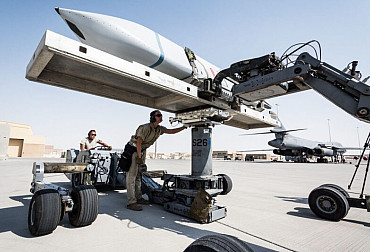
At the heart of the F-15EX’s capabilities is its unmatched payload capacity among U.S. fighters. The aircraft can haul up to 29,500 pounds of ordnance across 23 hardpoints, far exceeding most contemporaries. In an air superiority configuration, it routinely carries 12 air-to-air missiles – such as AIM-120D AMRAAMs for beyond-visual-range engagements and AIM-9X Sidewinders for close combat – while retaining the internal M61A1 20mm Vulcan cannon with 500 rounds. For strike missions, it serves as a formidable “missile truck,” capable of deploying standoff weapons like the AGM-158 JASSM cruise missile, Joint Direct Attack Munitions, Small Diameter Bombs, and even hypersonic options such as the AGM-183 Air-launched Rapid Response Weapon. This massive weapons loadout allows the F-15EX to saturate enemy defenses or provide overwhelming support to stealthier assets that penetrate deeper into hostile airspace.
Performance remains exceptional. Powered by two General Electric F110-GE-129 turbofans, each producing up to 29,500 pounds of thrust with afterburner, the Eagle II achieves a top speed of Mach 2.5 and a service ceiling of 60,000 feet. Its combat radius exceeds 680 nautical miles, extendable with conformal fuel tanks and aerial refueling, making it ideal for long-range patrols or rapid response across vast theaters like the Indo-Pacific. Advanced sensors enhance its lethality: the Raytheon AN/APG-82(V)1 active electronically scanned array (AESA) radar offers superior detection and tracking, while the BAE Systems Eagle Passive Active Warning Survivability System (EPAWSS) provides robust electronic warfare protection. Integration of an infrared search and track (IRST) pod further bolsters passive targeting in electromagnetically contested battlespaces.
These features make the F-15EX a highly survivable and flexible platform. Its digital backbone and high processing power – capable of billions of operations per second – enable seamless sensor fusion, allowing pilots (and in the two-seat configuration, weapon systems officers) to manage complex missions with reduced workload. High mission-capable rates inherited from the Eagle family, combined with lower operating costs relative to fifth-generation jets, position it as a cost-effective workhorse for both homeland defense and expeditionary operations.
To fully appreciate the F-15EX’s role, it is instructive to compare it with analogous platforms fielded by potential adversaries: Russia’s Sukhoi Su-35 Flanker-E and China’s Shenyang J-16, as well as the stealthier Chengdu J-20. These aircraft represent the pinnacle of non-U.S. fighter development and highlight differing design philosophies in the ongoing evolution of air combat.
The Su-35, an evolution of the Su-27 family, emphasizes supermaneuverability through thrust-vectoring engines. It boasts a high thrust-to-weight ratio, excellent agility in dogfights, and a powerful Irbis-E passive electronically scanned array radar with long detection ranges. Its combat radius approaches 1,000 nautical miles, and it can carry a respectable mix of R-77 and R-37M air-to-air missiles. However, the F-15EX holds advantages in raw speed (Mach 2.5 versus the Su-35’s roughly Mach 2.25), AESA radar technology for better resistance to jamming, and significantly greater weapons payload. While the Su-35 excels in within-visual-range turning fights thanks to its 3D thrust vectoring, the Eagle II’s superior avionics, electronic warfare suite, and ability to launch larger missile salvos could prove decisive in beyond-visual-range scenarios, where modern air combat is increasingly decided. Production challenges and sanctions have limited the Su-35’s numbers and upgrade potential, contrasting with the F-15EX’s mature industrial base.
China’s J-16, a two-seat multirole derivative of the J-11 (itself based on the Su-27), serves as the closest direct counterpart. With a large AESA radar, advanced composites, and powerful WS-10 engines, the J-16 offers impressive range – potentially exceeding 1,000 nautical miles – and can carry PL-15 long-range air-to-air missiles and a variety of precision-guided munitions. It benefits from extensive Chinese investment in electronic warfare and datalinking. In some metrics, such as radar aperture size and certain missile ranges, the J-16 may hold edges. Yet the F-15EX surpasses it in maximum speed, payload capacity (nearly double in some configurations), and integration of proven Western systems like EPAWSS, which provide comprehensive all-aspect protection. The J-16’s two-crew setup mirrors the F-15EX’s flexibility for complex strike coordination, but U.S. advantages in training, networking, and munitions quality often tip the scales in simulated engagements.
Against the fifth-generation J-20 Mighty Dragon, the comparison shifts toward stealth versus brute force. The J-20’s canard-delta design and radar-absorbent materials grant it a significant first-look, first-shot advantage in contested airspace. Its PL-15 missiles and potential for supercruise enhance its reach. However, the F-15EX is not intended as a direct one-on-one dogfighter against stealth platforms; instead, it operates in concert with them. In beyond-visual-range fights, the Eagle II’s massive missile load and advanced radar could force engagements on favorable terms, while its IRST and EW systems mitigate some stealth disadvantages.
The USAF’s expansion to 267 F-15EX aircraft underscores a pragmatic approach to airpower: leveraging mature, affordable platforms for mass and flexibility while fifth-generation and future collaborative combat aircraft mature. In an era of potential high-intensity conflict against numerically superior adversaries, the Eagle II’s ability to deliver overwhelming ordnance at range makes it an indispensable force multiplier. As deliveries continue and squadrons stand up, this revitalized fleet will help ensure American air dominance well into the coming decades, bridging today’s needs with tomorrow’s technological leaps.