
Night Hunt in Belgorod: Ukraine’s FPV Drones Find a Solntsepyok
Ukraine’s expanding drone campaign has crossed another symbolic threshold, according to a new battlefield report from the country’s 72nd Brigade. The Bulava Unmanned Systems Battalion says its operators carried out what it describes as the first FPV-drone strike on a Russian TOS-1A “Solntsepyok” heavy flamethrower system on Russian territory since the start of the full-scale war—an operation the unit says took place in Russia’s Belgorod region.
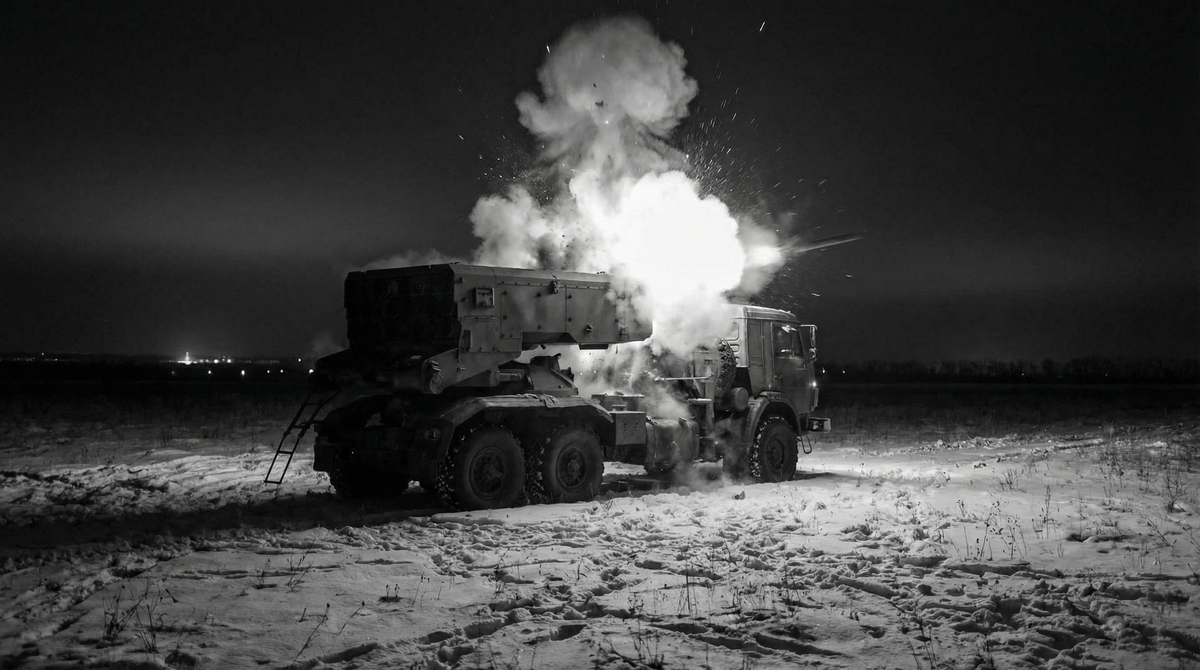
Footage released by the brigade on February 2 shows the engagement and the aftermath as presented by the unit. In its account, the strike began with nighttime aerial reconnaissance that detected the TOS-1A, enabling a targeted attack rather than a broad-area hunt. Two first-person-view (FPV) attack drones were then launched and successfully hit the system. The unit says follow-up reconnaissance in daylight confirmed damage to the vehicle, which it estimates to be worth more than $10 million.
If accurate, the claim matters for two reasons at once: it targets one of Russia’s most feared area-effect weapons, and it does so across the border—underscoring how Ukraine’s unmanned units are increasingly used to reach high-value systems beyond the immediate frontline.
Why the TOS-1A “Solntsepyok” is such a high-priority target
The TOS-1A occupies a unique place in Russia’s arsenal and in the psychology of ground combat. Mounted on a tank chassis, it launches thermobaric rockets—munitions designed to devastate personnel and positions over a wide area, particularly in trenches, bunkers, and built-up environments. Thermobaric effects are associated with intense blast pressure and heat, which is why the system is often described as both tactically destructive and psychologically intimidating.
Because of that combination—firepower plus fear factor—Ukrainian forces have treated the TOS-1A as a “drop everything” target whenever it appears within reach. It’s not just about destroying a single vehicle; it’s about removing a tool used to break defensive lines and suppress resistance.
A pattern: Drones hunting high-value systems
The Belgorod strike also fits a broader pattern of Ukrainian drone units increasingly taking on missions once associated with artillery, aviation, or special reconnaissance. In this case, the reported sequence—night detection, FPV engagement, then daylight confirmation—highlights a mature “find–fix–finish–verify” loop built around unmanned systems.
It’s also not the only recent reported success against this platform. Defense Express previously reported that Ukrainian drone operators from the 1st Battalion of the 59th Brigade struck a Russian TOS-1A, with footage published on January 29. Taken together, the reports suggest that Ukrainian FPV teams are not only reaching these systems but are increasingly prepared to engage them quickly when they appear.
What comes next
Even without independent verification of every detail, the significance of the claim is clear: Ukraine is emphasizing precision drone strikes against expensive, high-impact Russian systems—and signaling that geography is becoming less of a shield for such assets.
For Russian forces, that raises the cost of deploying rare, high-value launchers near border areas. For Ukraine, it reinforces the message that unmanned units can impose risk on platforms designed to dominate the ground fight.