
North Korea’s Irreversible Nuclear Doctrine: From Deterrence to Dominant Strategy in 2026
The North Korean nuclear program stands as one of the most defiant and strategically calculated challenges to the post-Cold War international order. Under Kim Jong-un, Pyongyang has transformed a once-clandestine effort into an openly embraced pillar of regime survival, national identity, and regional power projection. Far from a mere deterrent, North Korea’s arsenal serves multifaceted purposes: insurance against perceived existential threats, a bargaining chip, and a domestic legitimizer that frees resources.
Historical Evolution: From Survival to Supremacy
North Korea’s nuclear journey began in the 1950s–1960s with Soviet and Chinese assistance, initially framed as peaceful energy production. The Yongbyon reactor complex became the cornerstone, producing plutonium through reprocessing. By the 1990s, amid the collapse of Soviet support and the Agreed Framework’s breakdown, Pyongyang accelerated weaponization. The first nuclear test in 2006 (yield 0.7-2 kt) marked a turning point, followed by five more tests through 2017, with the last claimed (and unverified) as a thermonuclear device exceeding 100–250 kt.
Kim Jong-un’s ascension in 2011 injected urgency. The 2018–2019 summits with the US offered temporary diplomacy, but denuclearization talks collapsed. By 2021’s 8th Party Congress, Kim outlined a five-year plan for exponential nuclear expansion, including miniaturization for tactical use and diversification of delivery systems. Constitutional amendments in 2023 enshrined nuclear status as permanent. The March 23, 2026, speech to the Supreme People’s Assembly reiterated this: the nuclear arsenal is “absolutely irreversible,” rejecting any trade for sanctions relief or security guarantees. Kim argued that nuclear weapons had prevented war, enabling focus on economic growth, housing, and living standards.
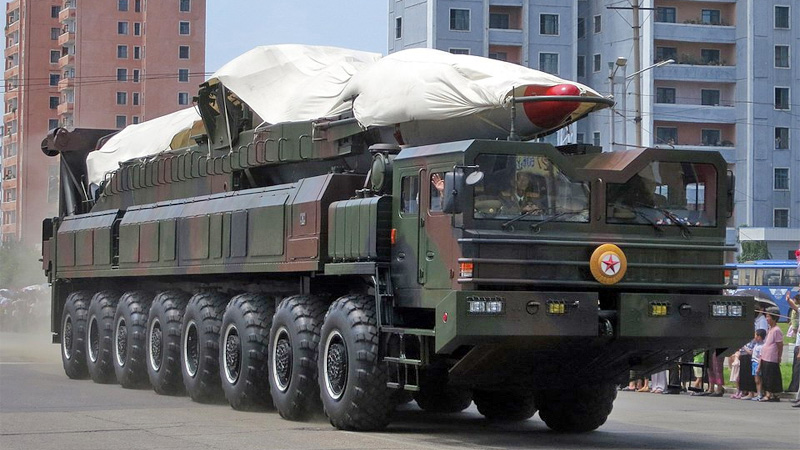
This evolution reflects a shift from defensive opacity to assertive transparency. Early ambiguity gave way to parades displaying warheads and missiles, signaling both capability and resolve.
Current Capacities: A Growing, Diversified Arsenal
Estimates of North Korea’s nuclear stockpile vary due to opacity, but consensus points to rapid growth. As of early 2026, the Federation of American Scientists (FAS) and SIPRI assess approximately 50 assembled warheads, with fissile material sufficient for up to 90. Claimed production capacity allows 6–7 new warheads annually, potentially accelerating via uranium enrichment at undisclosed sites and plutonium from Yongbyon. Some South Korean analyses suggest higher figures – up to 127–150 by mid-decade projections – factoring in unreported advances.
Warhead Design and Yield: North Korea has demonstrated miniaturization for missile delivery, including tactical variants. Displays include a 5 kt device suitable for short-range systems. Claims of “super-large” hydrogen bombs persist, though unverified beyond 2017. Warheads support both strategic (city-busting) and tactical (battlefield) roles, with improvements in reliability and yield-to-weight ratios.
Delivery Systems: The backbone is a ballistic missile force, emphasizing solid-fuel technology for survivability, rapid launch, and reduced warning time compared to liquid-fuel predecessors. The US Defense Intelligence Agency (DIA) estimates 10 or fewer operational Intercontinental Ballistic Missiles (ICBMs) currently, projecting up to 50 by 2035. Solid-fuel shift enhances pre-launch survivability.

- Intermediate- and Medium-Range Ballistic Missiles (IRBM/MRBM): Threaten US bases in Guam, Japan, and South Korea. Hwasong-12/16 variants, including hypersonic glide vehicle (HGV) tests. Ranges 3,000-5,500 km.
- Short-Range Ballistic Missiles (SRBMs) and Tactical Systems: Hundreds deployed, including solid-fueled KN-23 (Hwasong-11 series, range 400-800+ km), KN-24, and 600mm multiple rocket launchers (MLRS) with nuclear-capable Hwasan-31 warheads. These enable “warhead ambiguity” (conventional or nuclear), complicating enemy defenses. Low-altitude trajectories and maneuvers challenge missile shields.
- Other Platforms: Land-attack cruise missiles (LACMs, e.g., Hwasal series, range 1,500–2,000 km) launched from ground, ships, and potentially submarines. Submarine-launched ballistic missiles (SLBMs) in development, with new destroyers like Choe Hyon integrating tactical nuclear strike options. Underwater drones and hypersonic projects add layers. No confirmed nuclear-capable aircraft, but ambitions exist.
Command and control emphasizes centralized authority with Kim as sole decision-maker, bolstered by a 2022 Nuclear Force Policy Law allowing “immediate and automatic” retaliation if leadership or C2 is threatened. A “nuclear trigger” system (2023) automates responses in crises. Redundancy via mobile launchers and dispersal mitigates preemption risks.
Recent tests (dozens of SRBMs in 2025) focus on theater capabilities, with fewer ICBM flights, indicating maturation over demonstration.
Ambitions: Quantitative Expansion and Qualitative Leap
Kim’s vision is “limitless” expansion. The five-year defense plan (through 2026) targets annual warhead production increases, diversification of platforms (land, sea, air), and integration of tactical nukes for battlefield use against South Korean forces. Goals include MIRVs, improved reentry vehicles for accuracy, hypersonic glide vehicles to evade defenses, and solid-fuel universality for quick-reaction forces.
Longer-term: A nuclear triad (land, sea, air), super-large warheads, and AI-enhanced C2. Economic linkage is explicit – nuclear deterrence “guarantees” peace, allowing resource allocation to a new five-year economic plan emphasizing industry, energy, food, and housing. Defense budget (claimed at 15.8% of state spending in 2026, up 5.8%) funds this dual track.
Pyongyang seeks recognition as a legitimate nuclear state, rejecting denuclearization as “surrender of sovereignty.” Conditional dialogue with the US remains possible if Washington drops hostility and acknowledges nuclear status.
Strategy and Doctrine: Assumed, Irreversible, and Multi-Domain
North Korea’s doctrine blends deterrence, compellence, and warfighting. Officially “self-defensive nuclear deterrent,” it evolved via the 2022 law into a first-use posture under specific conditions: imminent nuclear attack, leadership/C2 threat, or even non-nuclear aggression endangering the state. Preemption is authorized if regime survival is at stake.
Key tenets:
- Existential Deterrence: Arsenal prevents US/ROK invasion or decapitation strikes, drawing lessons from Libya/Iraq (denuclearized states attacked) and Iran.
- Escalation Control: Tactical nukes enable asymmetric responses – limited nuclear use to halt conventional advances without full strategic exchange.
- Political Leverage: Tests and rhetoric coerce sanctions relief or negotiations on Pyongyang’s terms. Hardline stance toward South Korea (“most hostile state,” abandonment of reunification) frames inter-Korean relations as enemy-to-enemy.
- Economic Enablement: Nuclear “peace” dividend funds development, per Kim’s narrative.
- Irreversibility: Constitutional embedding, sustained production, and public doctrine make rollback politically impossible domestically.
Strategy integrates conventional asymmetry (artillery, special forces, EW/GPS jamming) with nuclear options. In crisis, “automatic” retaliation plans reduce decision time, raising escalation risks. Relations with Russia/China provide diplomatic cover and potential tech/material support, evident in parades and summits.
Critics note vulnerabilities: limited fissile material, unproven full-range ICBM accuracy/reentry, and reliance on road-mobile systems detectable by satellites. Yet survivability via mobility, tunnels, and deception counters this. International sanctions have slowed but not halted progress, with cyber and procurement networks sustaining the program.
Implications and Outlook
North Korea’s nuclear posture heightens Northeast Asian instability, complicating US extended deterrence, allied missile defenses, and non-proliferation norms. It emboldens proliferation risks elsewhere and tests great-power coordination. For Pyongyang, success lies in permanence: a nuclear-armed state pursuing parallel military-economic strength without concessions.
As of March 2026, with Kim’s latest declarations and ongoing production, the program appears on track for further growth – potentially 100+ warheads by decade’s end. Diplomacy without accepting nuclear reality risks irrelevance; containment demands enhanced regional alliances, intelligence, and credible conventional/nuclear responses. The doctrine is not bluff – it is a calculated, irreversible bet on survival through strength.