PANG Carrier: France Builds Europe’s Largest Warship to Secure Strategic Autonomy
France is advancing its most ambitious naval project in decades: the Porte-Avions de Nouvelle Génération (PANG), a next-generation nuclear-powered aircraft carrier set to replace the aging Charles de Gaulle. Approved for realization in late 2025 by President Emmanuel Macron, the program reflects France’s commitment to maintaining strategic autonomy and blue-water power projection amid rising global uncertainties.
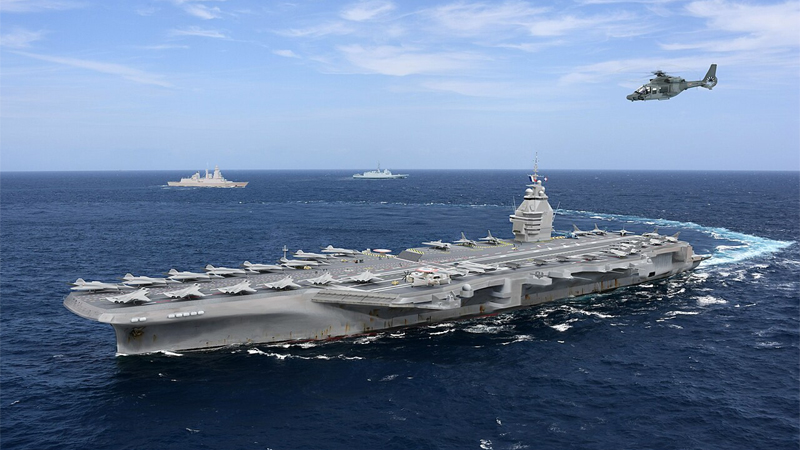
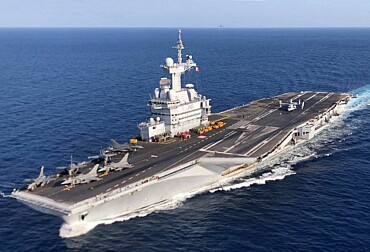
The PANG represents a major leap in scale and technology. With an estimated displacement of around 78,000 tons (full load figures vary slightly between 75,000–80,000 tons across sources), the ship will measure approximately 310 meters in length and feature a beam of about 85–90 meters. This makes it nearly double the size of the Charles de Gaulle (42,000 tons displacement, 261 meters long). Nuclear propulsion, powered by two advanced K22 pressurized water reactors (each around 220 MW), will deliver virtually unlimited range and high endurance, a capability shared only by the United States and France among current operators.
Expected capabilities emphasize enhanced operational flexibility and integration of future technologies. The carrier is designed to embark around 30–40 aircraft, including up to 30 next-generation fighters (such as naval variants of the Future Combat Air System/FCAS program), Rafale M fighters (at F5 standard initially), E-2D Hawkeye airborne early warning aircraft, helicopters (NH90 or H160M), and unmanned combat aerial vehicles (UCAVs) or drones. It will incorporate advanced features like electromagnetic aircraft launch systems (EMALS) – adapted from U.S. technology – for efficient launches of heavier aircraft, optimized deck layout for simultaneous operations, and adaptability for AI-driven systems, advanced digital networks, and emerging weapons. This will enable higher sortie rates, greater payload capacity, and more resilient power projection compared to the current carrier’s steam catapults.
The construction timeline follows a phased approach. Preliminary design work concluded around 2025–2026, with major contracts and production phase launch in 2025–2026. Hull construction is expected to start around 2031, sea trials in the mid-2030s (around 2035), and full operational entry into service targeted for 2038 – aligning with the Charles de Gaulle’s retirement after over 35 years of service. This roughly 12–15-year build period accounts for the program’s complexity, though hypothetical delays could arise from supply chain issues, technological integration, or budgetary constraints, potentially pushing service entry into the early 2040s.
Cost estimates for the PANG hover around €10.25 billion (approximately $12 billion), as cited in recent budgetary documents and official announcements, though according to the documents accompanying the 2026 budget bill at least €12.2 billion excluding aircraft, escorts, and infrastructure – pushing the full system cost higher. Financing is spread across multiple years to ease pressure on public finances. The program involves nearly 800 companies, mostly SMEs, supporting thousands of jobs (up to 14,000 at peak) and boosting domestic industry in regions like Pays de la Loire, Brittany, and Provence-Alpes-Côte d’Azur.
Compared to the Charles de Gaulle, the PANG offers dramatically superior capabilities at a significantly higher price. The current carrier, commissioned in 2001 after a costly build (originally around €3 billion, equivalent to roughly €4–6 billion today adjusted for inflation and overruns), supports a typical air wing of about 26–30 aircraft with limited sortie generation due to its smaller size. The PANG’s larger displacement, EMALS catapults, and modern design enable greater aircraft numbers, faster operations, and better integration of 6th-generation assets – making it a true generational upgrade for sustained high-intensity missions.
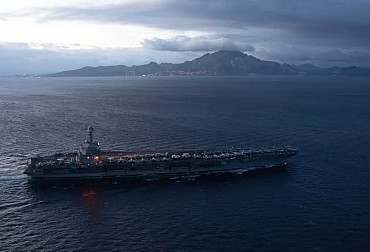
Unlike American nuclear-powered aircraft carriers, the PANG is more modest in both size and capabilities. American Gerald R. Ford-class supercarriers have a displacement of over 100,000 tons, carry more than 75 aircraft, and each costs around $13 billion (with the first ship experiencing budget overruns and delays due to new technologies, such as the EMALS system). Older Nimitz-class ships cost about $4.5–11 billion when adjusted for inflation. Although the PANG’s price is comparable to that of a single Ford-class unit (despite being smaller), it offers far fewer aircraft and overall lower capacity—but it has a smaller displacement and is tailored to France’s needs for independent operations rather than global dominance. This positions the PANG as the largest warship in Europe, a symbol of sovereignty, while the U.S. fleet emphasizes scale and numbers (a total of 11 aircraft carriers). The PANG underscores France’s resolve to project power autonomously into the 2060s–2080s, even as most European navies lack comparable assets.