Russia Sends Rare Mi-35P Phoenix Helicopters to Guinea – But How Many Can It Really Spare
Russia has delivered at least two Mi-35P Phoenix attack helicopters to Guinea, according to photos circulating online, marking what appears to be the first known transfer of this rare variant to the West African country. The move is notable not only because of the helicopter itself, but because it opens a bigger question: how many Mi-35P Phoenix helicopters does Russia actually have available for export?
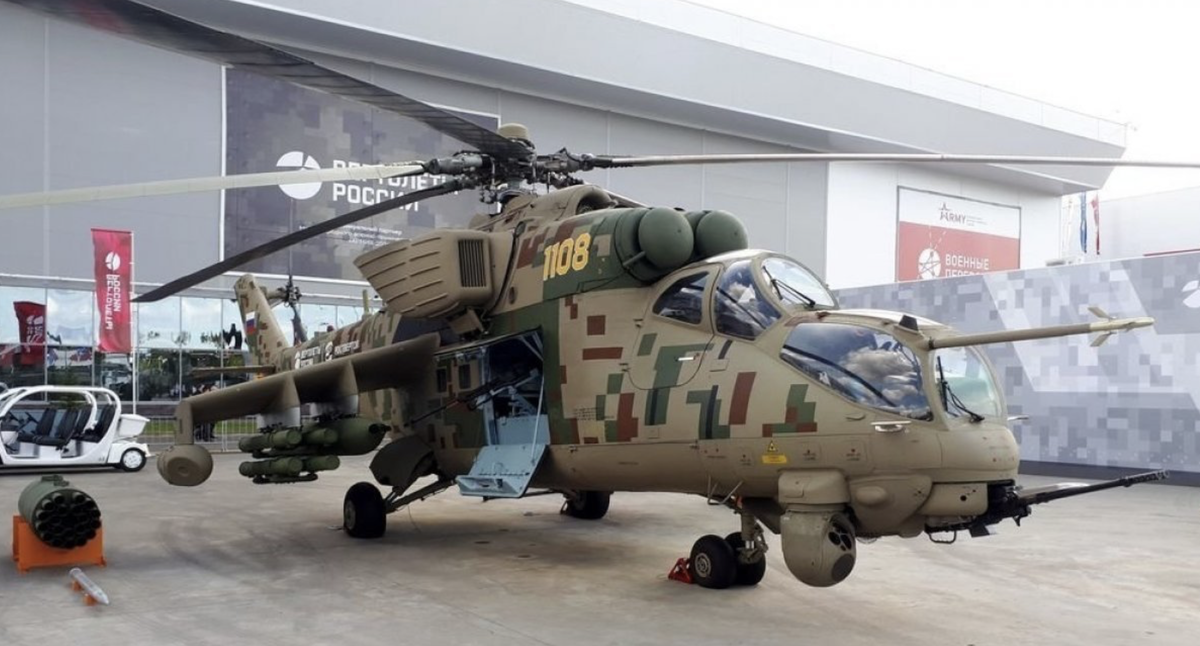
That question matters because the Mi-35P Phoenix is not an old surplus platform pulled from deep storage. It is a relatively recent variant, with production beginning only in 2020. While Russia is known to operate more than fifty Mi-35 helicopters across all versions, there is no clear public number showing how many of those are specifically Mi-35P Phoenix aircraft. In other words, even a delivery of two helicopters may represent a meaningful allocation rather than a routine export shipment.

The Mi-35P Phoenix stands out as one of the more distinctive descendants of the famous Mi-24 family. First publicly presented during the Armiya-2018 exhibition, the variant combines familiar Hind-series firepower with a set of upgrades that make it more flexible and more modern in operational use. Compared with the baseline Mi-35, the Phoenix features retractable landing gear and six hardpoints instead of four, giving it greater payload flexibility and a more aggressive configuration for strike missions.
Its weapon package is equally significant. The helicopter is armed with a twin 23-mm nose-mounted cannon on a movable turret and can carry Vikhr and Ataka guided anti-tank missiles. It can also be equipped with Igla missiles in an air-to-air role, expanding its usefulness beyond ground attack. On the sensor side, the helicopter uses the OPS-24N-1L observation and sighting system, which includes thermal imaging and television cameras, improving target detection and engagement in day and night conditions.
For Guinea, the arrival of such helicopters is hard to ignore. The country’s armed forces are relatively modest in scale, with around 9,700 personnel, 15 PT-76 tanks, as many as 230 armored vehicles, and more than 50 artillery systems, including BM-21 Grad and BM-27 Uragan launchers. Its air force is even more limited. Officially, Guinea operates two MiG-21 fighters and four Mi-24 helicopters, but these are listed in storage, which points to a serious shortage of combat-ready air assets. In that context, the delivery of even one or two modern attack helicopters could significantly improve Guinea’s immediate airpower on paper.
At the same time, the circumstances of the transfer suggest that the helicopters may not be intended purely as a conventional strengthening of Guinea’s national forces. Around 200 Russian military personnel are currently present in Guinea under the stated mission of combating terrorism. That raises the possibility that the Mi-35P Phoenix helicopters were supplied primarily to support the Russian contingent, even if the aircraft visible in imagery carries Guinean Air Force markings. If so, the transfer would fit a familiar pattern in which military aid also serves as a mechanism for extending Russian operational reach and political influence.
That is where the broader geopolitical meaning becomes clearer. Supplying rare, modern helicopters to an African partner sends a signal that Moscow still intends to preserve and expand its security ties on the continent, even while under pressure elsewhere. Yet the scale of the delivery may be just as revealing as the delivery itself. If Russia truly had large numbers of Mi-35P Phoenix helicopters available, larger and more structured export deals might be expected. Instead, what is visible here looks more like a limited, carefully measured shipment.
This points to a possible shift in how the Kremlin sustains its defense relationships in Africa. Rather than major transfers of large equipment batches, Russia may increasingly be relying on smaller, symbolic, and highly targeted deliveries. These shipments can still create political leverage, generate headlines, and strengthen local dependence, even if they involve only one or two advanced systems. A similar pattern was seen in April 2026, when Russia transferred two BMP-3 infantry fighting vehicles to Madagascar.
Seen in that light, the Guinea helicopter delivery is about more than hardware. It suggests that Russia is trying to maintain influence in Africa with smaller but more strategic gestures, balancing its external ambitions against the demands placed on its own military resources. The Mi-35P Phoenix is a rare and capable helicopter, but in this case its rarity may be the most important part of the story. Sending even a couple of them to Guinea implies that Moscow still sees African partnerships as worth investing in, while also hinting that it may no longer be able—or willing—to provide such support in larger numbers.