SpaceX Enters the Pentagon’s High-Stakes Race for Voice-Controlled Drone Swarms
In a significant escalation of private-sector involvement in advanced military AI, Elon Musk’s SpaceX, leveraging its recently integrated xAI subsidiary, has joined a secretive Pentagon competition to pioneer voice-activated autonomous drone swarming technology. Revealed by Bloomberg on February 16, 2026, this development marks a pivotal moment in the U.S. Department of Defense’s push to accelerate AI integration into operational systems, particularly amid evolving global threats and lessons from ongoing conflicts.
The Pentagon’s Ambitious Challenge
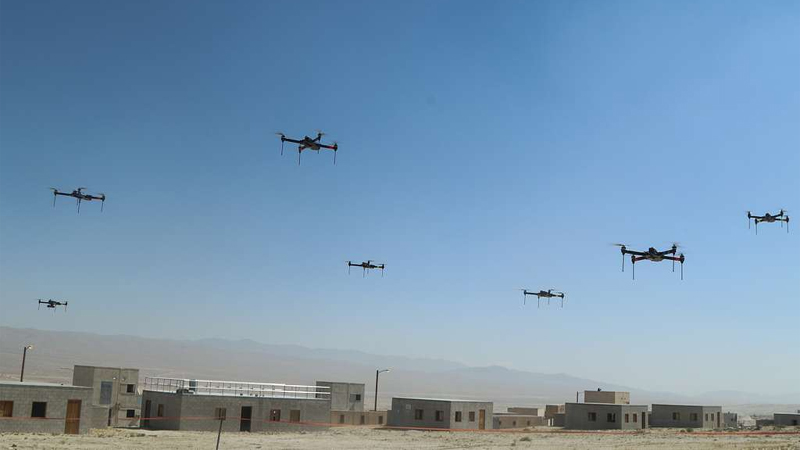
Launched in January 2026 by the Defense Innovation Unit (DIU) in collaboration with entities like the Defense Autonomous Warfare Group under U.S. Special Operations Command, the program is structured as a rapid, six-month prize challenge with up to $100 million in total awards (approximately €92 million). The core objective is to develop an “orchestrator” software layer that translates natural voice commands – such as “Secure the eastern perimeter with reconnaissance drones” or “Redirect all units to suppress target coordinates” – into precise digital instructions for coordinating swarms of unmanned aerial, ground, and maritime vehicles.
This goes far beyond basic remote piloting. The system must enable a single operator, potentially without specialized training, to direct large formations of autonomous drones in real time. Swarms offer inherent advantages: redundancy against losses, saturation of enemy defenses, distributed sensing, and adaptive decision-making in dynamic environments. Drawing inspiration from real-world applications seen in recent asymmetric warfare, the Pentagon seeks to reduce human cognitive load while enhancing lethality and responsiveness.

The competition’s timeline underscores urgency – selected participants must commence initial testing within days of notification, progressing through increasingly complex sprints involving simulations and potentially live demonstrations. Details remain classified, reflecting the program’s sensitive nature and potential implications for autonomous weapons systems.
SpaceX and xAI’s Strategic Entry
SpaceX’s participation, confirmed through anonymous sources cited in Bloomberg and Reuters reporting, represents a notable diversification for the company. Historically renowned for reusable rockets, Starlink satellite networks, and crewed spaceflight, SpaceX has steadily expanded into defense applications. It already holds major contracts for satellite launches and secure communications with the U.S. military. The addition of drone swarm orchestration aligns seamlessly with its expertise in propulsion, embedded software, secure data links, and real-time systems engineering developed for orbital and interplanetary missions.
Central to this bid is xAI, Musk’s AI venture, which SpaceX recently acquired in a merger announced in early February 2026 – conveniently ahead of SpaceX’s anticipated initial public offering later in the year. xAI brings advanced natural language processing (NLP), robust voice recognition, and multi-agent coordination capabilities, powered by models like Grok. This integration allows SpaceX to field a unified ecosystem where xAI’s AI handles command interpretation and swarm intelligence, while SpaceX contributes hardware-software interfaces and operational resilience.
The move is not isolated. xAI has previously secured significant Pentagon contracts, including a reported $200 million deal for integrating Grok into military systems and additional agreements for AI scaling across defense programs. Other AI leaders – OpenAI, Alphabet (Google), and Anthropic – have similarly won contracts worth up to $200 million each in related AI efforts, signaling a broader Silicon Valley-DoD convergence.

Technological Hurdles and Broader Implications
Achieving reliable voice-to-swarm control demands breakthroughs in several domains:
- Robust speech recognition in noisy battlefield conditions, with accents, jargon, and stress-induced variations.
- Advanced NLP to parse ambiguous or tactical commands while inferring context.
- Multi-agent AI coordination ensuring drones interpret orders collectively, adapt to losses or environmental changes, and avoid fratricide.
- Low-latency, secure integration across heterogeneous platforms.
Challenges include mitigating AI “hallucinations” in high-stakes scenarios, ensuring ethical human oversight, and addressing concerns over autonomous lethality – issues Musk himself has historically flagged in public statements about AI risks.
Success could redefine modern warfare, enabling faster decision cycles and overwhelming adversaries through coordinated autonomy. For SpaceX, winning would solidify its role as a strategic defense supplier beyond space, potentially unlocking billions in follow-on contracts and enhancing its valuation ahead of IPO.
Competitive Landscape
SpaceX and xAI are among a select few participants – exact numbers undisclosed but described as limited. Other reported contenders include teams partnering with OpenAI (via Applied Intuition, Sierra Nevada Corporation, and Noda AI) and possibly Alphabet or Anthropic-linked groups. This closed competition highlights the Pentagon’s preference for agile, innovative players over traditional defense primes in certain software-centric domains.
The Pentagon’s voice-controlled drone swarm initiative, with SpaceX and xAI at the forefront, exemplifies the accelerating fusion of commercial AI prowess and national security imperatives. As the six-month sprint unfolds through mid-2026, the outcome could shape not only U.S. military capabilities but also the trajectory of autonomous systems globally. Whether viewed as a necessary evolution or a concerning escalation, this program underscores that the future of warfare is increasingly spoken in natural language – powered by algorithms, not just pilots.