The Battlefield Energy Revolution: Challenges and Solutions for Powering the Modern Soldier
Today, soldiers carry not only ammunition, water, and food, but also an increasingly extensive array of electronic equipment – ranging from radios, thermal imaging devices, and night vision goggles to navigation systems, tablets, and drone control systems. Adequate power supply has become a critical factor in the overall logistics, mobility, concealment, and combat effectiveness of the deployed soldier. The war in Ukraine has shown that silent hybrid microgrids and strict energy discipline are essential for the effective operation of a soldier’s equipment.
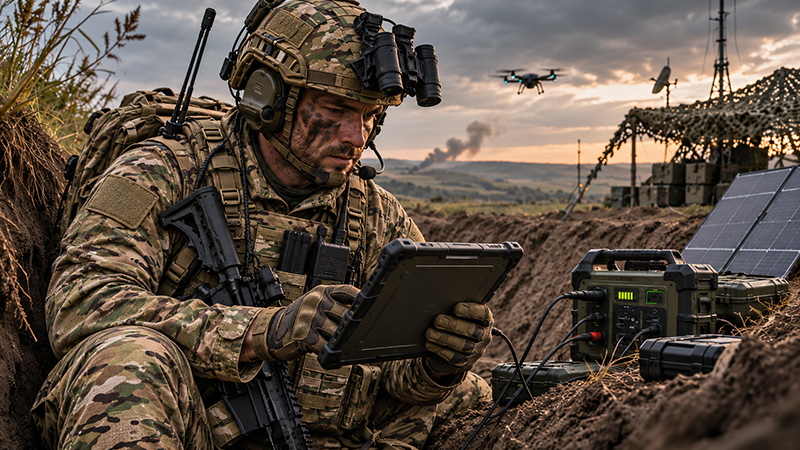
The digitization of ground forces’ equipment has transformed the energy balance of small units. According to U.S. Army data, a typical platoon during the Gulf War (around 1991) required approximately 1.74 kW of power. In the war in Afghanistan (around 2001), this figure had already risen to 2.07 kW, and by 2017, power consumption had reached 31.35 kW (the data includes not only soldiers’ personal electronics but also other unit communication, information, and support systems). The upward trend is quite evident and primarily affects individuals in the field. According to data from the U.S. Army, combat personnel carried an average of 4.5 kg of batteries, with some individuals carrying approximately 11.7 to 13.2 kg of batteries, depending on their role. According to estimates by manufacturers of field power systems, the weight of batteries for a 72-hour mission can account for about 15 to 20% of the total carried load.
The true extent of the problem becomes apparent when looking at the energy profile of current front lines. While the personal electronics of a single infantryman (NVG, GPS receiver, radio, thermal imager, and tablet) consume roughly 50 to 100 Wh per day according to analyses from the war in Ukraine (for a platoon of 30 to 40 men, this amounts to 1.5 to 3 kWh per day), the massive deployment of unmanned aerial vehicles and satellite communications with other connected systems further multiplies consumption significantly. A single drone team can go through 10 to 12 battery charges per day, which amounts to about 2 to 3 kWh of energy. In addition to the problem of high power consumption itself, there is also the issue of incompatibility. Dozens of different cell types with varying connectors cause further logistical complications.
Choosing a power source for field electronics is always a compromise between weight, cost, performance, and ballistic safety. Military forces therefore often combine rechargeable batteries for training and routine operations with disposable lithium cells for longer combat operations where recharging is not possible. A fundamental limitation of a battery is not only its capacity but also its safety when carried directly on a soldier’s body. In the event of mechanical damage or shrapnel impact, lithium cells, for example, pose a risk of thermal runaway, during which temperatures reach 600–1,000 degrees Celsius, accompanied by the release of toxic hydrogen fluoride.
In addition to the safety of the cells themselves, their mutual compatibility also poses a major challenge. The various types of connectors mentioned above can complicate joint Alliance operations. NATO has therefore introduced the STANAG 4695 standard for such cases, which specifies a common electrical and mechanical interface between power sources and a soldier’s body-worn systems. Thanks to this, the systems of individual armies can be powered by compatible energy sources regardless of their national origin.
Another challenge is increasing the electrical capacity of batteries while keeping their weight as low as possible. This presents a difficult trade-off, as this effort must go hand in hand with resistance to harsh environmental conditions, which poses a major problem for engineers in the form of chemomechanical demands.
However, rather than simply waiting for a breakthrough in the field of chemistry, other solutions are being sought in the form of changes to the soldier’s energy architecture. Instead of separate batteries in each device, the idea of a single centralized power supply from a flat, flexible vest-mounted battery is gaining traction. This concept is exemplified, for instance, by the Conformal Wearable Battery (CWB) project. One example is the BB-2525/U model, which offers a capacity of 148 Wh while weighing approximately 1.2 kg. An important feature of this battery is that its shape conforms to the ballistic plate. According to the CWB project, it should also be connected to a smart hub that distributes both power and data among the radio, tactical tablet, and helmet sensors. Through this hub, it is also possible to recharge the battery by connecting it to vehicles. Currently, a number of similar projects are emerging that address the issue of power on the battlefield. Future generations of equipment are moving toward conductive e-textiles integrated directly into vests. However, their current use is still hindered by a loss of conductivity after washing and repeated bending, as well as the mechanical vulnerability of the junctions between rigid connectors and soft fabric.

The high-intensity war in Ukraine has demonstrated the critical importance of soldiers’ access to electricity and shifted the emphasis toward energy self-sufficiency and the concealment of power sources directly in the trenches. According to analyses, hybrid tactical microgrids have become the backbone of frontline supply. These connect standard commercial battery stations with small, dispersed gasoline generators. A single 2-kWh battery station can silently recharge 15 to 20 tactical drone batteries and keep a forward operating position operational for approximately 48 to 72 hours. Internal-combustion generators are used only sporadically for rapid recharging of battery packs, as continuous engine operation creates an acoustic and thermal signature, which would increase the risk of position detection. With this in mind, strict energy discipline is also necessary when redistributing power and recharging all systems.
The Czech Armed Forces (AČR) also recognize that, with the increasing number of electronic devices carried by soldiers, it is necessary to ensure sufficient power supply. The “seated soldier” system therefore addresses how to integrate technologies and interconnect them. An important part of this effort is the standardization of the power supply interface, which in the Czech Republic is primarily addressed by the ČOS 593501 and ČOS 593502 standards. These are key to the compatibility of power supplies and the simultaneous transmission of electrical power and data. Attention is also being paid to battery and data management, which was one of the topics of a conference attended in 2026 by representatives of the Czech Signal Corps.
On the 21st-century battlefield, electrical energy has become just as important a commodity as ammunition or water, and today it is already a direct form of firepower. Although the development of a breakthrough battery type is expected, a combination of three measures is currently helping to realistically reduce the soldier’s load: consistent standardization of connectors and battery cells within NATO, projects such as CWB systems, and smart microgrids deployed directly on the front lines. Thanks to the integration of Czech and NATO standards, along with the introduction of modern systems and an emphasis on the operational effectiveness of the individual soldier, the Czech Armed Forces are currently on the right track. The question remains as to how quickly and effectively this energy architecture can be translated into practical, deployable solutions for the entire ground forces.