The Price of Sovereignty After FCAS: France Puts National Interests First, Germany Seeks Its Place Among the Great Powers
The new-generation European fighter jet has become a test of a much deeper issue than simply who will succeed the Rafale and the Eurofighter. It reveals which European nations want to control the technologies needed to wage war after 2040 – and how much they are willing to pay for that capability. The collapse of the FCAS project laid this divide bare. France subsequently opted for its own Avion de Combat du Futur (ACF). Germany, on the other hand, is still weighing whether to join the British-Italian-Japanese GCAP or pursue a new program with Sweden and, potentially, Spain. Behind the technical debate over the fighter jet lies the question of sovereignty and, ultimately, the will to act as a major power.
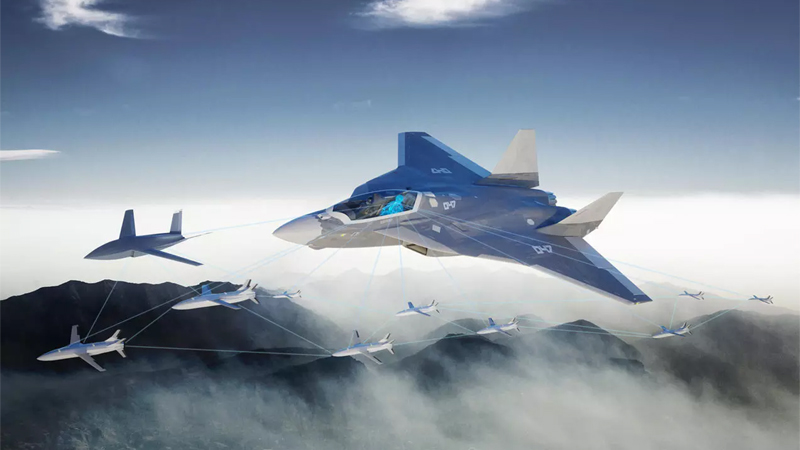
FCAS was launched in 2017 as a Franco-German program, later expanded to include Spain. Its ambitions extended far beyond the sixth-generation fighter jet itself. The system was to include unmanned aerial vehicles, stealth capabilities, a new engine, sensors, connectivity, and a combat cloud. However, disputes between Dassault Aviation and Airbus Defence and Space over responsibility for individual technological pillars brought the joint development to an end.
The French response came quickly. Paris transferred the future fighter jet to the national ACF program and intends to utilize the technologies developed during FCAS. France is open to international cooperation, but on its own terms. Jérôme Bellanger, Chief of the French Air and Space Forces, stated that the country remains open to cooperation with other nations, “but within different frameworks that will not be fundamental to the development of this aircraft.” This clearly defines the boundaries of France’s concept of sovereignty: cooperation, yes; dependence in the development of a key platform, no.
The reason is also linked to France’s nuclear deterrent. The ACF is slated to fly conventional missions around 2040 and to carry the ASN4G hypersonic nuclear missile by 2050. The Rafale F5 is expected to integrate the first elements of the emerging system as early as 2035. The timeline for the new aircraft is therefore directly linked to the preservation of France’s Force de frappe.
Paris is pursuing this ambition despite a challenging budgetary situation. According to the current plan, funding for the program is set to increase from approximately 1.2 billion euros in 2026 to 2.74 billion euros in 2027, provided the budget is approved by parliament. Éric Trappier, CEO of Dassault Aviation, estimates the development cost of the new aircraft at less than 50 billion euros. Other French companies, Safran and Thales, lend credibility to Paris’s ambitions. Dassault will assemble the AFC, Safran will manufacture its engines, and Thales will produce a significant portion of the electronics and sensors. France can therefore make sovereign decisions regarding armaments, modernization, and exports without having to negotiate with foreign partners.
Germany is responding differently following the collapse of the FCAS. It boasts the European Union’s largest economy, Airbus Defence and Space, MTU Aero Engines, and decades of experience with the Eurofighter. However, since 1945, its security culture has been built on the principle of anchoring German military power within NATO, European integration, and multinational programs. Its decision-making therefore reflects the tension between its economic size and the search for a geopolitical role commensurate with that size.
Berlin is exploring several options. According to the news portal POLITICO, an internal assessment by the German Ministry of Defense described a partnership with Sweden and Spain as “more advantageous and promising” than joining the GCAP. It cites more similar military requirements and a more favorable starting position for German industry. The second option, however, offers strong geopolitical continuity. The United Kingdom, Germany, and Italy have been united by the Eurofighter Typhoon for several decades. A potential German entry into the GCAP would therefore not send current relations in a new direction from scratch. It would carry over a significant portion of the Eurofighter’s industrial and political architecture into the next generation.
For the United Kingdom, such an alliance holds specific geopolitical value. Brexit ended the country’s membership in the European Union, but London remains a European military and nuclear power with an extensive aerospace industrial base centered around BAE Systems and Rolls-Royce. The relationship between Berlin and London is also taking on a broader character. “German-British relations are better than ever before. In recent years, we have grown even closer,” said German Defense Minister Boris Pistorius. “Together, we are not only making plans, but also implementing them in very concrete ways.”
London is leaving the door open for Germany’s entry, but the decision requires the approval of Italy and Japan. This presents a specific challenge for Berlin. The GCAP has already agreed on significant aspects of responsibility-sharing and intellectual property. The participating countries spent approximately five years negotiating the current contractual framework. This is where German industry, led by Airbus, comes into play. “We won’t just be manufacturing keels or wings,” said CEO Michael Schöllhorn, summarizing the company’s position. Airbus demands a significant and equal role for German and Spanish industry in development, production, and operations. “Purely political decisions without an industrial foundation are not enough.”
From this perspective, Sweden is offering Germany a different deal than GCAP. A new program would allow for the division of responsibilities to be defined from scratch. GCAP, on the other hand, offers a head start of several years, an existing organizational structure, and ties to the United Kingdom, Italy, and Japan. Berlin is thus not merely choosing between two aircraft, but between two paths to sovereignty. GCAP offers faster entry into a large technological bloc where other nations have already established a significant portion of the rules. Cooperation with Sweden offers a greater opportunity to help shape those rules. At the same time, it requires more time, funding, and the assumption of program risk.
The collapse of FCAS revealed more than just differing views between Dassault Aviation and Airbus. France provided a swift answer to the question of what price it is willing to pay for control over key military technology. The United Kingdom, Italy, and Japan are building sovereignty in a different way through the joint GCAP program. Germany is now deciding whether to carry over the relationships forged around the Eurofighter into the next generation or to create a new system with Sweden and, possibly, Spain. For smaller countries the same question takes on a different scale. Sovereignty does not mean manufacturing everything domestically. It means possessing technology significant enough to ensure that the state and its industry have a seat at the table when others make decisions.
While manufacturing based on supplied documentation creates a contract, owning the sensor, algorithm, data interface, or electronic warfare system is what secures a negotiating position. Following the end of the FCAS program, France is demonstrating how much it is willing to pay for such a position. Germany must now decide what price it places on its own strategic weight. And it is precisely the distribution of such positions – and the willingness to actually make use of them – that is at stake in Europe today.