The Rafale F5 and the Future of French Strategic Autonomy in Europe
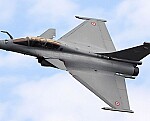
As Europe confronts renewed great-power competition and questions about the durability of American security guarantees, France is accelerating the modernization of its independent nuclear deterrent. At the center of this effort stands the Rafale F5, the next major standard of the Dassault Aviation multirole fighter. Planned as a deep mid-life renovation rather than a routine software update, the F5 is scheduled for full development launch by the end of 2026, with qualification targeted around 2033 and operational service in the mid-2030s. Under France’s updated military programming law, the combat fleet will grow to 225 aircraft, of which at least 47 are to be at F5 standard by 2035. This program has assumed greater strategic weight after the collapse of the Franco-German manned-fighter component of the Future Combat Air System.
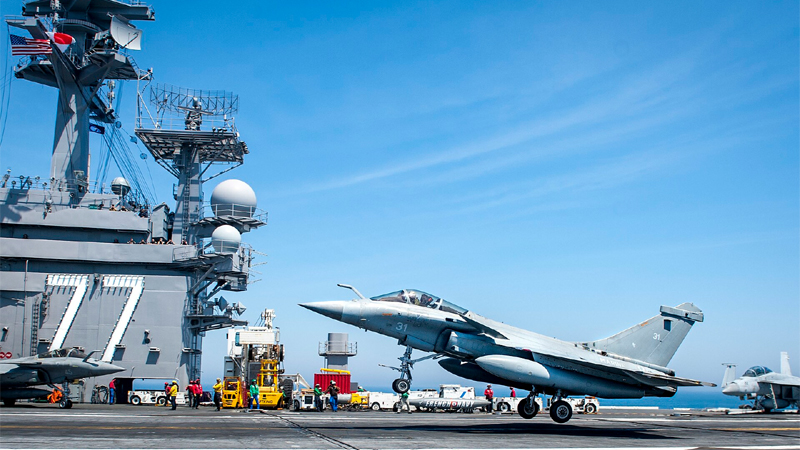
The F5 incorporates a suite of advanced systems designed for high-intensity operations in contested airspace. Thales is developing the new RBE2-XG radar, while a fully digital SPECTRA F5 electronic-warfare suite, produced by Thales and MBDA, will enhance self-protection and jamming. A new Inter-Vehicle Data Link provides jam-resistant connectivity, and Dassault is supplying a high-precision inertial navigation unit based on hemispherical resonator gyroscope technology that reduces reliance on GPS. Propulsion comes from Safran’s M88 T-REX engine, which increases maximum thrust by roughly 20 percent to 9 tonnes. Beyond sensors and propulsion, the aircraft is engineered to operate as the command node of a distributed formation that includes stealth combat drones derived from the nEUROn demonstrator. In November 2026 the Direction générale de l’armement delivered the first dedicated flying testbed, Rafale B374, to begin flight trials of these systems.
Central to the F5’s role is its integration with the ASN4G, the fourth-generation air-to-surface nuclear missile under development by MBDA. The Directorate General of Armament awarded the development contract on 2 June 2026; the weapon is scheduled to enter service around 2035 and will equip both the Strategic Air Forces and the Naval Nuclear Air Force. Unlike its predecessor, the ASMPA-R, which flies at roughly Mach 3 over an estimated range of 500 kilometres, the ASN4G is designed as a hypersonic missile capable of speeds exceeding Mach 5 while retaining the ability to maneuver.
Public descriptions indicate a range greater than 1,000 kilometres, most likely achieved with scramjet propulsion, and a single TNA 4G thermonuclear warhead. French planners have chosen hypervelocity and unpredictability over pure stealth as the primary means of penetrating the integrated air-defence systems expected in the 2040s. The missile will be carried by both land-based Rafale F5 aircraft and carrier-based Rafale M fighters operating from the Charles de Gaulle, preserving the dual airborne legs of the deterrent that France has maintained for decades.
These developments rest on the long-established architecture of the Force de dissuasion. France maintains an arsenal of fewer than 300 warheads – estimates place the active stockpile near 290 – guided by the principle of strict sufficiency. The force consists of two components. The ocean-based leg, the Force océanique stratégique, operates four Triomphant-class nuclear-powered ballistic-missile submarines based at Île Longue. At least one boat remains on continuous patrol, armed with M51 missiles whose range is on the order of 10,000 kilometres. This sea-based force accounts for the large majority of the arsenal and provides the invulnerable second-strike capability that underpins French doctrine.
The airborne leg is provided by the Forces aériennes stratégiques, which field nuclear-capable Rafales – currently around forty aircraft organized in two squadrons primarily at Saint-Dizier, with dispersal options at Istres and Avord – armed with ASMPA-R missiles and supported by A330 MRTT tanker aircraft. A smaller naval nuclear air force can embark the same missiles on carrier-based Rafales when ordered by the President. France abandoned its land-based ballistic-missile component in 1996. Doctrine does not include a no-first-use pledge; a limited “final warning” strike remains possible to signal resolve before any larger exchange. The forces remain outside NATO’s integrated military command, preserving full national control over the decision to use nuclear weapons.
In March 2026 President Emmanuel Macron articulated a new concept of “forward deterrence” (dissuasion avancée) during a speech at Île Longue. The initiative invites interested European partners to deepen cooperation with France’s nuclear posture while leaving command authority exclusively in French hands. Partners may participate in nuclear-related exercises, provide conventional support such as air defence, early warning or intelligence, and host temporary deployments of nuclear-capable French aircraft on their territory in peacetime for signalling or in crisis for dispersal. France has explicitly ruled out nuclear sharing on the American model, in which allies operate dual-capable aircraft with U.S. weapons, and it offers no formal security guarantee. The concept is presented as a complement to, rather than a replacement for, the NATO nuclear umbrella that continues to rest primarily on the United States.
As of late 2026 the initiative had drawn in approximately ten partners, including the United Kingdom, Germany, Poland, the Netherlands, Belgium, Greece, Sweden, Denmark, Norway and Finland; Czech Republic is interested too. Discussions have produced bilateral coordination groups and joint exercises, such as the October 2026 Exercise Rummy in which French Rafales flew a simulated nuclear mission escorted by British Typhoons. For frontline states the arrangement offers an additional layer of strategic signalling and the prospect of diversified launch axes that complicate an adversary’s planning.
For France it enhances the survivability of the airborne component through geographic dispersal while reinforcing European solidarity at a moment of strategic uncertainty. Whether the arrangement will evolve into a more structured European nuclear dimension remains open; its immediate effect is to demonstrate that France’s independent deterrent can be exercised in closer coordination with allies without compromising the fundamental sovereignty that has defined the Force de dissuasion since the 1960s.