
Ukraine Unveils Trailer-Mounted STASH Air Defense During Record Russian Aerial Assault
In the early hours of May 1, 2026, as waves of Russian Shahed drones darkened the skies over western Ukraine, a previously unknown surface-to-air missile system made its dramatic combat debut. Dubbed STASH by Ukrainian forces, this mobile, trailer-mounted platform intercepted multiple threats during a saturation attack involving over 400 unmanned aerial vehicles. In the western sector alone, Ukrainian defenders downed at least 58 drones, with STASH playing a visible and effective role in the layered defense that thwarted Moscow’s attempt to overwhelm air protections through sheer numbers.
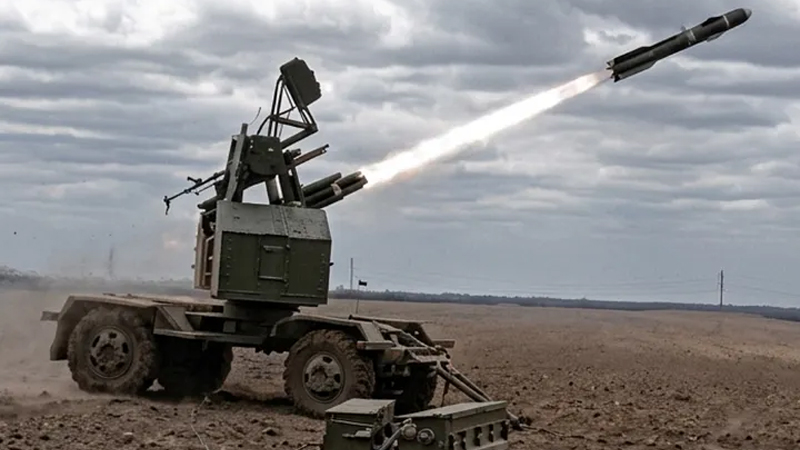
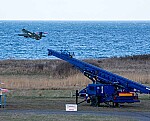
The footage released by Ukraine’s Air Command West captured the system in action: a compact launcher on a four-wheeled trailer firing what appear to be AGM-114L Longbow Hellfire missiles. One missile streaked skyward, locking onto a low-flying Shahed drone before detonating in a brilliant flash that obliterated the threat mid-air. The system’s mobility allowed rapid repositioning, its low profile enhancing survivability against Russian reconnaissance efforts. This unveiling marks not just a tactical success but a significant evolution in Ukraine’s adaptive approach to asymmetric warfare, where innovation meets battlefield necessity.
STASH builds on concepts from the American V2X company’s Tempest system, first demonstrated in late 2025. While the original Tempest used a lightweight buggy chassis like the Can-Am Maverick X3 for high agility, STASH opts for a towed trailer configuration. This design choice likely prioritizes cost reduction, easier transport by standard vehicles, and simpler logistics in a resource-constrained environment. Analysts suggest it integrates an Israeli RADA radar for target acquisition, paired with precision Hellfire missiles originally designed for anti-armor roles but repurposed here for aerial threats. The hybrid nature – American munitions, Israeli sensors, and Ukrainian operational integration – exemplifies the creative international collaboration sustaining Ukraine’s defense.
Russia’s strategy on May 1 exemplified swarm tactics refined over years of conflict. Launching hundreds of inexpensive Shahed-136/Geranium drones alongside decoys and reconnaissance UAVs, Moscow aimed to exhaust Ukrainian interceptors, create gaps in coverage, and strike critical infrastructure in the west. These one-way attack drones fly low and slow, evading many traditional radar systems while saturating defenses. Prior to STASH’s appearance, Ukraine relied on a mix of Western-supplied systems like NASAMS, Gepard, and improvised solutions, alongside its own developments and electronic warfare tools. The scale of the assault tested this network to its limits, yet the reported high success rate in the western sector underscores improving resilience.
What sets STASH apart is its optimization for exactly these threats. Short-range by design, it excels at engaging low-altitude, slow-moving targets where larger, more expensive systems might be overkill or unavailable. Hellfire missiles provide fire-and-forget capability with radar or semi-active homing, ensuring high hit probability even against maneuvering drones. The trailer’s mobility allows deployment near vulnerable sites – power plants, rail hubs, or forward positions – then quick relocation to avoid counter-battery fire or follow-up strikes. Low observability further aids survivability; unlike bulky S-300 or Patriot batteries, STASH can hide in tree lines or urban fringes, popping up only when needed.
This debut occurs against a backdrop of evolving drone warfare. Russia has ramped up Shahed production domestically and via Iranian and North Korean ties, flooding the battlefield with cheap munitions. Each successful intercept of a $20,000-$50,000 drone by a Hellfire (costing tens of thousands) raises sustainability questions, yet during mass attacks, the priority is denial of penetration over perfect cost ratios. STASH likely serves as a gap-filler in the “tiered” defense: cheaper guns and EW for initial layers, precision missiles like STASH for confirmed leakers, and high-end systems for manned aircraft or cruise missiles. Its integration signals Ukraine’s shift toward diversified, proliferated short-range air defense (SHORAD) to counter saturation.
Experts like Russian military blogger Boris Rozhin noted the system’s towed Hellfire setup as a budget-friendly variant of Tempest, already sighted in Ukrainian service earlier in 2026. The combination of Western tech with local adaptations highlights a key strength: Ukraine’s forces rapidly iterate on supplied hardware, tailoring it to real-world conditions. Israeli radars offer excellent performance against small RCS targets like drones, while Hellfire’s proven track record ensures reliability. Though exact specifications remain classified – missile loadout, radar range, reload times – the visuals suggest a lightweight, crew-served or semi-automated platform deployable by small teams.
The broader implications extend beyond a single night’s success. As the war grinds on, drone swarms will only intensify. Russia’s adaptation includes better decoys, night operations, and coordinated strikes with missiles. Ukraine’s response involves not only more interceptors but smarter ones: AI-assisted cueing, networked sensors, and domestic production. STASH fits into this ecosystem, potentially paving the way for scaled Ukrainian manufacturing or further Western variants. Its mobility addresses a chronic issue – static defenses are vulnerable to Russian Lancet or Iskander strikes – allowing dynamic coverage across vast fronts.
In the May 1 engagement, STASH’s contribution was part of a larger symphony. Aviation assets, other SAMs, mobile groups with machine guns, and electronic jamming all played roles. Yet the public release of its footage serves dual purposes: boosting domestic morale and signaling to adversaries that new capabilities are online. Western partners gain validation of their technology in high-intensity combat, which could accelerate further transfers or co-development. For Ukraine, every downed drone preserves lives and infrastructure, buying time for deeper strikes into Russian territory with its own long-range drones.
Challenges remain. Cost-effectiveness will drive future iterations – perhaps pairing cheaper missiles or directed-energy weapons. Training crews for rapid deployment under fire, maintaining supply chains for foreign components, and protecting the systems from Russian sabotage or strikes are ongoing hurdles. Nevertheless, the system’s emergence demonstrates Ukraine’s ingenuity. From modifying civilian vehicles to integrating allied munitions, the Armed Forces continue to innovate under pressure, turning potential vulnerabilities into strengths.
Looking ahead, STASH could proliferate across Ukrainian brigades, especially air defense units in the west and south where drone incursions are frequent. Its trailer design facilitates rail or truck transport, ideal for a nation with contested airspace. As Russia experiments with new UAV types – fiber-optic guided, AI-piloted, or stealthier models – flexible systems like this will be crucial. Combined with expanding Ukrainian drone production and EW advancements, it contributes to a holistic strategy shifting the attrition balance.
The May 1 attack, though massive, failed to achieve strategic breakthroughs thanks to determined defense and tools like STASH. This event encapsulates the war’s technological race: Russia bets on quantity and persistence, Ukraine on quality, adaptability, and international synergy. As both sides evolve, platforms like STASH underscore that innovation on the ground often outpaces expectations. For observers worldwide, it offers a glimpse into future conflicts where cheap drones meet precision counters in a deadly ballet of detection, decision, and destruction. Ukraine’s air defenders, operating STASH and its brethren, continue writing a new chapter in modern warfare – one trailer, one missile, one intercept at a time.