Ukraine’s Gripens Set to Receive Meteor Missiles to Counter Russian Glide-Bomb Carriers
On 17 November 2026 in Brussels, Ukrainian Defence Minister Evgeniy Khmara, Swedish Defence Minister Pål Jonson and UK Defence Secretary Wes Streeting signed a letter of intent on further cooperation under the Gripen for Ukraine initiative. The document focuses on supplying ammunition, essential equipment and spare parts for the Saab JAS 39 Gripen fighters already procured for Ukraine, with deliveries to be synchronised with the arrival of the aircraft themselves. Khmara stated that Gripens will strengthen Ukraine’s air capabilities and that “the key priority is Meteor missiles. With them, Gripens will be able to destroy enemy glide bomb carriers and protect frontline cities and warriors’ positions.” The partners are working to ensure weapons arrive in step with the jets so combat employment can begin as quickly as possible.
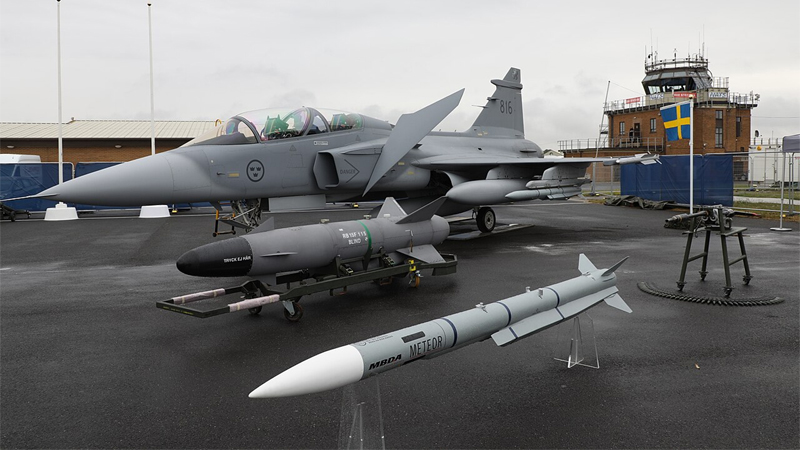
This step fits into a broader transformation of the Ukrainian Air Force. Since 2022, Ukraine has been shifting from Soviet-era MiG-29 and Su-27 fighters toward Western platforms. It already operates donated F-16s and Mirage 2000-5s. The Gripen programme adds a third Western type. Sweden intends to donate up to 16 Gripen C/D aircraft from its existing fleet, with the first expected in early 2027 (some reports point to January–February). In parallel, Ukraine has contracted for 16 new Gripen E aircraft (with earlier political discussions of up to 20), financed in part through European Union mechanisms and with UK involvement; deliveries of the E models are planned to begin in 2029. Ukrainian pilots and technicians have been training in Sweden for some time.
The Gripen’s design advantages are well matched to Ukrainian conditions: it can operate from dispersed sites and even roads, requires relatively modest ground support, and has a reputation for high availability and lower operating costs than some heavier Western fighters. These traits support operations under persistent Russian strikes on airfields. Longer-term Ukrainian ambitions have included a much larger Gripen fleet, potentially alongside continued F-16 and other Western types, as the Air Force moves toward NATO-standard structures and infrastructure by the mid-2030s.
The Meteor is the element that most changes the tactical picture. Developed by the European consortium MBDA under a six-nation programme (United Kingdom, France, Germany, Italy, Spain and Sweden), it is an active-radar-guided beyond-visual-range air-to-air missile that first entered service on Swedish Gripens in 2016. Its defining feature is a solid-fuel throttleable ducted rocket, or ramjet, that continues to provide thrust through much of the flight rather than burning out early like conventional solid-rocket motors. This sustains high speed (above Mach 4) and energy deep into the engagement. Published figures cite an operational range in excess of 100 km, with many assessments placing maximum range at 150–200 km or more depending on launch altitude, speed and geometry.
More important than raw range is the no-escape zone (this refers to a specific range of distances from the launching aircraft within which the target has only a minimal chance of evading the missile solely through evasive maneuvers – within this zone, the missile retains sufficient energy to hit the target even if the pilot of the target aircraft performs a sharp turn in time and attempts to fly away), commonly described as exceeding 60 km – several times larger than that of current medium-range air-to-air missiles such as the AIM-120 AMRAAM. The missile uses inertial guidance with mid-course updates via a two-way datalink (allowing updates or retargeting, including from third-party sources) before its active radar seeker takes over for the terminal phase. It carries a blast-fragmentation warhead with both impact and proximity fuzes and is designed to function in heavy electronic-warfare environments. Physical dimensions are approximately 3.65–3.7 metres in length, 178 mm in diameter and around 190 kg in weight. Gripen C/D and E variants are both integrated with the Meteor; the E can carry up to seven.
For Ukraine, the operational value is specific. Russian tactical aviation, particularly Su-34s (and to some extent Su-35s), has routinely released guided glide bombs (KABs) from 60–100 km behind the front line. Ukrainian fighters equipped with AIM-120 variants on F-16s or MICA on Mirages have struggled to reach these launch points reliably while remaining outside the most dangerous Russian air-defence and air-to-air envelopes. Analysts have noted that a Gripen C with Meteor offers a significantly better chance of engaging Su-34s dropping glide bombs 60–70 km behind Russian lines than existing Ukrainian options.
By holding the carriers at risk farther from the front, Ukrainian pilots could force Russian aircraft to operate from greater distances, reducing the volume and accuracy of glide-bomb strikes on Ukrainian positions and nearby cities. The combination of the Gripen’s sensors, the Meteor’s kinematics and datalink, and potential support from airborne early-warning assets (such as Swedish Saab 340 AEW&C systems) enables more stand-off, fire-and-forget engagements. Ukraine’s current F-16s and Mirages cannot employ the Meteor, making the Gripen the platform that unlocks this capability in the near term.
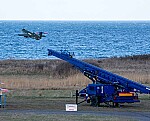
The weapons package is not limited to the Meteor. Swedish statements from earlier in 2026 indicated that the donation of Gripen C/Ds would include an advanced ammunition package that may consist of Diehl IRIS-T short-range infrared missiles, Raytheon AIM-120 AMRAAM medium-range missiles, and the Meteor. The IRIS-T provides high-agility close-range performance with imaging infrared guidance, useful against fighters, helicopters, cruise missiles and drones, and can be cued by helmet-mounted systems. The AIM-120 supplies a familiar NATO-standard medium-range layer that aligns with tactics already in use on Ukrainian F-16s.
Together they give the Gripen a layered air-to-air loadout: short-range IRIS-T, medium-range AMRAAM and long-range Meteor. The letter of intent covers ammunition more broadly, along with equipment and spare parts, and extends to the donated C/Ds, the purchased E/Fs and any future acquisitions. Sweden has also committed additional funding for air-defence and long-range capabilities through multilateral channels, while the United Kingdom has provided financial and industrial support linked to the Gripen effort. Exact missile quantities and precise delivery schedules remain undisclosed, as is typical for such sensitive transfers, but the stated intent is simultaneous arrival of jets and weapons.
Adding a third Western fighter type increases training, logistics and sustainment demands at a time when Ukrainian maintenance infrastructure is still adapting from Soviet standards. Pilot and ground-crew conversion is already under way, and the Gripen’s relatively simpler maintenance profile should help. The political and industrial commitment from Sweden and the United Kingdom, formalised in the Brussels letter of intent, signals a long-term partnership rather than a one-off transfer. For the Ukrainian Air Force, the arrival of Meteor-armed Gripens in early 2027 offers the first realistic prospect of systematically threatening the Russian aircraft that have sustained the glide-bomb campaign. That capability will not end the threat by itself, but it alters the risk calculus for Russian pilots and expands the protective umbrella over Ukrainian forces and cities along the front.