
U.S. Arms Manufacturers Are Conquering the European Industry: What Europe Will Gain and What Will Stay in the U.S.
Just a few years ago, the transatlantic arms trade followed a relatively simple model. European countries purchased American aircraft, missile systems, or ammunition; production took place primarily in the United States, and the finished products were shipped across the Atlantic. Today, a new model is emerging. The largest American arms manufacturers no longer want to simply sell to Europe; instead, they are seeking to manufacture directly on European soil.
Within a few weeks, Lockheed Martin, Raytheon, and Anduril Industries announced a series of projects that are reshaping transatlantic defense cooperation. Germany is preparing to manufacture ATACMS ballistic missiles; Poland will begin assembly and subsequently production of the Barracuda 500M missiles; and Raytheon, together with its European partners, is preparing to expand production capacity for AIM-120 AMRAAM missiles. At the same time, Berlin is negotiating with the United States regarding the licensed production of other American systems, including Tomahawk missiles. This is creating a new industrial model that links American technologies with European production capacities.
At the same time, several long-term trends are converging: the United States is replenishing its own stockpiles following large-scale deliveries to Ukraine, strengthening deterrence in the Indo-Pacific, supporting Israel, and simultaneously modernizing its own armed forces. Production lines for rocket engines, guidance systems, and precision-guided munitions are operating at the limits of their capacity. Expanding production to Europe therefore represents a logical way to increase output without concentrating new factories exclusively on U.S. soil.

The rapid growth of European defense budgets plays an equally significant role. The SAFE program, new joint European financing instruments, and the commitment by NATO member states to allocate five percent of their gross domestic product to defense are creating the fastest-growing defense market in the Western world. Over the next few years, hundreds of billions of euros will flow into the European defense industry. American companies clearly understand where their greatest export opportunity will lie in the coming decades. Rather than simply selling finished products, they are therefore striving to establish a long-term industrial presence directly in Europe.
From the U.S. government’s perspective, this model offers several advantages at once. It expands the production capacity of the entire Alliance, shortens delivery times for European customers, reduces pressure on U.S. manufacturing plants, and simultaneously strengthens the position of U.S. companies in the European market. An assembly facility represents a much stronger business relationship than a one-time arms delivery. Once European companies are integrated into the supply chains of Lockheed Martin, Raytheon, or Anduril, partnerships will form that could last for several decades.
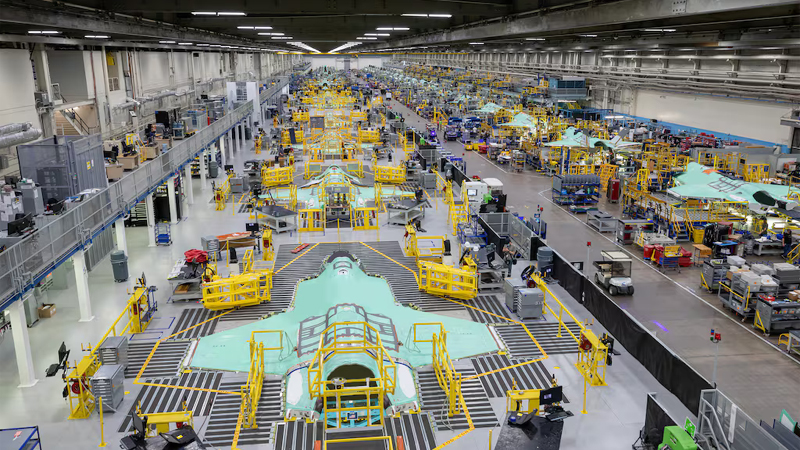
Germany is gradually becoming the main hub of this transformation. Rheinmetall already manufactures parts of the F-35 fuselage, has opened one of Europe’s most modern artillery ammunition factories, and is completing a plant for the production of rocket engines. It is this Düsseldorf-based conglomerate that is behind the first production facility for ATACMS ballistic missiles outside the United States. A memorandum of understanding between Lockheed Martin and Rheinmetall, signed during the NATO summit in Ankara, provides for the establishment of a joint venture for the production, integration, and distribution of these missiles to European allies. “We are creating new capabilities for Germany and Europe, ensuring supplies to customers, and strengthening our defense autonomy. Rheinmetall has been entrusted with building the first and only production facility for ATACMS missiles outside the United States,” said Rheinmetall CEO Armin Papperger, summarizing the significance of the project.
An agreement between the U.S.-based company Anduril and the Polish state-owned group PGZ follows a similar logic. Production of the Barracuda 500M missiles will begin with assembly at the WZL 2 plant in Bydgoszcz and will gradually transition to full-scale production with an increasing share of Polish and other European components. The project will thus seek to pave the way for funding from the SAFE program, which supports weapons systems with a high proportion of European production. “By transferring Barracuda production to Poland in partnership with PGZ, we are helping to build a European industrial base capable of producing precision-guided munitions at a pace that meets current security requirements, while simultaneously accelerating the transformation of European defense manufacturing,” said Brian Moran, Anduril’s Director of Business Operations in Europe, describing the company’s strategy.

At first glance, this creates a win-win situation for all parties involved. Europe gains new factories, jobs, faster deliveries, and access to some manufacturing technologies. American companies expand their manufacturing base, penetrate deeper into European industry, and strengthen their position in a market poised for a period of extraordinary growth. A more detailed analysis, however, shows that individual licensing agreements have clearly defined boundaries. The most valuable technologies remain under U.S. control.
Developments surrounding the Patriot system illustrate the criteria Washington uses to determine the scope of technology transfer. Production of PAC-2 GEM-T missiles has been supported through a partnership between Raytheon and MBDA Deutschland. However, the state-of-the-art PAC-3 MSE interceptor missiles remain outside of European production. The United States has supported the establishment of a European maintenance and repair center for these missiles, but production itself continues only in the United States and Japan. The same principle can also be observed with ATACMS missiles. Rheinmetall is acquiring the production program at a time when the U.S. military is gradually introducing a new generation of Precision Strike Missiles. In doing so, Washington is expanding its allies’ production capacities while retaining control over technologies that represent a long-term strategic advantage. From the perspective of export controls, this is not an exception but rather a standard approach. The transfer of production licenses does not automatically entail the transfer of the most valuable intellectual property, source data, design documentation, or manufacturing processes.
The entire process has another, less visible consequence. The more European companies are involved in the production of U.S. systems, the more technical standards, certification processes, and quality management requirements will converge across the Alliance. A common industrial ecosystem will emerge in which European companies gradually adopt U.S. standards for production, supply chain security, and the protection of technical data. From a long-term perspective, this standardization may be even more significant than the sheer number of newly opened manufacturing plants, as it lowers barriers to further joint programs while deepening the technological integration of the European and U.S. defense industries.
However, this industrial integration raises a fundamental question: who will control the technology, not just the production? In the modern defense industry, the greatest value no longer lies in the production facility itself, but in design data, software, control algorithms, manufacturing know-how, testing procedures, and the ability to independently modernize the system. A European factory producing an American weapons system can significantly increase production capacity, shorten delivery times, and create thousands of jobs. However, this alone does not mean technological autonomy. If key components, technical documentation, or software remain under the control of the original manufacturer and are subject to U.S. export regulations, a certain degree of strategic dependence also remains.
This is where the U.S. export control regime, ITAR (International Traffic in Arms Regulations), plays a significant role. It applies not only to the export of finished weapons, but also to technical data, manufacturing documentation, components, and services related to defense technologies. A European company can thus manufacture a component of an American system without automatically gaining the right to further modify this technology, integrate it into other projects, or export it to third countries. From Washington’s perspective, this is a logical tool for protecting the technological edge into which the United States has invested decades and hundreds of billions of dollars. Transatlantic cooperation therefore exhibits a certain imbalance: the U.S. intends to utilize European manufacturing capacity, but at the same time wants to retain control over technologies that represent its strategic advantage. The result will be a model in which manufacturing becomes internationalized, while technological sovereignty remains largely centralized.
This issue will be even more critical for the next generation of defense systems. The value of modern weapons is increasingly shifting from the physical platform to software, data, artificial intelligence, autonomous control, and the ability to receive continuous updates. A fighter jet, missile system, or autonomous drone may be manufactured in Europe, but their actual combat value may depend on technologies that remain outside European control. The strategy of companies like Anduril shows that future commercial and geopolitical competition will take place at the level of technological ecosystems linking hardware, software, data, and artificial intelligence. For Europe, therefore, the current wave of U.S. investment represents both a significant opportunity and a strategic challenge: whether it will become an equal technological partner or merely an assembly plant for U.S. defense systems. In future conflicts, the decisive factor will not be merely who can produce the most weapons, but also who controls the technologies that enable armed forces to make decisions, communicate, and adapt.
Developments in recent months are reshaping the traditional architecture of transatlantic relations. After decades in which the United States primarily exported finished weapons to Europe, it is increasingly exporting its own defense industry. The true significance of this transformation will not be determined by the number of memorandums signed or production facilities opened, nor by whether American weapons will be manufactured on European soil. The main challenge remains whether Europeans will learn to develop their own technologies over the next decade, or whether their companies will remain a secondary production capacity for the American defense industry.