U.S. Doomsday Plane Seen Following Air Force One After China Summit
A U.S. Air Force E-4B Nightwatch, often described as America’s “doomsday plane,” was tracked flying near Air Force One as President Donald Trump returned from China following the Asia-Pacific Economic Cooperation summit in Shenzhen.
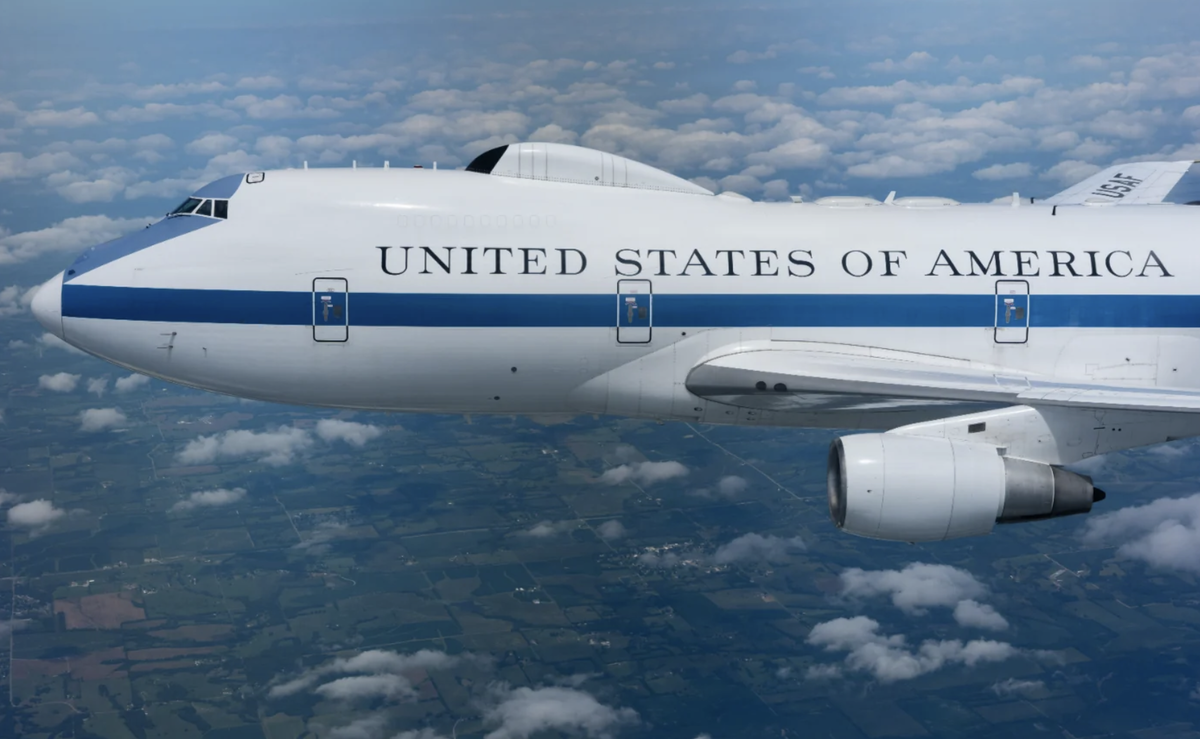
The aircraft, a heavily modified Boeing 747 designed to serve as an airborne command center during a national emergency, was spotted over the western Pacific near Japan. Flight tracker Andrew Leyden reported on X that Air Force One, two backup presidential 747 aircraft, and the E-4B were all in the region as Trump departed China.
The E-4B is one of the most important aircraft in the U.S. military’s command-and-control system. Its role is to ensure that the president, defense secretary, and senior military leaders can continue directing U.S. forces — including nuclear forces — if ground-based command centers are disabled or destroyed.
According to tracking data shared online, the E-4B was operating under the call sign TRUCK55 with the registration number 73-1676. The aircraft was flying at roughly 31,000 feet and traveling northeast at about 720 mph.
The presence of the E-4B alongside presidential aircraft is unusual to the public eye but not unprecedented. The aircraft frequently supports overseas presidential travel as part of broader continuity-of-government and national security planning. On this trip, the U.S. Air Force also reportedly deployed all three presidential 747 aircraft, underscoring the scale of the security operation surrounding the president’s visit.
Trump had been in Shenzhen for the APEC summit, where he met Chinese President Xi Jinping and Russian President Vladimir Putin. The summit drew additional attention after Russian state television filmed a naval officer accompanying Putin who confirmed he was carrying the Cheget, Russia’s nuclear command briefcase.
The Russian briefcase, like the U.S. “nuclear football,” is intended to allow a national leader to authorize nuclear forces if necessary. While such systems routinely travel with nuclear-armed leaders, they are rarely shown so directly in public footage.
The timing of both sightings — the U.S. E-4B over the Pacific and the Russian Cheget at the summit — highlighted the quiet but constant presence of nuclear command infrastructure during major diplomatic events involving world powers.
Air Force One was bound for Joint Base Andrews near Washington, D.C., while the E-4B was reportedly returning to Offutt Air Force Base in Nebraska, its home station. Tanker aircraft from Yokota Air Base in Japan and Elmendorf Air Force Base in Alaska were expected to support the E-4B’s long-range flight with aerial refueling.
Although the aircraft’s nickname evokes worst-case scenarios, the E-4B’s appearance does not indicate an immediate crisis. Instead, it reflects the standard but highly guarded security architecture that follows the U.S. president during high-profile international travel — especially when meetings involve other nuclear powers.
The episode offered a rare public glimpse into the airborne systems that remain in the background of presidential diplomacy, ready to preserve command authority even under extreme conditions.