
War Robots at Eurosatory 2026: Europe Accelerates UGV Adoption Amid Battlefield Lessons from Ukraine
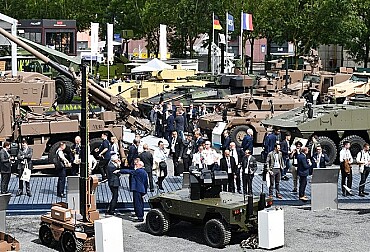
The halls of Eurosatory 2026 in Paris buzzed with a new intensity this June, as unmanned ground vehicles shifted from niche demonstrations to a dominant theme across dozens of exhibitor stands. More than 50 companies showcased UGVs of varying sizes and capabilities, reflecting a marked acceleration in Western European interest in robotic ground systems. Ukrainian firms, drawing directly from battlefield experience, stood out alongside established European and American manufacturers eager to translate operational lessons into marketable solutions. This surge signals a broader transformation in how European armies envision future land warfare, where uncrewed platforms increasingly complement traditional armoured forces to provide mass, reduce risk, and maintain operational tempo under contested conditions.

The conflict in Ukraine has served as a powerful catalyst. Ukrainian operators have deployed UGVs for logistics under fire, reconnaissance in denied areas, and even direct engagements, proving that ground robots can sustain positions and deliver effects where human soldiers face extreme danger. At Eurosatory, Ukrainian platforms – many combat-proven and refined through iterative frontline feedback – drew significant attention for their pragmatic design philosophy: affordable, modular, and rapidly upgradable. Larger Western firms responded with their own offerings, bridging the gap between experimental systems and production-ready solutions suitable for NATO-standard forces.
Among the notable displays was General Dynamics European Land Systems’ Bullfrog, a versatile platform designed for a range of support roles, alongside entries from AM General that highlighted American industrial involvement in the European market. These systems emphasised greater payload capacity, improved autonomy, and integration with existing command networks. Traditional European players, including those from Germany, France, and the Nordic countries, unveiled platforms tailored for reconnaissance, mine-clearing, and resupply missions. The common thread was adaptability: many vehicles featured swappable modules for sensors, weapons, or cargo, allowing rapid reconfiguration depending on the threat environment.
European nations face renewed pressure to modernise land forces amid evolving Russian capabilities and the need for credible conventional deterrence. UGVs address several persistent challenges: protecting personnel in high-casualty zones, sustaining logistics when roads are under constant surveillance, and generating mass without proportionally expanding manpower.
Several countries are translating exhibition interest into concrete programmes. The United Kingdom, for instance, has already awarded contracts for operational UGV fleets, while other NATO members are exploring similar acquisitions. Germany and France, through joint initiatives and national efforts, are examining how UGVs can integrate with next-generation main battle tanks and infantry fighting vehicles under programmes like the Main Ground Combat System. Smaller nations along the eastern flank see particular value in UGVs for border surveillance and rapid reaction forces, where they can extend sensor reach and act as force multipliers for limited standing armies.
Industrial momentum is equally important. European defence companies are investing heavily in domestic production lines to ensure supply chain resilience and compliance with export regulations. Collaboration between established primes and agile startups has accelerated innovation, with many new platforms incorporating commercial off-the-shelf components for cost control and faster iteration. Artificial intelligence plays an expanding role, enabling semi-autonomous navigation, obstacle avoidance, and basic target recognition, though full independence in complex terrain remains a work in progress. Manufacturers highlighted improved resistance to electronic warfare, with redundant communication links and fallback manual controls proving essential selling points.
The logistical and doctrinal implications are profound. Traditional armoured columns require extensive fuel, maintenance, and protection assets. UGVs, particularly lighter logistics variants, can operate with reduced signatures and lower sustainment demands, freeing manned units for offensive tasks. In defensive scenarios, they can form networked sensor webs or mobile minefields, complicating adversary advances. European armies are increasingly structuring experiments around hybrid formations – crewed vehicles providing firepower and command oversight, while UGVs handle the dangerous or mundane work. This approach aligns with broader NATO efforts to enhance interoperability and share technological burdens across the alliance.
Challenges persist, of course. Technical hurdles around reliable autonomy in mud, urban rubble, or dense forests continue to demand investment in sensing and computing power. Regulatory and ethical questions surrounding armed UGVs require careful handling, with many European nations preferring remote-operated or supervised systems for lethal roles. Integration into existing doctrine also demands significant training reform; commanders must learn to orchestrate mixed human-robot teams effectively, while soldiers need confidence that robotic partners will not fail at critical moments. Cybersecurity represents another vulnerability, as adversaries may target the networks linking these systems.
The exhibition underscored transatlantic dimensions. American firms showcasing platforms at Eurosatory signal willingness to partner with European customers, potentially harmonising standards and enabling joint exercises. This cross-pollination strengthens collective defence while fostering healthy industrial competition that drives down costs and spurs innovation. For smaller European defence companies, the event offered opportunities to form consortia or secure niche roles within larger programmes.
Looking forward, the integration of UGVs into European land armies will likely proceed in spirals: initial small-scale deployments for logistics and reconnaissance, followed by more ambitious combat applications as technology matures and trust builds. Multinational exercises will play a key role in refining tactics, techniques, and procedures. Budgetary realities may temper the pace, yet the strategic necessity – driven by demographic pressures on recruiting and the character of modern conflict – provides sustained impetus.
The prominent role of unmanned ground vehicles reflected both urgency born from ongoing conflict and optimism rooted in technological progress. As Western European armies move from contemplation to fielding these systems, the character of land warfare stands to change. Soldiers will operate alongside robotic counterparts, extending their reach, preserving their lives, and enhancing overall combat effectiveness. The coming years will reveal how effectively industry and militaries translate exhibition prototypes into reliable, integrated capabilities ready for the demands of high-intensity operations.