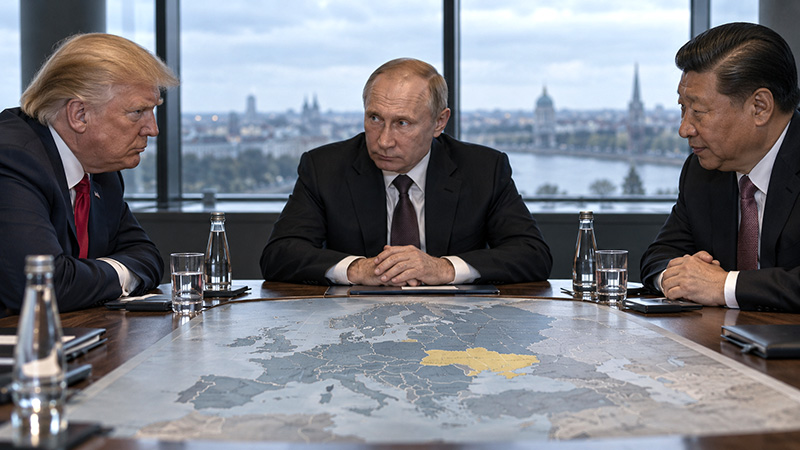
A New Concert of Great Powers – Yalta 2.0?
When decisions about Europe’s security are made without Europe, it is not a peace conference. It is a test of whether the sovereignty of smaller states still means anything. The idea that Donald Trump, Vladimir Putin, and Xi Jinping will sit down at the same table and agree on new rules for world politics has a seemingly reassuring appeal: three nuclear powers will stop risking a direct confrontation. But behind the promise of a grand peace may lie an even greater danger. A world divided into privileged spheres of influence may not actually be safer. It may simply be more convenient for those with the power to make decisions – and more dangerous for everyone else.
A Summit That May Never Happen – but Is Already Changing the Rules of the Game
In October 2026, the Russian president proposed holding trilateral talks with the U.S. and Chinese presidents on the sidelines of the November APEC summit in Shenzhen. As of the analysis’s deadline, U.S. participation had not been confirmed. Reports on the content of private discussions should therefore not be mistaken for an agreement that has been reached. The proposal itself, however, is politically significant: Moscow is seeking a format in which Ukraine and European security would be discussed over the heads of the states directly affected. Even a meeting that never takes place can push the boundaries of what is considered acceptable in global diplomacy. First, it is acknowledged that others can negotiate the fate of the attacked country. Then, discussions begin on what concessions such negotiations should yield. And ultimately, sovereignty may be reduced to a bargaining chip.
Yalta Was Not About Signing Off on a Map – It Was About Accepting the Reality of Power
The historical comparison to Yalta in February 1945 is a powerful one, but it must be accurate. At that time, Roosevelt, Churchill, and Stalin were not the strategic rivals they are today; they were allies in the war against Nazi Germany. Moreover, the Yalta Conference did not formally declare the division of Europe into spheres of influence and also included commitments to free elections. What proved decisive was the deployment of armies, de facto control over territory, and a lack of will or ability to change that control. Czechoslovakia experienced the consequences in February 1948 and in the decades that followed. This is precisely where the uncomfortable analogy with the present lies: a new sphere of influence need not arise from a ceremonial signing. It is enough for the powers to learn to accept foreign pressure as an immutable fact. Yalta 2.0, therefore, may not even require a group photo or a final communiqué. It can take place as a series of small concessions, each of which is presented individually as pragmatism.

A Concert of Great Powers or a Cartel of the Powerful?
The European concert following the Congress of Vienna in 1815 was based on a balance of power, a shared conception of legitimacy, and regular consultations. Its relative stability, however, came at a price: smaller nations often became the subject of decisions made by others. Today, the very conditions that held that concert together are missing. The United States and China are systemic rivals; Russia is a nuclear power but a significantly weaker economic actor; and none of these countries shares a unified vision of a legitimate international order with the others. Instead of a “concert,” therefore, there is a risk of an unstable cartel. Participants might temporarily grant each other privileges, but each would have a reason to break the agreement as soon as the balance of power shifts. Peace based on mutual respect for the rights of states and peace based on the tolerance of the stronger toward the even stronger are two entirely different things.
Three Presidents, Three Different Calculations
Washington may be seeking to reduce the costs of its global commitments, reach a trade agreement with Beijing, and present an end to the war in Ukraine as a political success. That in itself does not prove a willingness to divide the world. Moreover, U.S. policy is constrained by Congress, allies, domestic political competition, and the need to maintain the credibility of U.S. security guarantees. Moscow derives a different benefit from the trilateral format: the very invitation to negotiate alongside the U.S. and China would symbolically confirm its status as a great power and could undermine the principle that decisions about Ukraine cannot be made without Ukraine. Beijing would gain diplomatic prestige and could seek more favorable terms in trade and technological competition, as well as on the issue of Taiwan. At the same time, however, it does not want to unconditionally bear the costs of Russian policy or jeopardize its extensive relations with Europe. Thus, the three powers are not united by a shared vision of the world order. What unites them is the opportunity to gain something at the expense of actors who are absent from the table.
The Greatest Threat Is Not a Grand Yalta – It Is a Silent One
Lze formulovat čtyři scénáře pro období do roku 2030. Explicitní dohodě o rozdělení sfér interní analýza přisuzuje jen 5–10 %, zatímco „tiché Jaltě“ přibližně 40 %, pokračující transakční soutěži 30 % a neřízené eskalaci 20–25 %. Jde o expertní orientační odhady, nikoli statisticky vypočtené pravděpodobnosti; intervaly navíc nejsou přesně normalizovaným rozdělením. Jejich hlavní sdělení je však důležitější než samotná čísla. Nejpravděpodobnější nebezpečí nemusí mít podobu jednorázové historické dohody. Může vznikat postupně: zmrazením války bez věrohodných záruk, oslabováním sankcí, zmenšováním americké vojenské přítomnosti v Evropě, oddalováním rozhodnutí o Tchaj-wanu nebo přijetím zásady, že některé státy mají přirozené právo rozhodovat o sousedech. Každý krok lze vysvětlit izolovaně. Dohromady však mohou změnit samotnou architekturu bezpečnosti.
Ukraine as a Testing Ground for a New World Order
The crucial question is not whether a ceasefire will be concluded, but under what conditions and with what consequences. A cessation of hostilities can save lives and create space for diplomacy. However, if the ceasefire leaves the aggressor free to resume the war once it has regained its strength, it will not be a lasting peace, but a strategic pause. If other states were to decide on territory, sanctions, and security guarantees without Kyiv’s genuine consent, a precedent would be set that extends beyond Ukraine. The right to territorial integrity would cease to be the rule and become a bargaining chip. A similar signal would be perceived by Moldova, Georgia, the states of the South Caucasus, as well as actors in the Taiwan Strait. A genuine peace process must combine an end to violence, the consent of the attacked state, verifiable commitments, and mechanisms to deter further aggression. Without these conditions, the conflict will merely be postponed.

Europe on the Menu?
It would be a strategic defeat for the European Union if decisions on the European security architecture were made without its substantial participation. This does not mean that Europe must block every move by the major powers. It means that it must have the strength to influence the outcome. Diplomatic statements without military capabilities and economic resilience are easily ignored. European allies need their own intelligence and reconnaissance capabilities, air and missile defense, strategic transport, secure satellite communications, ammunition reserves, and a defense industry capable of long-term production. It is equally important to overcome political fragmentation: differing national approaches toward Russia, China, and the U.S. must not paralyze collective decision-making. European strategic responsibility, however, does not have to mean a departure from NATO. On the contrary, it may be a prerequisite for the Alliance to survive the shift in American priorities.
Article 5 Could Be Weakened Before It Is Ever Amended
The most vulnerable aspect of transatlantic security is the credibility of deterrence. The North Atlantic Treaty does not need to be terminated for its effectiveness to wane. All it takes is for Moscow to begin doubting whether Washington would actually act quickly and decisively in a specific crisis. Such uncertainty increases the appeal of test operations that fall below the threshold of open war: sabotage, cyberattacks, airspace violations, information campaigns, or the provocation of crises along borders. This is not merely a matter of technical defense against individual incidents. It is about the allies’ political ability to recognize coordinated aggression in a timely manner, assess it jointly, and respond appropriately. If European nations were to wait for an unambiguous conventional attack, they could lose a crucial part of the conflict even before it formally begins. The Alliance’s defense therefore also hinges on the speed of decision-making, information sharing, and the resilience of civilian institutions.
Security Cannot Be Bought with a Single Percentage Point or a Single Weapon
The discussion on defense spending must not stop at a media-friendly figure. The background document emphasizes the NATO target of 3.5% of GDP for core defense spending and an additional 1.5% for broader security and resilience needs. What matters, however, is what capabilities these funds will create. The Czech Republic needs a functional air defense system, ammunition reserves, unmanned and counter-unmanned systems, high-quality reconnaissance, secure communications, logistics, reserves, and the ability to maintain government operations and infrastructure during a crisis. Large-scale procurements without personnel, training, maintenance, and supplies are merely expensive symbols, not true defense capabilities. A security strategy must integrate the military, intelligence services, police, cybersecurity, industry, energy, transportation, healthcare, and local government. A “New Yalta” would not merely be a foreign policy issue. It would be a test of the functioning of the entire state.
Actions, Not Photographs, Will Be Decisive
In the coming months, it will be important to monitor not only a potential meeting of the three presidents, but above all its actual substance and the subsequent steps taken. Will Ukraine be a participant in negotiations about its future? Will any security guarantees be concrete and enforceable? Will the sanctions regime against Russia change? Will the U.S. reduce its military presence in Europe? Will Beijing secure political concessions on the issue of Taiwan? And will European nations be able to act in unison? A single summit can end without results and yet pave the way for fundamental change. Conversely, a grandiose statement may be nothing more than diplomatic theater. Security analysts must therefore distinguish between the political narrative, verified decisions, and their actual implementation. Confusing these three levels is precisely what allows propaganda to pretend that victory has already been achieved.
Yalta 2.0 Is Not Inevitable – It Is a Warning
The most dangerous question is not whether Trump, Putin, and Xi Jinping will agree on how to divide the world. It is whether democratic states will gradually accept that the rights of the weaker can be traded for the temporary peace of the stronger. Great-power diplomacy is inevitable and can sometimes prevent a catastrophe. However, it must not become a substitute for international law, sovereignty, and credible deterrence.