
B-21 Raider Clears Key Refueling Test as U.S. Air Force Pushes Toward Operational Service
The U.S. Air Force has marked another major step forward for its next-generation stealth bomber, confirming that the B-21 Raider has successfully completed aerial refueling with a KC-135 Stratotanker during flight testing at Edwards Air Force Base in California.
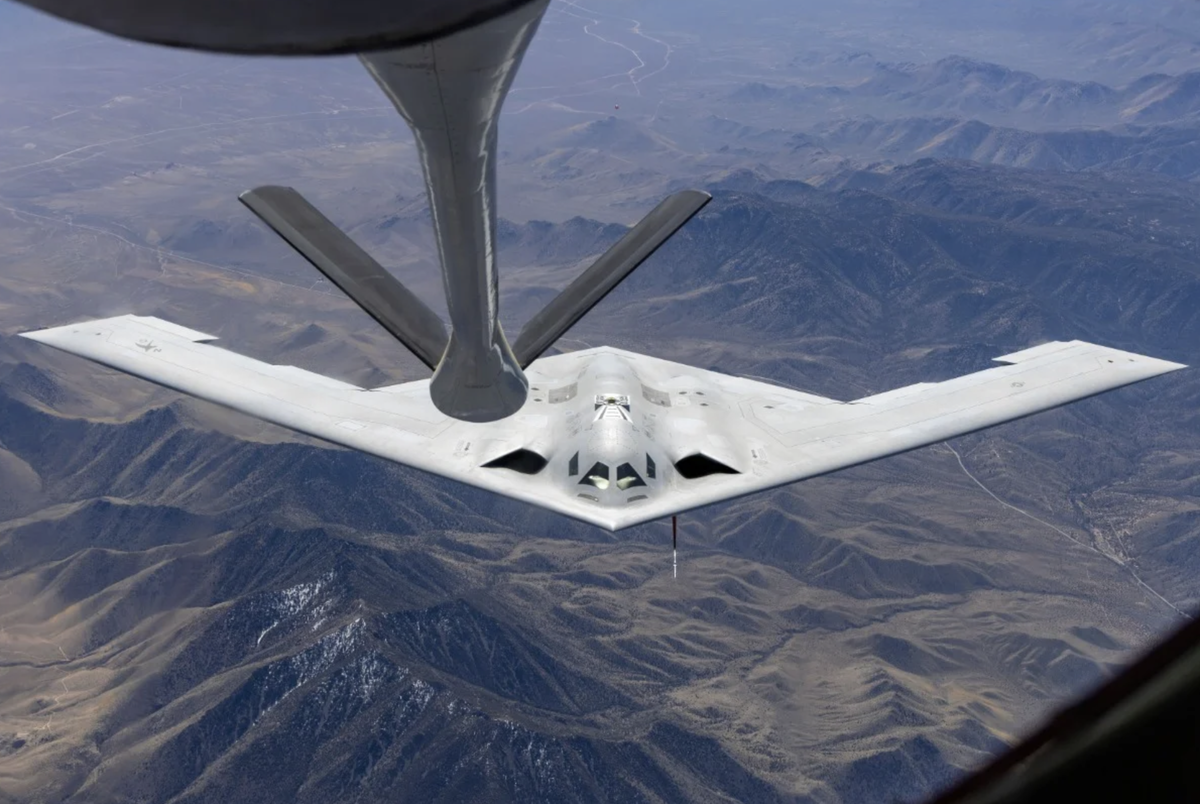
The achievement, announced on April 14, 2026, is more than a routine technical milestone. It signals that the B-21 is steadily moving from prototype promise toward real-world operational capability. For a long-range stealth bomber designed to penetrate heavily defended airspace, successful in-flight refueling is essential. Without it, range and endurance are limited by fuel carried at takeoff. With it, the aircraft becomes a global strike platform capable of extended missions, longer loiter times, and intercontinental reach.
All B-21 flight testing is being carried out at Edwards Air Force Base as part of a joint effort involving the Air Force Test Center, the 412th Test Wing, and Northrop Grumman, the bomber’s prime contractor. While the Air Force has not revealed how many B-21 aircraft are currently involved in the test campaign, nor provided a date for the refueling event itself, senior leaders made clear that the program is advancing with momentum.
One of the strongest signals from the Air Force was the confidence expressed by top officials overseeing the program. Gen. Dale White pointed to the speed of progress as evidence that the B-21 program is benefiting from a different acquisition approach than legacy systems. He emphasized that digital engineering and modern production methods are helping deliver a mature, highly capable aircraft while also allowing production capacity to scale more effectively.
That matters because the B-21 is not just another bomber entering development. It is intended to become a central part of the Air Force’s future strike fleet, eventually replacing the B-1B Lancer and B-2 Spirit while operating alongside the B-52H Stratofortress. In practical terms, the Raider is being built to carry the burden of missions that require stealth, deep penetration, and flexibility in environments that are far more dangerous than those earlier bombers were designed to face.
Air Force Chief of Staff Gen. Ken Wilsbach highlighted another important but often overlooked feature of the aircraft: fuel efficiency. The Air Force describes the B-21 as the most fuel-efficient bomber ever built, using only a fraction of the fuel consumed by older bombers. That gives it a significant operational advantage. A bomber that burns less fuel places less demand on tanker support, reduces the number of refueling sorties required, and eases logistical pressure across a wider theater. In a high-end conflict, where tanker fleets may already be stretched thin, that kind of efficiency can translate directly into more mission options and stronger deterrence.
Gen. S.L. Davis, commander of Air Force Global Strike Command, framed the refueling test in terms of what it means for combat operations. For bomber crews and commanders alike, aerial refueling is about endurance and mission readiness. It gives the aircraft the ability to remain in the fight longer, strike at greater distance, and respond with flexibility wherever needed. For a platform expected to support both conventional and nuclear missions, that capability is not simply useful — it is central to its role.
The B-21’s strategic value extends well beyond its stealth profile. It is being built as both a conventional and nuclear-capable bomber, making it a key part of the U.S. nuclear triad alongside land-based intercontinental ballistic missiles and submarine-launched ballistic missiles. Its open systems architecture is also a major part of its long-term relevance. Rather than locking the aircraft into a fixed technological baseline, the design is intended to allow new weapons, sensors, and electronic systems to be integrated over time without redesigning the airframe itself.
That flexibility is especially important given how much the threat environment has evolved. The B-2 Spirit, the Air Force’s only operational stealth bomber since the 1990s, was revolutionary in its day. But the B-21 is being shaped for a world with more advanced air defenses, denser sensor networks, and increasingly sophisticated adversary capabilities. Its design reflects decades of progress in stealth, networking, survivability, and systems integration.
The successful refueling test does not answer every question about the Raider program. The Air Force has not disclosed an initial operational capability date, and much of the aircraft’s testing and performance remains closely held. But the direction is becoming clearer. Every completed milestone reduces uncertainty and brings the bomber closer to frontline service.
With aerial refueling now added to its growing list of demonstrated capabilities, the B-21 Raider is moving closer to the role it was built for: a stealthy, long-range strike aircraft designed to reach targets anywhere in the world and remain relevant in the most demanding combat environments of the future.