
CBRN Defense Is Not Obsolete: Why Its Importance Is Growing on the Modern Battlefield
The acronym CBRN (chemical, biological, radiological, and nuclear threats) was long viewed through the lens of the Cold War and later primarily as a tool of asymmetric terrorism. However, given current developments in the security situation, the return of high-intensity conventional conflicts, and rapid technological progress, the threat of state actors using these substances is once again becoming a reality. For NATO and modern armed forces, protection against weapons of mass destruction (WMD) is thus a key component of the overall deterrence strategy. Moreover, its essence lies not merely in passive survival, but in maintaining the ability to conduct combat operations effectively even in a contaminated environment.
The basic architecture of CBRN protection rests on three pillars. The first of these is prevention. The armed forces must be constantly prepared to deny the enemy access to CBRN materials and delivery systems. In the event of a conflict escalation, they are required to have the capability to neutralize WMDs directly in the field, eliminate sources of attack, and degrade the aggressor’s offensive capabilities. This includes conducting specialized interdiction operations and operations against the proliferation of WMD (including maritime operations), which play a central role in global efforts to curb the proliferation of dangerous materials and technologies.
In the event of actual deployment, the second pillar comes into play: protection. All components of NATO’s deployable forces must, first and foremost, be capable of protecting themselves against a wide spectrum of threats in a hazardous operational environment. This requires integrated support from basic, enhanced, and highly specialized defensive capabilities. To carry out the most demanding tasks, specialized CBRN units are deployed to provide supplementary and highly specialized capabilities. These units can be flexibly adapted to specific missions – ranging from direct operations against WMDs to providing support for large-scale combined operations in contaminated areas.

The third and equally important pillar is recovery. Military capabilities in this phase serve to restore forces as quickly as possible following a potential CBRN incident, maintain combat readiness, and subsequently support the recovery of the affected territory, population, and other units. A key element for a successful return to normalcy is an operational military medical component. Medical personnel must therefore be systematically trained and drilled to rapidly identify the nature of the threat, provide effective specialized care, and ensure a timely biological response as part of a comprehensive risk management framework.
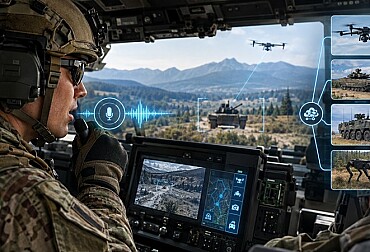
Technological advances are fundamentally changing the very nature of CBRN operations. The goal is to transform defense from a purely reactive discipline into a highly mobile and predictive system. Given that the top priority is protecting human lives, there is an increasing emphasis on the deployment of unmanned and robotic platforms. Deploying ground drones and robots to the epicenters of contamination for reconnaissance and sample collection not only protects the specialists themselves but also addresses the problem of extreme physiological exhaustion among soldiers, who would otherwise have to work in heavy, non-breathable isolation suits.
Moreover, modern sensor technology now makes it possible to detect the threat of contamination well in advance. Thanks to advanced systems, direct contact with a hazardous substance is no longer necessary; sensors can analyze it remotely and provide units with critical time to prepare. However, today’s transparent battlefield carries the risk of information overload from a vast number of sensors. This is where the enormous potential of artificial intelligence (AI) comes into play, as it could transform reactive defense into an active and predictive system. AI algorithms can analyze massive volumes of data in fractions of a second, learn to reliably filter out false alarms, and mathematically model and predict the spread of a threat.
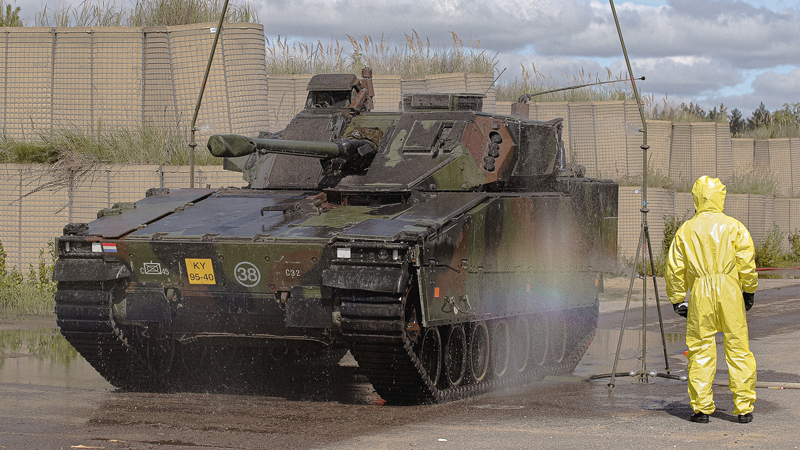
Logistics remains one of the greatest obstacles in CBRN operations. A typical example is the need to secure vast quantities of water for the decontamination process. Innovations in this area therefore have a clear goal: to keep soldiers combat-ready for as long as possible and minimize the logistical burden. Promising developments include the creation of advanced materials for protective clothing that reduce heat stress. In the medical field, substances that facilitate the elimination of radiation from the body (e.g., Prussian blue) are being introduced, and intensive work is also underway to improve methods for effective waterless decontamination.
In the context of weapons of mass destruction, the war in Ukraine represents a alarming erosion of international law. Russian forces have demonstrably deployed irritant agents in the conflict, which is in direct violation of the Chemical Weapons Convention. The tactic of dropping tear gas grenades from drones directly into trenches forces defenders to wear gas masks at all times. The Organization for the Prohibition of Chemical Weapons (OPCW) has already confirmed the use of these agents based on sample analysis. Although these are so far “only” irritant gases intended primarily for crowd control, this precedent raises serious concerns about a gradual escalation and the future use of highly toxic chemical warfare agents.
Furthermore, the reality of the modern, transparent battlefield in Ukraine shows that building large-scale, centralized decontamination centers is tactically unsustainable for the future. Developments are thus moving toward the necessary decentralization of CBRN capabilities, where reconnaissance and local decontamination will have to take place primarily at the level of small tactical units.
After years in which the threat of weapons of mass destruction was associated primarily with asymmetric terrorism following the end of the Cold War, it is clearly returning to the interstate sphere. The changing international order and the war in Ukraine compel us to fully accept this reality. The future of CBRN protection will depend on scientific progress, innovation, and the ability of the armed forces to adapt flexibly to new conditions – including the need for decentralization. We must not forget that the potential use of these weapons would have a devastating impact not only on troops in the field but also on the lives of civilians far behind the front lines.