Norway’s New Leopard Capacity Looks Beyond Its Own Army
On 15 October 2026, serial production of the Leopard 2A8 NOR main battle tank formally began at a purpose-built facility in Levanger, Trøndelag. The start of work by KNDS Deutschland and its Norwegian industrial partner RITEK marks the first time main battle tanks have been assembled on Norwegian soil and constitutes the central industrial element of the Norwegian Army’s largest armoured modernisation programme in a generation. Of the 54 tanks ordered for Norwegian service, 37 will be completed in Levanger while the remaining 17 are manufactured in Germany. The plant’s design capacity of up to 36 vehicles a year deliberately exceeds the national requirement, signalling longer-term ambitions that extend well beyond the Norwegian Army’s own re-equipment.
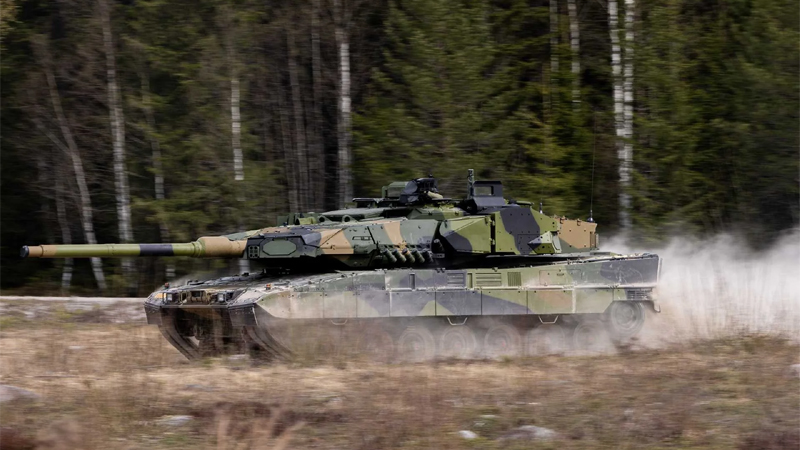
The acquisition itself dates to a contract signed on 17 February 2023 between the Norwegian Defence Materiel Agency and Krauss-Maffei Wegmann, now operating as KNDS Deutschland. Norway chose the Leopard after a competitive evaluation that also examined South Korea’s K2 Black Panther. At the time of signature the vehicles were designated Leopard 2A7 NOR; by June 2023 both parties had agreed to reconfigure them as the 2A8 NOR standard so that they would incorporate the Israeli Trophy hard-kill active protection system together with the digital and protection upgrades being adopted for Germany’s own future Leopard fleet. The contract includes an option for a further 18 tanks. Its financial framework began within a parliamentary ceiling of approximately NOK 19.7 billion and has since been adjusted to roughly NOK 23.4 billion once logistics equipment, spare parts, simulators, training systems and price escalation are included. Deliveries run from 2026 through 2028, with the first two German-built tanks handed over to the Norwegian Army at Rena on 30 April 2026. The new fleet will replace the service’s ageing Leopard 2A4s, which have been in Norwegian use since the early 2000s after earlier acquisition from the Netherlands, and will form the heavy core of Brigade Nord as Norway meets NATO force goals for a mechanised infantry brigade.
The industrial arrangement that enabled Norwegian assembly was formalised on 11 June 2024 when KNDS and RITEK signed a subcontracting agreement. RITEK, a specialist in the service and maintenance of heavy vehicles whose origins lie in former Norwegian Army workshops in the region, became an official Leopard 2 production partner. The Levanger site was constructed in only 18 months and inaugurated at the end of April 2026, with full serial production following in mid-October. The facility integrates assembly halls with specialised test infrastructure that includes a laser measuring track, steep-gradient courses and an immersion pool for fording trials. Energy is supplied from geothermal sources, a design choice that supports sustained operations with a lower carbon footprint. Norwegian industry contributes beyond pure assembly: Kongsberg supplies the ICS/CORTEX digital communications architecture that links the tanks into the wider combat system, while other domestic firms participate in system integration and long-term sustainment. Officials from the Defence Materiel Agency have stressed that domestic production and maintenance capability gives Norway an independent ability to keep its most capable ground combat asset operational in crisis or war, irrespective of the condition of external supply lines.
Production capacity is the clearest indicator of the programme’s wider industrial purpose. Thirty-six tanks a year is substantially more than the throughput required to complete Norway’s remaining 37 vehicles on the planned schedule. At the time of the 2024 agreement, Norwegian Defence Minister Bjørn Arild Gram stated that the production line is intended to remain in operation after the national order is fulfilled so that RITEK can continue to produce tanks for export to other countries. The same facility is planned to develop into a Nordic hub for the maintenance, repair and modernisation of the region’s Leopard fleets. KNDS executives have repeatedly described the Levanger site as important for scaling the company’s overall European manufacturing capacity. Contemporary German defence commentary has noted that the excess throughput makes it reasonable to expect Leopard 2A8 vehicles destined for other operators to be assembled in Norway once the Norwegian Army’s requirement is met. No firm third-country orders have been publicly confirmed at the moment production began, yet the combination of surplus capacity, central Nordic location near major logistics corridors, existing industrial relationships and explicit political support for continued production points toward a dual mission: completing Norway’s own modernisation while contributing to broader NATO output of the most modern Leopard variant.
Technically, the Leopard 2A8 NOR brings a clear generational step forward. It is armed with the Rheinmetall 120 mm L55A1 smoothbore gun capable of firing advanced kinetic and programmable multipurpose ammunition, protected by improved passive armour plus the Trophy active protection system that can intercept certain incoming anti-tank guided missiles and rocket-propelled grenades, and equipped with a modern digital architecture that improves situational awareness and coordination with infantry fighting vehicles, artillery and reconnaissance assets. These features, together with the domestic sustainment base now being established, position the tank as the principal heavy combat element of Norway’s land-domain rebuild under current long-term defence planning. That rebuild also encompasses expansion of the K9 self-propelled howitzer fleet and mid-life upgrades to the CV90 infantry fighting vehicle, all aimed at meeting NATO commitments on the Alliance’s northern flank.
The strategic implications therefore extend beyond a single national fleet. By pairing a more capable tank with a new European production and sustainment node, Norway simultaneously strengthens its own readiness and adds incremental manufacturing capacity to the Alliance at a time when demand for modern main battle tanks remains elevated across multiple member states. Markus Helm, Chief Financial Officer of KNDS Deutschland, characterised the production launch as an important contribution to both Norwegian and NATO defence readiness and as a deepening of industrial cooperation between Germany and Norway. Florian Hohenwarter, CEO of KNDS Deutschland, has highlighted the Levanger site’s significance for scaling production capacities. In practical terms, the facility reduces some of the industrial bottlenecks that have constrained European heavy-armour output and gives Norway a lasting role in the regional Leopard ecosystem—first as an assembler of its own vehicles, then potentially as a supplier and support centre for others.
As the first Norwegian-assembled Leopard 2A8 NOR vehicles begin to take shape in Levanger, the programme stands as both a concrete industrial achievement and a deliberate bet on continuity. The tanks will enter Norwegian Army service from 2027 after testing and verification, with the full order expected to be complete by 2028. What happens to the production line thereafter will determine whether Levanger remains a one-time assembly site or becomes a durable Nordic centre for Leopard manufacturing and sustainment. The capacity, the political statements and the industrial partnership all indicate that the latter outcome is the intended one.