France Turns to Sweden’s Proven CB90 After Its Own Fast-Boat Program Collapses
The decision crystallised in mid-November 2026 when the Swedish government submitted a supplementary budget proposal to the Riksdag seeking authorisation for a government-to-government sale of up to twenty Stridsbåt 90 (Combat Boat 90, or CB90) vessels to France in 2027. The package is expected to include the boats themselves, crew training, support equipment and associated services, all funded by Paris. The move follows an eighteen-month operational evaluation of three loaned Swedish CB90s that began in the summer of 2025. Two of those craft have been operating with the Amyot d’Inville battalion of the Force des fusiliers marins et commandos (FORFUSCO) at Brest, while a third has been based with the Détroyat battalion at Toulon. French crews have used them for harbour and approach protection, maritime interception, coastal surveillance and limited amphibious tasks in both Atlantic and Mediterranean conditions, and the results have been judged satisfactory.
The acquisition fills a gap left by the collapse of a domestic programme. In 2018 the French Navy ordered twelve Vedettes de Fusiliers Marins (VFM), 15-metre interceptors, from the Ufast yard in Quimper. Only two boats were eventually delivered before the shipyard entered insolvency and the contract was terminated. The original requirement had envisaged a modest craft carrying roughly eight troops; the Swedish boats more than double that capacity while offering substantially greater range, protection and proven reliability. In practical terms, a fleet of twenty CB90s would restore and expand the ability of the fusiliers marins to secure the approaches to major naval bases, protect high-value units such as the nuclear-powered ballistic-missile submarines at Île Longue, and support amphibious and special-operations movements.
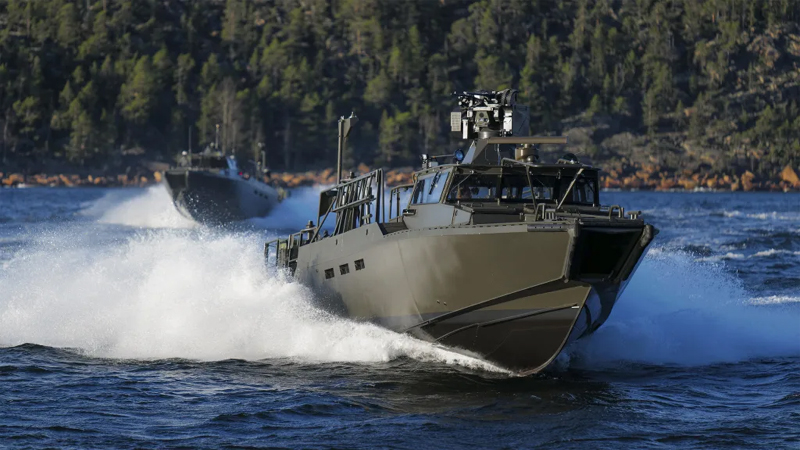
The CB90 itself is a product of Sweden’s unique geography. Designed in the late 1980s by Dockstavarvet (later absorbed into Saab) to operate among the thousands of islands of the Stockholm archipelago, the boat entered Swedish service in 1991 as the Stridsbåt 90 H. Its name signals both the year of acceptance and its role: it carries and can land a half-platoon of eighteen fully equipped amphibious infantry. The aluminium hull is typically 15.9 to 16.3 metres long with a beam of about 3.8 metres and a draught of only 0.8 to 0.9 metres, allowing it to work in very shallow water.
Twin waterjets driven by Scania diesels give the original version roughly 1,250 horsepower and a top speed of around 40 knots; the more modern HSM (or Next Generation) variant raises power to about 1,800 horsepower and speed to approximately 45 knots when fully loaded. Range is commonly quoted as 240 nautical miles at economical speed for the earlier boats and around 300 nautical miles for the HSM. The craft is famous for its agility: it can execute extremely sharp turns at high speed, stop from full speed in roughly two and a half boat lengths, and adjust pitch and roll while under way. A bow ramp allows troops to disembark directly onto a beach or quay in seconds.
Armament is modular. Typical fits include heavy machine guns, automatic grenade launchers and, on the HSM, a stabilised Saab Trackfire remote weapon station. Newer boats also feature improved ballistic protection, better CBRN measures and an updated combat-management system. The combination of speed, shallow draught, troop capacity and the ability to beach or reverse off a shoreline has made the type useful for coastal defence, rapid reaction, special-operations insertion, patrol and, in some forces, even limited mine or depth-charge roles.
For the French Navy the boats bring capabilities that the cancelled VFM programme could not deliver at scale. Where the domestic design offered limited endurance and a small passenger load, the CB90 provides a platform that can loiter for hours, sprint to intercept, or deliver a meaningful infantry contingent in a single lift. The evaluation boats have already been employed protecting the approaches to Brest – home of the strategic submarine force – and Toulon, and the permanent acquisition will allow similar tasks to be conducted with greater numbers and with the added flexibility of amphibious support. There is also the wider political context of Franco-Swedish defence cooperation; the boat order is widely seen as part of the reciprocal industrial and operational relationship that has accompanied other major naval transactions between the two countries.
Beyond France and Sweden the CB90 has found a durable international market. More than 250, and by some counts closer to 300, examples have been built. Norway operates about twenty boats as the S90N, adapted with a higher deck height, stern anchor and enhanced communications for its Coastal Ranger Commandos. Mexico acquired roughly forty-eight, some built under licence, primarily for Caribbean interdiction. Malaysia has seventeen, Greece’s coast guard three, and the United States Navy has used a version known as the Riverine Command Boat. Sweden has also transferred numbers to Ukraine. The type’s combination of simplicity, speed and versatility has kept it relevant more than three decades after its introduction, and Saab continues to evolve the family – most recently with the larger, optionally crewed CB90 CX variants aimed at sensor, anti-ship and short-range air-defence roles.
In short, France’s decision to acquire twenty CB90s is both a pragmatic response to the failure of a national programme and a recognition of a mature, battle-proven platform that matches the French Navy’s need for rapid, high-capacity protection of its most sensitive coastal installations while offering useful secondary roles in amphibious and special operations. Once the intergovernmental agreement is concluded and deliveries begin, the boats will become a visible and practical element of FORFUSCO’s order of battle at Brest, Toulon and potentially other bases, extending Swedish design experience from the Baltic archipelagos into the waters that guard France’s nuclear deterrent and Mediterranean approaches.