
From Iranian Roots to Chinese Engines: Inside Russia’s New Geran-5 Hybrid Cruise-Kamikaze Missile
The arrival of the Geran-5 marks a significant turning point in the evolution of Russian long-range attack drones, collectively designated as the “Geran” series (the Russian name for systems derived from Iranian designs). Earlier models, such as the propeller-driven Geran-2 (based on the Iranian Shahed-136) and the jet-powered Geran-3 (analogous to the Shahed-238), focused primarily on low-cost, high-volume production to enable saturation attacks that overwhelm air defenses through sheer numbers. These drones emphasized affordability, with unit costs estimated in the tens of thousands of dollars, allowing Russia to launch hundreds in coordinated barrages against Ukrainian infrastructure, particularly energy facilities during winter campaigns.
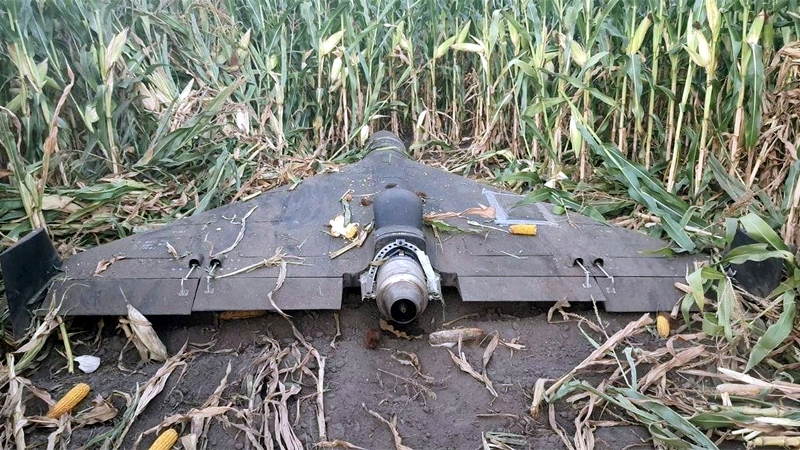
In contrast, the Geran-5 represents a deliberate shift toward enhanced aerodynamic efficiency, speed, and operational versatility. According to detailed assessments by Ukraine’s Main Directorate of Intelligence (HUR/GUR), released on January 11, 2026, following the drone’s first combat deployment in early January combined aerial strikes, the Geran-5 adopts a more conventional aerodynamic configuration. This includes a slender, tubular fuselage, large straight wings, and a dorsal air intake – a clear departure from the delta-wing or blended-wing layouts of prior Geran variants.
Physically, the Geran-5 measures approximately 6 meters in length with a wingspan of up to 5.5 meters (roughly 20 feet long and 18 feet wide), placing it in an intermediate category between heavy tactical UAVs and lightweight cruise missiles. The most notable doctrinal innovation is the propulsion upgrade: the Geran-5 is powered by a Chinese-manufactured Telefly turbojet engine (likely a JT80 variant or similar), which delivers greater thrust than the engine in the Geran-3. This enables significantly higher cruising speeds, improved stability during medium-altitude flight, and reduced transit times to targets – factors that complicate interception by defenses optimized for slower, low-flying threats.
Aerodynamically, the straight-wing layout combined with the dorsal intake supports sustained, efficient flight rather than a purely ballistic terminal phase. This configuration enhances payload carriage without severely penalizing range. Ukrainian intelligence estimates a combat radius of around 1,000 kilometers and a primary warhead of approximately 90 kg – sufficient to cause substantial damage to critical infrastructure, command centers, or hardened targets. As a one-way (kamikaze) platform, the Geran-5 functions effectively as a deep-strike asset, minimizing dependence on vulnerable forward launch sites.
Guidance employs a cost-effective hybrid approach blending military-grade and commercial off-the-shelf components: a 12-channel Kometa (Comet) satellite navigation receiver for jamming-resistant positioning, a tracking module built around a Raspberry Pi-style microcomputer, and 3G/4G cellular modems for real-time data relay and route corrections. This mix reduces development costs and enables rapid software adaptations for evolving mission profiles. However, reliance on civilian networks creates exploitable vulnerabilities in contested electromagnetic environments, where Russian electronic warfare jamming or signal spoofing could degrade performance.
The platform’s modularity supports advanced configurations beyond basic ground strikes. Ukrainian sources indicate ongoing Russian efforts to integrate R-73 (NATO: AA-11 Archer) short-range air-to-air missiles with infrared homing seekers. This would potentially allow the Geran-5 to engage Ukrainian aircraft or helicopters attempting interceptions, echoing earlier experiments with R-60 missiles on Geran-2 variants. While integration challenges remain – including sensor fusion, target designation, and maintaining flight stability under asymmetric loads – this reflects asymmetric innovation to raise defender costs.
A particularly intriguing development is the exploration of air-launch capability from manned aircraft, such as the Su-25 attack jet. Conceptual renderings and analyses suggest underwing carriage, which would extend effective range by leveraging the carrier’s altitude and speed, enable unpredictable approach vectors, and reduce the drone’s initial radar signature during takeoff.
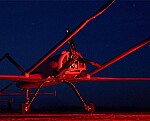
For comparison, the Geran-5 bears notable structural and technological resemblances to Iran’s Karrar jet-powered drone, a reusable platform originally developed for reconnaissance, target simulation, and strike roles, often armed with air-to-air missiles in demonstrations. These parallels – including overall layout, jet propulsion, and potential weapon integration – support Ukrainian claims of technology transfer or design adaptation rather than purely indigenous Russian development.
In the broader context of sanctions and restricted access to advanced components, Russia continues to demonstrate adaptability by combining foreign engines (Chinese), civilian electronics (Raspberry Pi equivalents, commercial modems), and localized assembly. This accelerates fielding new systems amid ongoing battlefield evolution.
Since its debut in early January 2026 attacks, the Geran-5 has added another layer to Russia’s persistent aerial campaign, which saw nearly 1,100 drones launched in a single recent week alongside missiles and glide bombs. By bridging the gap between low-cost mass drones and more sophisticated cruise missiles, the Geran-5 aims to impose escalating interception burdens on Ukrainian defenses while preserving production scalability.