
Iran Wants a Missile That Can Hit America - And the Real Story Is Who May Help Build It
Iran has raised the prospect of developing a ballistic missile with a range of 15,000 kilometers, a distance that would place not only the United States but effectively any point on the globe within reach from Iranian territory. The statement marks a dramatic escalation in rhetoric around Tehran’s missile ambitions and has renewed concerns over where the necessary technology could come from.
At present, Iran’s longest-range ballistic missile is the Khorramshahr, which has demonstrated a range of 4,000 kilometers. Moving from that level to a true intercontinental ballistic missile would already be a major leap. Jumping further to a 15,000-kilometer system would represent an even more significant technological breakthrough, one that few states have achieved on their own.

That is why the most important question is not only whether Iran wants such a missile, but how it could realistically build one.
A range above 5,500 kilometers is generally enough to classify a missile as an ICBM. To strike major cities on the U.S. East Coast from Iranian territory, a missile would need roughly 10,000 kilometers of reach. Even 12,000 to 13,000 kilometers would be sufficient to cover the entire continental United States. The mention of a 15,000-kilometer system therefore suggests that Tehran may be aiming beyond a basic first-generation ICBM and instead looking at a more advanced design already developed elsewhere.
Iran’s missile program has a history of absorbing foreign technology. The Khorramshahr itself is widely understood to be based on North Korea’s Hwasong-10, which in turn traces its design roots back to the Soviet R-27 submarine-launched ballistic missile. That pattern makes outside assistance a central factor in any discussion of Iran’s future long-range missile capabilities.
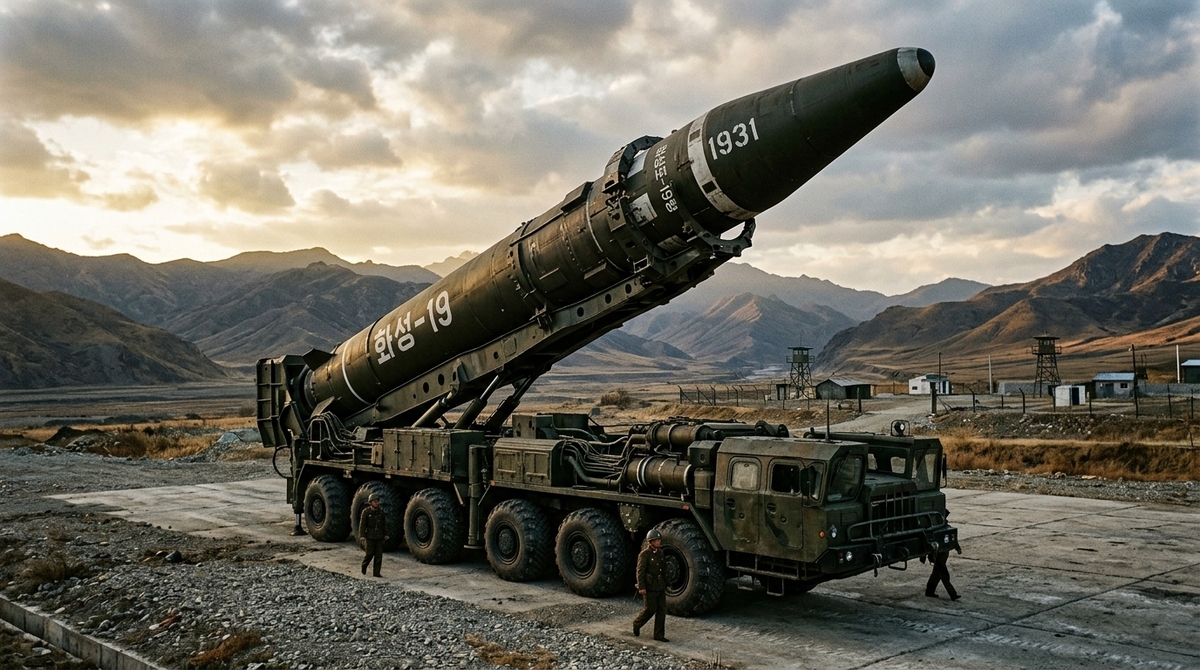
North Korea is the most obvious intermediary. In recent years, Pyongyang has tested several missile systems associated with ranges of 15,000 kilometers or more. Among them is the Hwasong-18, whose range was assessed at 15,000 kilometers after its July 2023 launch trajectory was recalculated. An even more powerful system, the Hwasong-19, is believed to be capable of flying more than 17,000 kilometers. The Hwasong-17, a liquid-fueled missile, is also estimated to have a range of around 15,000 kilometers.
What makes these systems particularly significant is the belief that they did not emerge in isolation. The Hwasong-18 is widely seen as drawing heavily from the russian three-stage, solid-fuel Topol-M ICBM. The Hwasong-17, meanwhile, is often linked to the R-36 design lineage. The speed of North Korea’s progress and the success of its testing program have reinforced the view that proven external technologies played a major role.
If Iran is now pursuing a missile in the 15,000-kilometer class, it would fit a familiar pattern: technology flowing from russia to North Korea and from North Korea onward to Iran. Whether that transfer happens indirectly through existing networks or more directly through closer strategic cooperation, the geopolitical implications would be serious.
For Washington and its allies, the issue is not just the theoretical range of a future Iranian missile. It is the possibility that Tehran could shorten its development timeline by bypassing years of domestic trial and error and instead building on designs that have already been tested elsewhere. That would turn a long-term strategic concern into a far more immediate one.
If this trajectory continues, Iran’s missile program may no longer be viewed simply as a regional deterrent. It would increasingly be seen as part of a broader axis of military and technological cooperation linking Tehran, Pyongyang, and Moscow — one with implications far beyond the Middle East.