
NATO Eyes in the Sky: Saab GlobalEye Ushers in a New Era as E-3 Sentry AWACS Fleet Prepares for Retirement
In July 2026, at the NATO Summit in Ankara, Secretary General Mark Rutte announced a landmark decision: a coalition of 11 allies would initiate formal negotiations with Saab for the joint procurement of up to ten GlobalEye Airborne Early Warning and Control (AEW&C) aircraft. This move marks the beginning of the end for NATO’s fleet of 14 Boeing E-3A Sentry aircraft, the Alliance’s venerable “eyes in the sky” that have patrolled European airspace since the early 1980s. The transition from the Cold War-era American platform to a modern Swedish system built around a Canadian business jet represents not only a technological leap but also a strategic realignment in European defense industrial cooperation.
The Boeing E-3 Sentry, derived from the 707 airliner, has served as the backbone of NATO’s airborne surveillance for decades. Its most distinctive feature is the massive rotating radar dome, or rotodome, mounted atop the fuselage on two struts. This mechanical marvel houses a pulse-Doppler radar capable of detecting low-flying aircraft at ranges exceeding 400 km while simultaneously tracking higher-altitude targets out to 640 km or more. Operating at altitudes above 8840 m, the E-3 can provide all-weather, all-altitude surveillance over land and sea, eliminating ground clutter through advanced signal processing. A crew of four flight personnel and up to 19 mission specialists mans consoles that display real-time battlespace data, enabling command and control functions such as directing fighter intercepts, coordinating air strikes, managing tankers and transports, and providing early warning of hostile activity.
NATO’s E-3A fleet, based at Geilenkirchen Air Base in Germany and operated by multinational crews from 21 member nations, has proven indispensable in operations from the Balkans to Afghanistan, Libya, and the monitoring of Russian activities near Alliance borders. The aircraft’s endurance of roughly eight hours without refueling – extendable significantly with aerial tanker support – allows it to loiter for extended periods, serving as a mobile air operations center. Its identification friend-or-foe (IFF) systems, electronic support measures, and data links integrate seamlessly with ground and naval forces, offering commanders a comprehensive picture that has shaped countless joint and coalition missions. However, the platform’s age brings challenges. The 707-based airframe, with its four Pratt & Whitney TF33 engines, demands substantial maintenance, and the mechanical rotodome, while reliable, represents older technology vulnerable to modern electronic warfare and less agile in rapidly evolving threat environments dominated by stealthy targets, drones, and hypersonic weapons.
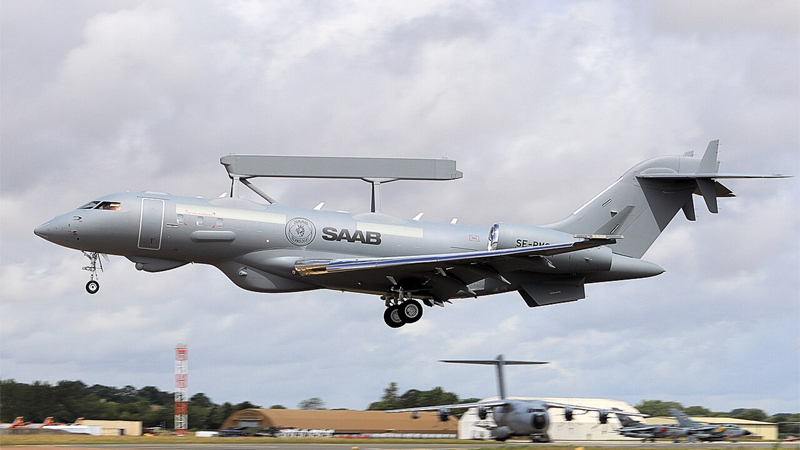
Enter the Saab GlobalEye, a next-generation AEW&C solution mounted on the Bombardier Global 6000/6500 ultra-long-range business jet. Unlike the bulky E-3, the GlobalEye features a sleek “ski-jump” fairing atop the fuselage housing the Erieye Extended Range (ER) Active Electronically Scanned Array (AESA) radar. This fixed, adaptive radar uses gallium nitride transmit/receive modules to deliver a claimed 70 percent increase in detection range over previous Erieye variants, with instrumented ranges exceeding 650 km and the ability to detect small, low-observable targets at distances up to 450-550 km depending on altitude. Operating at higher cruise altitudes – up to around 15,500 m – the GlobalEye peers farther over the horizon, spotting low-level threats such as cruise missiles or small boats from beyond 450 km.
What truly distinguishes GlobalEye is its multi-domain capability. In addition to the primary Erieye ER for air surveillance, it integrates a Leonardo Seaspray 7500E maritime radar with synthetic aperture and moving target indication modes, an electro-optical/infrared turret for visual identification, Automatic Identification System (AIS) receivers, and electronic support measures for signals intelligence. This suite allows a single aircraft to simultaneously track airborne threats, monitor naval movements down to periscope-sized objects or jet skis, and detect ground vehicles over wide areas using Ground Moving Target Indication (GMTI). Five operator stations, supported by advanced automation and multi-domain command-and-control software, enable real-time data fusion and dissemination via secure links to ground stations, other aircraft, or even unmanned systems. The platform can operate with reduced or even zero onboard operators by streaming data remotely, enhancing survivability and flexibility.
Performance advantages are significant. The Global 6500 airframe, powered by Rolls-Royce BR710 engines, offers a maximum speed around Mach 0.85, a range exceeding 11,000 km, and endurance surpassing 11-12 hours – outpacing the E-3 in efficiency and persistence without refueling. Its excellent short-field performance allows operations from smaller airfields, reducing logistical footprints. A full self-protection suite including missile warning, radar warning receivers, and countermeasures adds resilience in contested airspace. Crew comfort is markedly improved with lower noise, better pressurization, and ergonomic workspaces, supporting longer missions with less fatigue. Operating costs are expected to be substantially lower due to the modern business-jet platform and reduced maintenance demands.
This procurement also carries broader implications. By selecting a European-led solution after the effective collapse of Boeing’s E-7 Wedgetail option for NATO, the Alliance strengthens transatlantic burden-sharing while bolstering Sweden’s defense industry following its NATO accession. Deliveries could begin in the late 2020s, with the new fleet gradually phasing out the E-3As toward 2035. The GlobalEye will not only maintain NATO’s airborne early warning edge but enhance it for hybrid threats, drone swarms, and high-intensity conflict scenarios. Its data-sharing architecture aligns with evolving joint all-domain command and control concepts, ensuring interoperability with F-35 fighters, ground-based air defenses, and naval assets.
Critics might note the smaller fleet size or the learning curve for multinational crews transitioning from the familiar Sentry. Yet the GlobalEye’s modularity, scalability, and proven service with operators like the United Arab Emirates demonstrate its maturity. As geopolitical tensions persist along NATO’s eastern flank and beyond, the ability to maintain persistent, multi-domain awareness from fewer, more capable platforms will prove decisive. The E-3 Sentry wrote an illustrious chapter in Alliance history; the Saab GlobalEye promises to author the next one with greater precision, reach, and adaptability in an era where information dominance defines victory.
This transition underscores NATO’s commitment to innovation and collective procurement. By investing in cutting-edge European technology, the Alliance not only modernizes a vital capability but also signals resilience and forward-thinking defense planning for the challenges of the 21st century. The GlobalEye’s arrival will redefine how NATO sees the battlespace, ensuring that its forces remain one step ahead in an increasingly complex world.