Nuclear “Battleships” and the End of the Next-Generation Destroyer
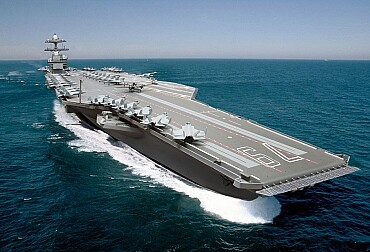
The United States Navy has formally embedded in its long-range shipbuilding plans a vision of fifteen nuclear-powered guided-missile “battleships,” vessels of roughly 35,000 tons or more that would rank among the largest surface combatants constructed since the Second World War and would effectively supplant the long-planned DDG(X) next-generation destroyer. Announced by President Donald Trump in December 2025 as a centerpiece of the “Golden Fleet” initiative, the class – variously designated BBG(X) or BBGN and provisionally led by the USS Defiant – has moved from political rhetoric into the Navy’s Fiscal Year 2027 thirty-year shipbuilding blueprint. That document confirms nuclear propulsion, a target inventory of fifteen hulls by the mid-2050s, and an explicit judgment that even the carefully designed DDG(X) would have forced “undesirable capability and weapon system compromises.” In the Navy’s telling, national security requires “the most comprehensive capability a surface combatant can provide, not just what we can make do with tradeoffs.”
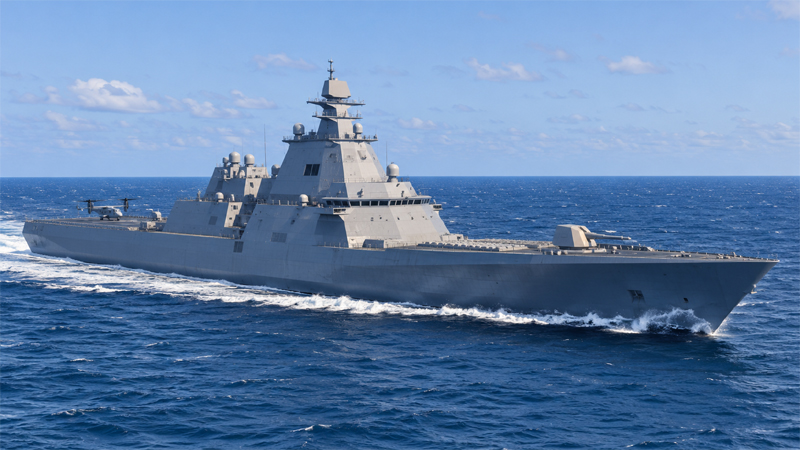
What the service actually proposes is less a revival of the armored gun battleship than a high-end capital ship optimized for magazine depth, electrical power, endurance, and command-and-control. Full-load displacement is pegged at least at 35,000 long tons – more than three times a Flight III Arleigh Burke-class destroyer – with length in the 256-to-268-meter range, beam of 32 to 35 m, and sustained speed exceeding 30 knots. Nuclear propulsion, using the same A1B reactor plant that powers the Gerald R. Ford-class aircraft carriers, is intended to deliver the endurance required for protracted Pacific operations without the logistical burden of conventional fuel, while also generating the electrical capacity demanded by future directed-energy weapons and advanced sensors. Crew size is estimated in the 650-to-850 range.
Armament concepts center on 128 Mk 41 vertical launch system cells – substantially more than the 96 cells of a Flight III Burke or the 122 of a retiring Ticonderoga-class cruiser – plus twelve Conventional Prompt Strike hypersonic missiles in dedicated large-diameter tubes, provision for the nuclear-armed sea-launched cruise missile (SLCM-N), a 32-megajoule electromagnetic railgun, high-energy lasers in the hundreds of kilowatts, conventional 5-inch guns, and layered close-in defenses. Aviation facilities would accommodate helicopters, V-22 Ospreys, or future vertical-lift aircraft. The intended roles are high-volume, long-range offensive fires and service as a survivable forward command node that can orchestrate distributed forces, including unmanned vessels, across vast ocean expanses.
Navy leaders have been careful to state that the battleship “is not a destroyer replacement.” In practice, however, the FY2027 plan drops the DDG(X) entirely, expands purchases of Flight III Arleigh Burke destroyers from earlier projections of twenty-three to fifty-seven, and inserts the fifteen nuclear capital ships. The DDG(X) had been conceived as a roughly 14,500-ton large surface combatant to succeed both aging Ticonderoga-class cruisers and the oldest Arleigh Burkes, incorporating an integrated power system for directed energy, growth margins for new sensors and weapons, and air-defense command facilities.
Officials now argue that fitting hypersonic launchers, an adequate vertical-launch magazine, a meaningful gun, and future growth into a hull of that size required unacceptable trade-offs. By moving to a clean-sheet nuclear design three times larger, the Navy seeks to avoid those constraints while still relying on continued production of the mature, less expensive Burke class for the bulk of the surface combatant force. First procurement is scheduled for fiscal 2028, with delivery of the lead ship projected around 2036 and subsequent hulls arriving at roughly one every other year through 2056.
Cost remains the most contested element. The Congressional Budget Office, analyzing the nuclear-powered configuration, estimates a total program cost of approximately $275 billion in 2026 dollars for the fifteen ships: the lead vessel at $23.4 billion and the subsequent fourteen averaging about $18 billion each. The Navy’s own earlier figures were lower – around $15 billion to $17.5 billion for the first ship and roughly $9.7 billion to $10 billion for follow-ons – reflecting a previously considered conventional design and more optimistic learning-curve assumptions. Nuclear propulsion itself is assessed to add roughly 13 percent relative to a conventional plant.
These figures have already drawn congressional skepticism; in November 2026 Senate appropriators proposed stripping nearly $1.84 billion from the fiscal 2027 request, eliminating the entire $1 billion advance-procurement request as “early to need” and cutting associated research-and-development funding. Shipyard capacity, competition with aircraft-carrier and submarine construction for nuclear-industrial resources, and the sheer scale of the vessels further complicate the timeline. An average battleship is estimated to cost as much as five new Burke destroyers, though nuclear endurance could reduce lifetime fuel and logistics expenses.
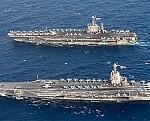
No other navy is pursuing a nuclear-powered surface combatant of comparable size or ambition. Russia’s Project 1144 Orlan (Kirov-class) battlecruisers, displacing roughly 25,000 to 28,000 tons and nuclear-powered, remain the only non-carrier nuclear surface warships in existence; the modernized Admiral Nakhimov, recently returned to service after decades of refit, carries a large missile battery (reports cite on the order of 80 strike cells plus extensive air-defense launchers) and hypersonic weapons, yet the class is a Cold War design whose operational future is limited. China’s Type 055 destroyers, at approximately 12,000–13,000 tons with 112 vertical-launch cells, represent the most capable large conventional surface combatants currently in series production, but they remain well under half the displacement of the proposed American ships and rely on conventional propulsion.
Japan’s two Aegis System Equipped Vessels under construction, each roughly 12,000–16,000 tons with 128 vertical-launch cells and the SPY-7 radar, are specialized ballistic-missile-defense platforms whose size approaches that of a large cruiser yet still falls far short of the American concept and is not nuclear. South Korea’s Sejong the Great and follow-on Aegis destroyers are similarly sophisticated but conventional and smaller. Historical American nuclear surface ships – the aircraft carrier Enterprise, the cruiser Long Beach, and a handful of frigates – demonstrated the endurance advantages of nuclear power but were never produced in the numbers or with the multi-mission magazine depth now contemplated. In short, while several navies are fielding larger, more heavily armed surface combatants than the classic destroyer, none is attempting a nuclear-powered capital ship on the scale or with the planned weapons suite of the Trump-class program.
Whether the concept survives congressional scrutiny, industrial-base constraints, and the inevitable technical challenges of integrating a Ford-class reactor into a new hull form will determine if the Navy ultimately fields a small force of nuclear capital ships alongside a much larger inventory of conventional destroyers, or whether the DDG(X) – or some intermediate design – reemerges once the full costs and schedule risks become clearer. For the moment, the service’s stated expectation is that these vessels will supply the endurance, power, and combat mass required for sustained high-end operations in the world’s largest ocean, at a price that remains the subject of intense debate.