What We Know About China’s First Nuclear Aircraft Carrier and How It Stacks Up Against American, French, and British Designs
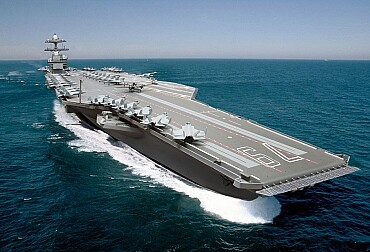
China is building what defense analysts increasingly regard as its first nuclear-powered aircraft carrier. At the Dalian Shipyard in Liaoning Province, satellite imagery from late 2025 and throughout 2026 has tracked the rapid assembly of a large hull commonly referred to as the Type 004. Prefabricated sections began appearing in early 2025; by October 2026 the structure had already reached roughly 320 meters in length and about 46 meters at its widest point, already larger than China’s third carrier, the conventionally powered Fujian, at a comparable stage of construction. Analysts at the Center for Strategic and International Studies and other observers have noted two approximately 15-by-15-meter compartments inside the hull that appear consistent with heavily shielded nuclear reactor containment structures – features absent from the Fujian.
These observations, combined with earlier evidence of a land-based prototype reactor linked to China’s 701 Institute, have led most open-source assessments to conclude that nuclear propulsion is extremely likely. China has not officially confirmed the design, and final dimensions, reactor details, and exact aircraft capacity remain unknown. A launch as early as 2027 has been suggested by some researchers, though the ship’s greater size and novel propulsion could extend the timeline. Once complete, the vessel is expected to approach or exceed 330 meters and displace in the 80,000- to 100,000-ton range, placing it in the supercarrier category.
Nuclear propulsion would mark a decisive step for the People’s Liberation Army Navy. China’s existing carriers – the Liaoning and Shandong, both ski-jump designs derived from Soviet technology, and the Fujian, which features electromagnetic catapults – are all conventionally powered. Nuclear power removes the need to carry large quantities of propulsion fuel, grants effectively unlimited range limited mainly by crew endurance, aviation fuel, and munitions, and supplies abundant electrical power for sensors, catapults, and future systems. It also enables sustained high-speed operations without the logistical constraints that bind conventional ships. For a navy seeking to operate farther from home waters, these advantages are substantial.
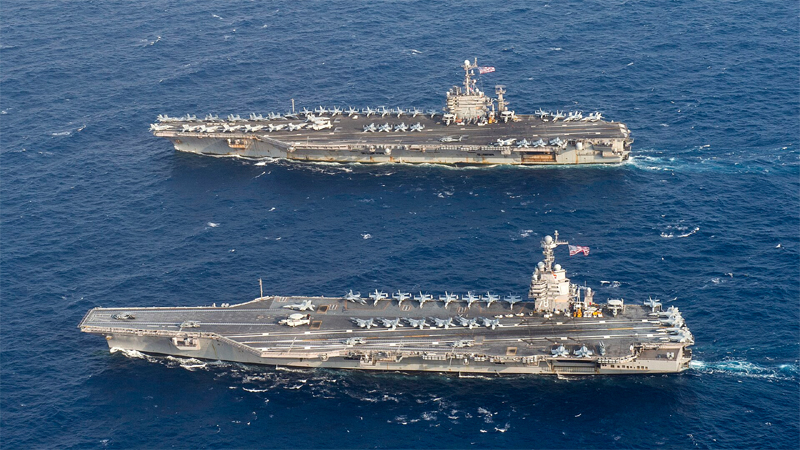
Comparison with the United States Navy’s carriers highlights both the scale of China’s ambition and the remaining gaps. The Nimitz-class carriers, ten of which remain in service, measure approximately 333 meters overall and displace roughly 100,000 tons at full load. Each is powered by two nuclear reactors driving four shafts and can exceed 30 knots. They typically embark 60 to 90 aircraft, launched by four steam catapults. The newer Gerald R. Ford class is similar in size – about 333 to 337 meters and around 100,000 tons – but incorporates two advanced A1B reactors, four electromagnetic catapults (EMALS), a redesigned flight deck, and higher electrical generating capacity.
Ford-class ships are designed for higher sortie rates and greater growth margins over a 50-year service life. A completed Type 004 of comparable length and displacement, equipped with nuclear propulsion and electromagnetic catapults, would therefore approach the physical parameters of these American ships. Whether it can match their operational tempo, combat-system integration, trained air-wing experience, or supporting logistics remains an open question; China is still building the institutional knowledge that the U.S. Navy has refined over decades.
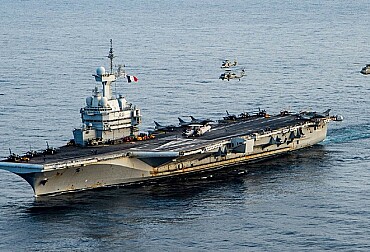
The French Navy offers a useful intermediate benchmark. The Charles de Gaulle, commissioned in 2001 and still France’s sole carrier, is nuclear-powered by two K15 reactors. It measures 261.5 meters, displaces about 42,500 tons fully loaded, and reaches 27 knots. Two steam catapults launch an air wing of roughly 30 to 40 aircraft, centered on Rafale M fighters and E-2C Hawkeye early-warning planes. The ship demonstrated that a mid-sized nuclear carrier can project power independently, yet its limited size and two-catapult configuration constrain sortie generation relative to American supercarriers.
France’s planned successor, the Porte-Avions de Nouvelle Génération (PANG or PA-NG), is intended to close that gap. Current design figures call for a ship approximately 310 meters long, displacing 75,000 to 78,000 tons, powered by two new K22 reactors, and equipped with three EMALS catapults. It is expected to carry around 30 combat aircraft plus supporting types, for a total air group near 40, and to enter service around 2038. In size and capability the PANG sits between the Charles de Gaulle and a full U.S. supercarrier; a Chinese Type 004 of the dimensions now visible at Dalian would likely be larger and potentially able to embark more aircraft.
Britain’s Queen Elizabeth-class carriers illustrate a different design philosophy. HMS Queen Elizabeth and HMS Prince of Wales each measure 284 meters and are officially listed at 65,000 tons, though full-load figures can approach 80,000 tons as the ships are upgraded. They use integrated electric propulsion driven by gas turbines and diesel generators rather than nuclear reactors, giving a range of roughly 10,000 nautical miles and a speed in excess of 25 knots.
A ski-jump bow enables short take-off and vertical landing operations with F-35B fighters; typical air wings consist of up to 36 F-35Bs plus helicopters, with surge capacity higher. The design prioritizes large flight-deck area and relatively lean manning over catapult-and-arrestor capability and nuclear endurance. The British ships therefore excel at flexible, lower-cost power projection within logistical reach of allied support, but they cannot match the sustained high-speed, long-range operations or the ability to launch heavier conventional aircraft that nuclear CATOBAR carriers provide.
Taken together, these comparisons suggest that a nuclear Type 004 would place China in a small club currently occupied only by the United States and France. It would surpass the Charles de Gaulle in size and potential capacity, approach or match the PANG, and offer endurance and launch-system advantages over the conventionally powered Queen Elizabeth class. Relative to American Nimitz- and Ford-class ships, it would be roughly comparable in physical scale if the largest estimates prove accurate, yet China would still need to demonstrate comparable proficiency in sustained flight operations, damage control, logistics, and integrated battle-group tactics. Construction progress at Dalian is rapid, but commissioning, crew training, and air-wing maturity will take additional years. What is already clear is that China has moved beyond incremental improvement of conventional carriers and is investing in the industrial and technical foundations for nuclear-powered supercarriers capable of sustained blue-water operations.