
Operation Vivaldi: Ukrainian Drone Campaign Strains Russian Logistics in the Lyman Sector
Ukrainian drone units have intensified pressure on Russian military logistics in eastern Ukraine, forcing Russian forces to stretch supply routes, disperse storage sites, and move key resources deeper into the rear.
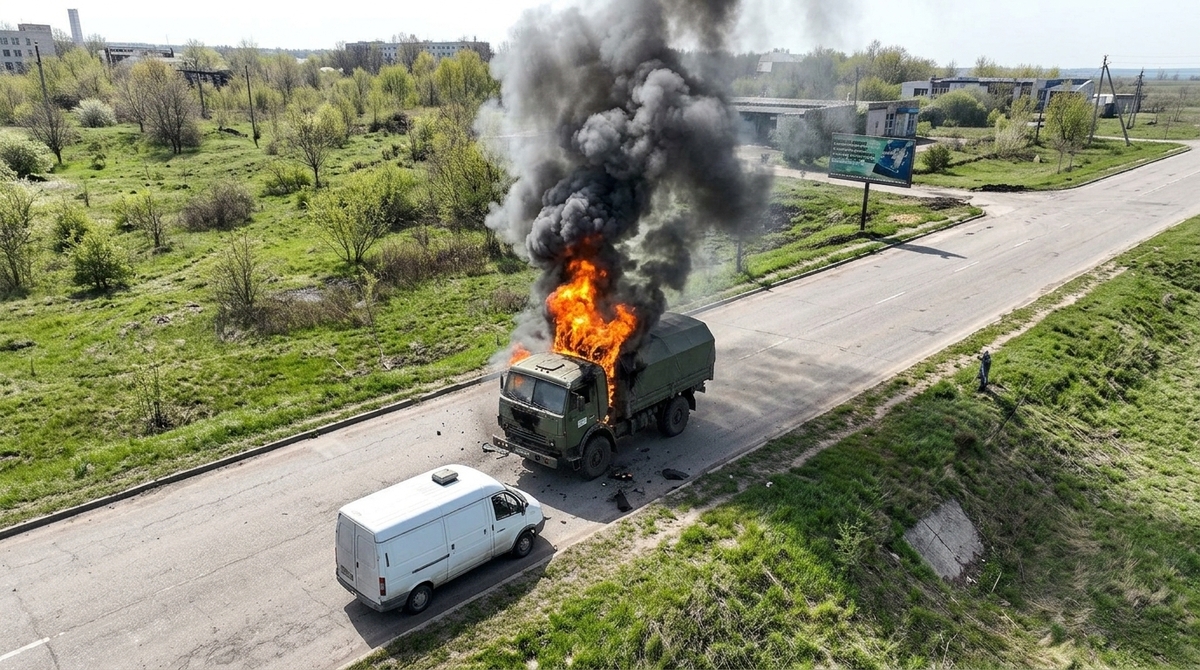
According to information provided by Ukraine’s 3rd Army Corps and reported by Militarnyi, unmanned systems units carried out around 36,000 strike missions as part of Operation Vivaldi, an offensive effort underway in the Lyman sector of Donetsk Region.
The campaign focused not only on frontline targets, but on the logistical system that keeps Russian units supplied with fuel, ammunition, communications support, and replacement equipment. The result, according to the report, has been a growing disruption of Russian supply chains and a forced shift toward longer, more complicated routes.

Drone strikes target the supply network behind the front
The reported drone campaign unfolded in two main stages.
In the first phase, Ukrainian strike drones isolated an area extending roughly 50 kilometers from the line of contact. This created pressure on Russian transport, storage, and support nodes close enough to directly sustain units at the front.
In the second phase, the strike zone was expanded to approximately 120 kilometers, bringing deeper rear areas within reach and making it harder for Russian forces to rely on previously established logistics hubs.
This approach suggests that Ukrainian forces are using drones not only as weapons against individual vehicles or positions, but as tools to reshape the battlefield by attacking the flow of supplies. Instead of focusing solely on troops in trenches, the campaign appears aimed at weakening the entire support structure behind them.
Fuel supply becomes a key vulnerability
One of the most significant reported effects of Operation Vivaldi has been on Russian fuel logistics.
Systematic Ukrainian strikes on field fuel and lubricant depots in Luhansk Region reportedly forced Russian forces to shut down a pipeline used to move fuel from Russia. After that, Russian units had to shift fuel supply operations toward Voronezh Region, requiring fuel trucks to travel through Russian territory before reaching units closer to the front.
That change matters because longer routes consume more time, more fuel, more drivers, and more vehicles. They also create more opportunities for delays, breakdowns, and further attacks.
For a modern army, fuel is not simply a support commodity. It determines whether armored vehicles can maneuver, whether generators can run, whether electronic warfare systems can stay active, and whether drone teams can operate consistently. When fuel becomes scarce or harder to deliver, battlefield tempo slows.
According to the report, fuel shortages have already limited the use of Russian drones and electronic warfare systems in affected areas. That, in turn, can increase the effectiveness of Ukrainian precision strikes, because Russian units may have fewer tools available to detect, jam, or intercept incoming threats.
Russian evacuation routes reportedly extended by 250 kilometers
Ukrainian strikes also targeted ammunition depots, communications nodes, command posts, and vehicles. The cumulative effect reportedly forced one Russian division to extend its equipment evacuation route by around 250 kilometers.
This is a major logistical burden. Damaged vehicles must be moved to repair areas, replacement equipment must be brought forward, and personnel must coordinate transport across longer distances. Every additional kilometer adds friction.
Longer evacuation routes also mean equipment may return to service more slowly. Vehicles that might once have been repaired and returned to the front relatively quickly may now spend more time in transit or waiting for support.
In a war where both sides rely heavily on artillery, drones, vehicles, and electronic systems, delays in repair and resupply can directly affect combat power.
Russian forces forced to disperse depots
Another reported consequence of the drone campaign is that Russian forces have begun dispersing depots into forests and across Russian territory.
Dispersal is a common response to precision strikes. Instead of concentrating supplies in large depots that are easier to detect and destroy, forces spread them across many smaller locations. This can reduce the damage from a single strike, but it also makes logistics less efficient.
Small, dispersed depots require more transport coordination. Supplies must be moved in smaller batches, often along more complex routes. Commanders may have less visibility over stock levels, and units at the front may experience more frequent shortages or delays.
In practical terms, dispersal may help Russian forces survive Ukrainian strikes, but at the cost of speed and simplicity.
Operation Vivaldi continues alongside ground advances
The drone campaign is taking place within the broader context of Ukraine’s Vivaldi offensive operation in the Lyman sector.
According to the same reporting, Ukrainian Defense Forces have cleared the settlements of Novoselivka, Oleksandrivka, and Yarova, as well as the outskirts of Korovyi Yar. Ukrainian forces also reportedly fully liberated the village of Serednie.
These gains suggest that the strikes on logistics are not isolated actions, but part of a broader operational effort. By weakening Russian supply lines, Ukraine may be seeking to reduce the ability of Russian units to hold positions, reinforce threatened areas, or counterattack effectively.
Modern offensive operations increasingly depend on this kind of combined pressure: ground forces contest territory while drones, artillery, and precision weapons disrupt the enemy’s rear.
Why the logistics battle matters
The reported effects of Operation Vivaldi highlight a central feature of the war in Ukraine: logistics are now exposed at unprecedented depth.
Drones have made rear areas more dangerous. Trucks, depots, command posts, communications equipment, and fuel storage sites can be found and struck far from the immediate front line. This forces armies to constantly adapt, camouflage, relocate, and decentralize.
For Russian forces in the Lyman sector, the reported impact is clear: supply routes are longer, depots are more dispersed, fuel delivery is more complicated, and evacuation chains are stretched.
For Ukraine, the value of such a campaign lies in compounding disruption. A single drone strike may destroy one truck or depot. But thousands of strikes, conducted systematically, can force the enemy to redesign its logistics network under pressure.
That is the broader significance of Operation Vivaldi. It shows how unmanned systems can be used not just for tactical strikes, but for operational-level disruption — weakening an opponent’s ability to fight before direct contact even occurs.
According to the reported figures, Ukraine’s 3rd Army Corps has used tens of thousands of drone missions to turn Russian rear-area logistics into an active battlefield. The longer Russian forces are forced to move supplies through extended and vulnerable routes, the harder it becomes for them to sustain frontline operations at the same pace.